EN
EN
Introduction
When deploying off-grid energy storage systems in coastal areas, most people focus on brand names and power ratings. They overlook a quieter killer: salt fog.
Sea breeze doesn't just bring humid air. It carries invisible salt particles. In a standard air-cooled cabinet, fans pull outside air through the enclosure to remove heat. Every cooling cycle also pulls in salt. The salt settles on copper busbars, terminals, and circuit boards. When condensation forms, the salt dissolves and becomes an electrolyte. This speeds up copper oxidation, contact corrosion, and insulation breakdown. By the time a fault appears, the damage is often beyond simple repair.
The problem is not the equipment grade. It's the protection logic.
The Hidden Cost of Air Cooling
Traditional storage cabinets use forced air cooling. Outside air is pulled in by fans, passes over hot components, and exits. In dry inland areas, this works fine. In coastal areas, every cooling cycle is a chance for salt fog to enter.
The corrosion path is clear: salt-laden air enters → condensation forms inside → salt dissolves → electrochemical corrosion accelerates. Copper busbars carry current between the PCS and the battery. Once they oxidize, contact resistance rises, local heating increases, and in severe cases, thermal runaway can occur.
Worse, this corrosion starts from the inside. Routine inspections rarely catch it in time.
What Real Coastal Protection Requires
The industry does have standards for coastal storage. According to corrosion level classification, PCS equipment in marine climates should meet C5 requirements. This means the coating system must withstand long-term exposure to high salt fog and high humidity.
But standards and real-world performance are not the same thing. The corrosion resistance of a coastal storage system depends on three layers working together:
Layer 1: Cabinet material and coating system. Standard galvanized steel with electrostatic spray has a limited protection period in coastal environments. C5 typically requires a multi-layer system: epoxy zinc-rich primer, epoxy intermediate coat, and polyurethane topcoat. Dry film thickness should reach around 280μm. Salt spray test hours are also a hard indicator—some coastal projects require air-cooled equipment to pass ASTM B117 1000-hour salt spray verification.
Layer 2: The cooling method itself. This is the most overlooked part. If cooling still depends on outside air exchange, even a thick coating won't stop salt fog from entering through the air duct. Sealed cooling design means physically separating outside corrosive air from internal electrical components. Heat is removed through a heat exchanger or liquid cooling system, not direct ventilation.
Layer 3: IP rating and sealing design. Storage containers usually require IP55 or above. Battery packs need IP66. For coastal sites, double-sealed cable glands at entry points and positive pressure systems with HEPA-grade filtration are key details that block salt fog penetration.
How Jiangsu Unita Approaches Coastal Projects
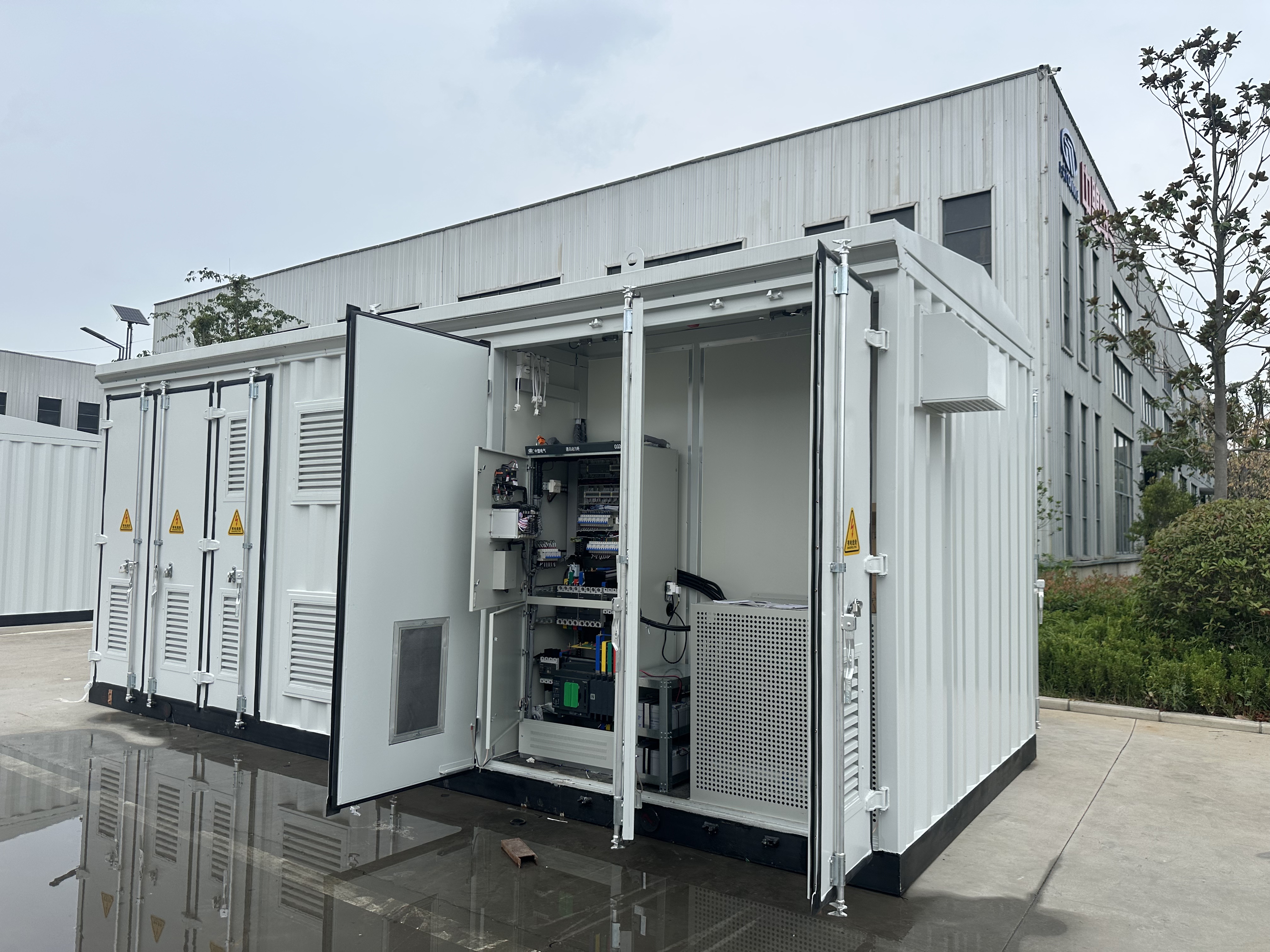
The PCS integrated cabin from Jiangsu Unita is designed around these three layers.
The cabinet uses a C5-verified coating system, forming a complete physical barrier and cathodic protection from primer to topcoat. The cooling design abandons traditional direct air cooling. Instead, it uses a sealed heat exchange path. Salt-laden air no longer has a chance to contact internal busbars and circuit boards.
The core judgment behind this design is simple: in coastal off-grid scenarios, corrosion reliability comes before cooling efficiency. A unit that stops working due to corrosion has no cooling performance to speak of.
Why Off-Grid Is Different
Off-grid systems differ from grid-connected storage in one key way: maintenance access. Grid-connected plants usually have dedicated O&M teams. Routine inspections and part replacements are relatively manageable. Off-grid sites are often on remote islands, coastal base stations, or border outposts. The cost of a single failure is not just parts—it includes personnel, transportation schedules, and downtime losses.
This means off-grid equipment needs a higher margin of protection. Sealed cooling costs more upfront, but over the full lifecycle, it reduces unplanned downtime and part replacements caused by corrosion. The total cost of ownership is often lower.
Selection Checklist
If you are planning a coastal off-grid storage project, start with these questions:
• What is the cooling method? Does it rely on direct outside air exchange?
• Does the coating system meet C5? What is the salt spray test duration?
• Do key conductive parts (busbars, terminals) have additional anti-corrosion treatment, such as tin plating, nickel plating, or insulating coatings?
• Does the IP rating match the salt fog concentration and humidity at the project site?
Equipment specs determine how much power it can produce. Protection design determines how long it can keep producing.
Jiangsu Unita Electric Equipment Co., Ltd. specializes in the R&D and manufacturing of PCS integrated cabins. With 15 years of technical experience and over 200 delivered projects, Unita provides customized integrated solutions for coastal off-grid, commercial and industrial storage, and other applications.