EN
EN
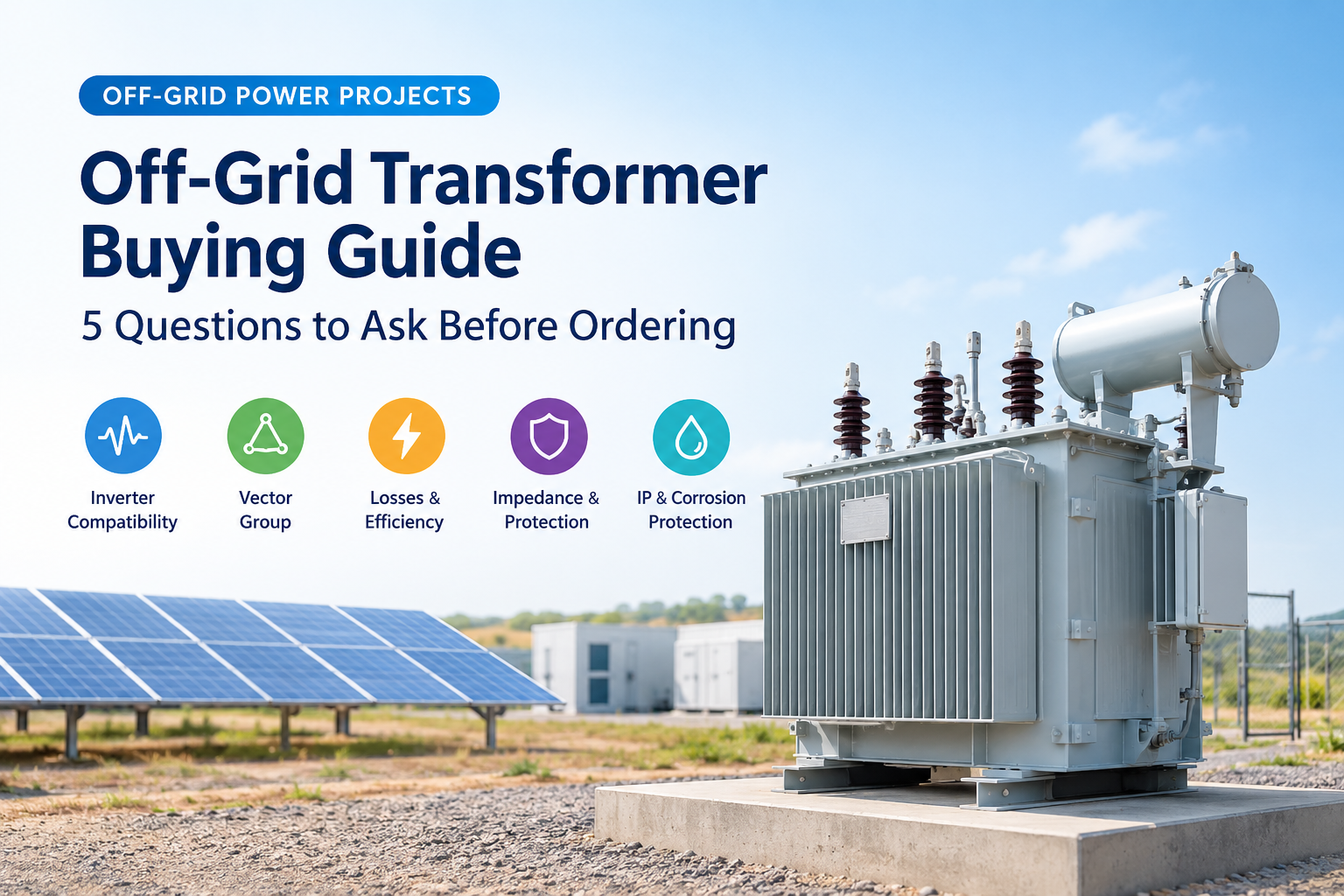
Buying a transformer for an off-grid power project is not simply about choosing the right kVA rating and finding the lowest price.
An off-grid system has different operating conditions from a conventional grid-connected power system. The transformer may work with a solar inverter, battery energy storage system, variable loads, limited short-circuit current, high ambient temperatures, dust, humidity, or corrosive environments.
Choosing a standard distribution transformer without checking these conditions can result in excessive temperature rise, insulation aging, nuisance protection trips, or premature transformer failure.
Before placing an order, make sure your transformer supplier can clearly answer the following five questions.
Two Off-Grid Projects, Two Completely Different Results
A West African off-grid project selected a standard dry-type transformer mainly because of its lower purchase price. The transformer was installed in an underground electrical room. After several months of operation, excessive heat contributed to insulation deterioration and transformer failure. The replacement, international shipping, and project downtime created significant additional costs.
In another East African solar microgrid project, the buyer clearly specified the operating environment, cooling method, corrosion protection, and inverter-related requirements during the quotation stage. The selected transformer cost more initially, but the project achieved stable long-term operation with significantly lower maintenance risk.
The difference was not simply the transformer price. It was the questions asked before the purchase order was placed.
Why Is Transformer Selection Important for Off-Grid Projects?
In a conventional grid-connected system, the utility grid normally provides a strong power source with relatively high short-circuit capacity.
An off-grid system is different.
The power source may be a solar inverter, battery inverter, diesel generator, or a combination of several sources. Inverter-based systems can have different harmonic characteristics and much lower fault current than a utility grid.
At the same time, many off-grid projects are installed in remote locations where maintenance and replacement are expensive.
For this reason, transformer selection should consider much more than rated capacity.
You should evaluate:
• Inverter compatibility
• Harmonic loading
• Transformer vector group
• No-load and load losses
• Short-circuit impedance
• Protection coordination
• Ambient temperature
• Enclosure and corrosion protection
• Installation environment
• Applicable standards and certifications
Here are the five questions you should ask before ordering.
1. Is the Transformer Installed on the Inverter Side or Load Side?
This is one of the first questions you should clarify with the transformer manufacturer.
In many off-grid solar and battery systems, the transformer is connected directly to an inverter. Unlike a traditional utility power source, an inverter can introduce harmonic currents and high-frequency switching components.
These conditions can increase additional losses and temperature rise in the transformer.
Therefore, a transformer used on the inverter side should be evaluated according to the actual inverter output characteristics rather than simply being selected as a conventional distribution transformer.
What Should You Ask the Supplier?
Ask:
"Is this transformer suitable for connection to an inverter output? Please confirm the expected harmonic conditions and provide relevant temperature-rise or design verification data."
A Common Supplier Answer
"It is a standard transformer and complies with the national standard."
This answer may not be enough.
Compliance with a general transformer standard does not automatically mean that the transformer has been evaluated for every inverter application.
Your Follow-Up Question
Ask the supplier:
"Please confirm the transformer design is suitable for the inverter output waveform and harmonic conditions specified in our project."
If the inverter manufacturer provides harmonic current data, THD information, switching frequency, or other relevant parameters, send these to the transformer manufacturer during the quotation stage.
Do not wait until the transformer has already been manufactured.
2. What Is the Transformer Vector Group?
The transformer vector group is another important parameter that should be confirmed before ordering.
Common vector groups include:
• Dyn11
• Yyn0
• YNd11
• Dd0
However, the correct vector group depends on the system design.
For an off-grid system, you should consider the inverter configuration, neutral requirements, grounding method, protection system, and the connection between the transformer and downstream loads.
A Delta winding can also provide a path for circulating triplen harmonic currents and prevent these components from appearing directly on the other side of the transformer. However, this does not mean Dyn11 is automatically the correct choice for every off-grid project.
What Should You Ask the Supplier?
Ask:
"Please confirm the transformer vector group and explain how the neutral point and grounding arrangement should be implemented for our off-grid system."
A Common Supplier Answer
"It is a star-delta connection."
This description is too vague for a purchase specification.
Your Follow-Up Question
Ask the supplier to provide the exact vector group, for example:
"Please specify the vector group as Dyn11, Yyn0, or another exact designation in the technical datasheet."
Also confirm:
• Which side is Delta?
• Which side is Star?
• Is a neutral terminal required?
• Where is the neutral point grounded?
• How does the grounding system coordinate with the inverter?
The vector group should be confirmed as part of the complete electrical system design, not selected simply because it is commonly used.
3. What Are the Actual No-Load and Load Losses?
Transformer efficiency is particularly important in off-grid and solar applications.
A transformer consumes energy even when the load is very low because of its core losses.
This is especially important in systems that operate 24/7 but have a relatively low average load.
For example, a solar-plus-battery microgrid may have a high load during the daytime but only essential loads at night. The transformer continues to consume power even when the load is small.
Over several years, these losses can become a significant part of the project's operating cost.
What Should You Ask the Supplier?
Instead of asking:
"Is this an energy-saving transformer?"
Ask for actual figures:
"Please provide the guaranteed no-load loss and load loss for the proposed transformer and specify the applicable efficiency or energy-efficiency standard."
For projects using Chinese standards, confirm the applicable edition and capacity category of GB 20052 rather than relying only on a general statement that the transformer is "energy efficient."
A Common Supplier Answer
"Our transformer is an energy-saving model."
This does not give you enough information to compare different suppliers.
Your Follow-Up Question
Ask for:
• Rated capacity
• No-load loss
• Load loss
• No-load current
• Impedance voltage
• Efficiency or applicable energy-efficiency classification
• Test or routine test documentation
You can then compare suppliers based on actual technical data instead of purchase price alone.
4. What Is the Short-Circuit Impedance and Does It Match the Inverter?
Short-circuit impedance is particularly important in inverter-based off-grid systems.
A conventional utility grid can provide a large fault current. An inverter-based power source may provide a much more limited fault current depending on its control strategy and protection settings.
This difference can affect protection coordination.
If the transformer impedance and system configuration result in insufficient fault current, downstream protection devices may not operate as expected under certain fault conditions.
On the other hand, an unnecessarily low impedance can increase short-circuit current and place greater stress on electrical equipment.
Therefore, the transformer impedance should be evaluated together with the complete system.
What Should You Ask the Supplier?
Ask:
"Please confirm the transformer's short-circuit impedance and check whether it is compatible with the inverter's maximum fault-current capability and the project's protection settings."
A Common Supplier Answer
"The impedance is the standard value for this transformer capacity."
That may not be sufficient for an off-grid project.
Your Follow-Up Question
Provide the transformer manufacturer with:
• Inverter rated current
• Maximum fault current
• Short-circuit current duration
• AC output voltage
• Transformer rated capacity
• Downstream protection device information
• Cable length and size, where relevant
Then ask the transformer supplier or electrical system engineer to verify protection coordination.
The transformer should be evaluated as part of the complete off-grid electrical system, not as an isolated piece of equipment.
5. What Are the IP and Corrosion Protection Requirements?
Many off-grid projects are located in environments where operating conditions are much more demanding than those of an indoor commercial building.
Examples include:
• Remote African projects
• Desert solar farms
• Tropical microgrids
• Coastal installations
• Mining sites
• Agricultural projects
• Outdoor battery energy storage systems
• Remote industrial facilities
Dust, humidity, salt spray, rain, insects, and high ambient temperatures can all affect transformer reliability.
If the transformer is installed outdoors, the enclosure and accessories should be selected according to the actual environmental conditions.
What Should You Ask the Supplier?
Ask:
"Please provide the enclosure IP rating, corrosion protection system, coating specification, and recommended environmental conditions for long-term outdoor operation."
If the project is located in a coastal or highly corrosive environment, ask for more detailed information about the coating system and relevant corrosion testing.
A Common Supplier Answer
"The transformer is suitable for outdoor installation."
Again, this is too general.
Your Follow-Up Question
Ask the supplier to specify:
• IP rating
• Corrosion category or coating system
• Paint/coating thickness
• Salt-spray test information, if applicable
• Ambient temperature range
• Humidity requirements
• Altitude limitations
• Outdoor installation requirements
For projects in harsh environments, environmental protection should be included in the technical specification before the quotation is finalized.
Off-Grid Transformer Purchasing Checklist
Before placing a purchase order, ask the transformer manufacturer to provide written answers to the following questions.
Item |
What to Ask the Supplier |
Inverter compatibility |
Is the transformer suitable for the inverter output and expected harmonic conditions? |
Vector group |
What is the exact vector group, such as Dyn11 or Yyn0? |
Neutral and grounding |
How should the transformer neutral point be grounded? |
No-load loss |
What is the guaranteed no-load loss? |
Load loss |
What is the guaranteed load loss at rated load? |
Efficiency standard |
Which energy-efficiency standard and edition apply? |
Short-circuit impedance |
What is the impedance voltage, and has it been checked against the inverter fault-current capability? |
Protection coordination |
Has the transformer been evaluated together with the project's protection system? |
IP rating |
What is the enclosure protection rating? |
Corrosion protection |
What coating or corrosion protection system is used? |
Ambient conditions |
What are the maximum temperature, humidity, and altitude limits? |
Testing |
What routine and type test reports are available? |
What Documents Should You Request Before Ordering?
A professional transformer supplier should be able to provide technical documentation before production.
Depending on the project, you may request:
1. Transformer technical datasheet
2. General arrangement drawing
3. Nameplate information
4. No-load loss and load loss data
5. Impedance voltage
6. Vector group
7. Temperature-rise information
8. Routine test report
9. Type test report, where applicable
10. Insulation test information
11. Enclosure and corrosion protection specifications
12. Applicable certificates and compliance documents
For international projects, you should also confirm the documents required for local customs clearance, grid connection, certification, and project acceptance.
For projects in African markets, requirements may vary by country and project. Do not assume that one certification package automatically applies to every country.
The Cheapest Transformer Is Not Always the Lowest-Cost Option
When comparing transformer quotations, many buyers look at only three numbers:
kVA + voltage + price.
For an off-grid project, this approach can be risky.
A transformer with a lower purchase price may have:
• Higher no-load losses
• Higher load losses
• Less suitable cooling
• Inadequate environmental protection
• Incorrect vector group
• Poor compatibility with the inverter
• Insufficient technical documentation
A slightly higher initial investment can sometimes reduce long-term energy losses, maintenance costs, downtime, and replacement risks.
The right question is not:
"Which transformer is the cheapest?"
It is:
"Which transformer is technically suitable for the complete off-grid system and provides the lowest total cost over its operating life?"
Final Checklist: 5 Questions Before You Order
Before signing a purchase order for an off-grid distribution transformer, make sure you have written answers to these five questions:
1. Is the transformer suitable for the inverter output?
Confirm harmonic conditions, temperature rise, insulation design, and inverter compatibility.
2. What is the exact vector group?
Do not accept vague descriptions such as "star-delta." Confirm the exact vector group and grounding arrangement.
3. What are the actual transformer losses?
Request guaranteed no-load loss and load loss rather than accepting "energy-saving" as a general statement.
4. Is the impedance compatible with the inverter and protection system?
Check short-circuit impedance and protection coordination using the actual inverter fault-current capability.
5. Can the transformer withstand the installation environment?
Confirm IP rating, corrosion protection, ambient temperature, humidity, altitude, and other site conditions.
A good transformer purchase starts with the right technical questions—not the lowest quotation.
If you are sourcing a distribution transformer for an off-grid solar, microgrid, industrial, or remote power project, provide the required capacity, voltage, inverter model, installation environment, and applicable standards to the transformer manufacturer before requesting a final quotation. This allows the supplier to recommend a transformer configuration based on the actual project requirements rather than a standard model.