EN
EN
Choosing the right cooling system for your oil-immersed transformer is a critical decision that impacts performance, lifespan, and operating costs. This guide provides a comprehensive comparison of the two most common cooling methods — ONAN (Oil Natural Air Natural) and ONAF (Oil Natural Air Forced) — to help you make an informed choice.
1. Why Oil-Immersed Transformers Need Cooling
Transformers are the workhorses of electrical power systems, converting voltage levels to enable efficient transmission and distribution. However, this process is not 100% efficient. During operation, core losses (no-load losses) and copper losses (load losses) generate significant heat.
This heat is not merely a byproduct — it is the primary factor limiting a transformer’s lifespan. The transformer’s internal insulation system, typically made of oil-impregnated cellulose paper, degrades faster at higher temperatures. As a rule of thumb, the aging rate of insulation doubles for every 6°C rise in hot-spot temperature. Excessive heat can lead to:
- Accelerated insulation aging and reduced service life
- Formation of sludge and acids that degrade oil quality
- Increased risk of winding hotspots and localized overheating
- Potential catastrophic failure, causing power outages and economic losses
Effective thermal management is essential to maintain safe operating temperatures, ensure reliability, and achieve the expected 25–30 year lifespan of power transformers.
2. ONAN Cooling Method — Oil Natural Air Natural
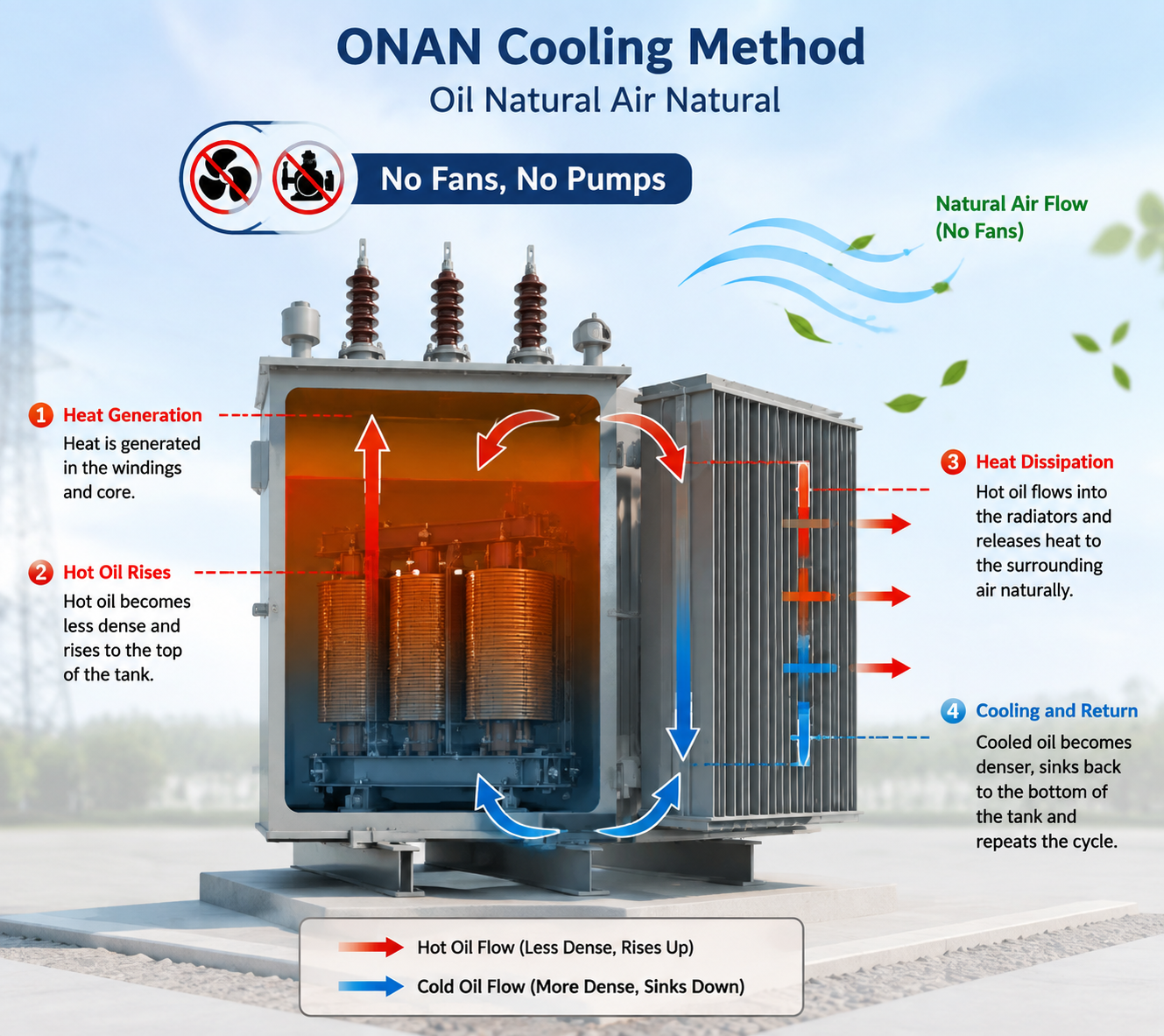
ONAN (Oil Natural Air Natural) is the simplest and most commonly used cooling method for distribution and smaller power transformers. It relies entirely on passive heat transfer — no fans, pumps, or moving parts are required.
2.1 How ONAN Cooling Works
The cooling cycle is driven by natural convection (thermosiphon effect):
- Heat Generation: The windings and core generate heat during operation.
- Oil Rises: The hot oil becomes less dense and rises to the top of the tank.
- Heat Dissipation: The hot oil flows into external radiators (or cooling tubes), where it transfers heat to the surrounding air through the radiator walls.
- Cooling and Return: The cooled oil becomes denser, sinks back to the bottom of the tank, and repeats the cycle.
This method is entirely buoyancy-driven and requires no external energy input for cooling.
2.2 Advantages of ONAN Cooling
- Zero Moving Parts: No fans or pumps means virtually no mechanical failure risk. This translates to the highest reliability and longest maintenance intervals.
- Silent Operation: With no fan noise, ONAN transformers are ideal for residential areas, hospitals, and noise-sensitive installations. Noise levels are typically ≤55 dB.
- Lowest Total Cost of Ownership: No auxiliary power consumption, minimal maintenance (annual oil testing), and lower initial capital cost compared to forced cooling systems.
- Proven Reliability: This technology has a service history exceeding a century and is well-understood.
2.3 Disadvantages of ONAN Cooling
- Limited Cooling Capacity: Passive cooling efficiency is lower, making ONAN unsuitable for very large transformers. Practical capacity limits are typically up to 25–30 MVA.
- Poor Performance in Hot Climates: In ambient temperatures above 30°C, ONAN transformers may require derating (capacity reduction) by 20–30% to avoid overheating.
- Larger Physical Size: To achieve a given MVA rating, ONAN transformers need larger radiators compared to forced-cooled designs, requiring more installation space.
2.4 Typical Applications for ONAN Cooling
- Distribution transformers up to 30 MVA
- Rural substations and residential areas where noise is a concern
- Base-load applications with steady, predictable loads
- Facilities with minimal maintenance staff available
3. ONAF Cooling Method — Oil Natural Air Forced
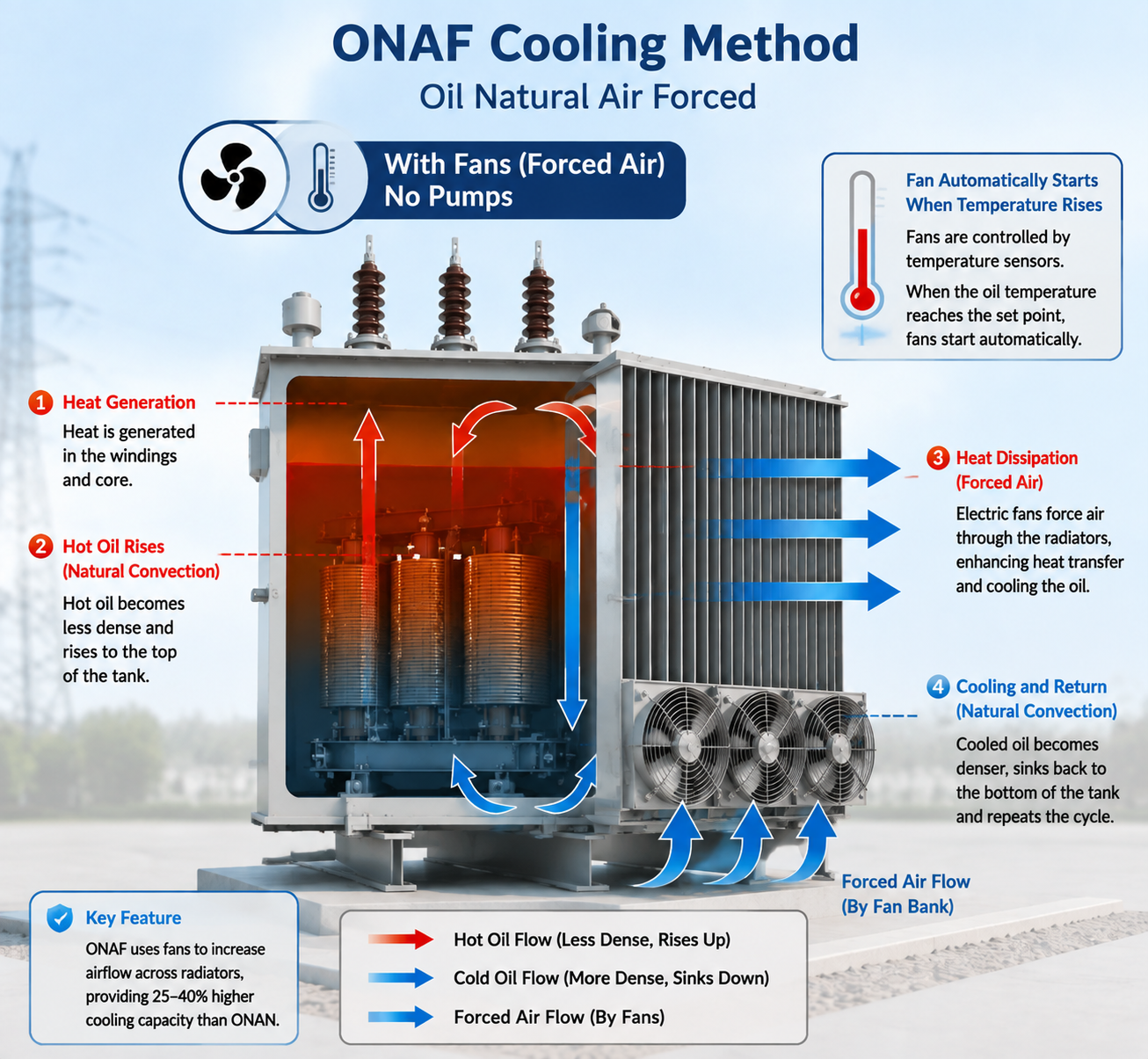
ONAF (Oil Natural Air Forced) builds upon the ONAN principle by adding electric fans to the radiators. The oil still circulates naturally by convection, but the forced airflow from the fans significantly enhances heat dissipation.
3.1 How ONAF Cooling Works
- Natural Oil Circulation: As in ONAN, hot oil rises from the windings to the radiators via the thermosiphon effect.
- Forced Air Cooling: Electric fans mounted on the radiator banks blow air across the radiator surface, greatly increasing the heat transfer coefficient and cooling rate.
- Automatic Control: Fans are typically activated by temperature sensors when the load and internal temperature rise. They switch off when cooling is no longer needed, optimizing energy use.
This is a semi-active cooling system that provides additional thermal capacity without requiring oil pumps.
3.2 Advantages of ONAF Cooling
- Increased Cooling Capacity: ONAF provides 25–40% additional cooling capacity compared to ONAN. This allows the transformer to handle higher loads without exceeding temperature limits.
- Dual-Rated Flexibility: Most power transformers are specified with dual ratings (e.g., 40/50 MVA ONAN/ONAF). They operate in silent, low-maintenance ONAN mode at base load and automatically switch to ONAF mode during peak demand.
-
Capacity Boosts: The capacity increase depends on transformer size:
- Below 2500 kVA: ~15% boost under ONAF
- 2500–10,000 kVA: ~25% boost
- Above 10,000 kVA: Up to 33% boost (ONAF1), or 67% with a second fan stage (ONAF2)
- Efficient for Variable Loads: Ideal for applications with significant daily or seasonal load fluctuations.
3.3 Disadvantages of ONAF Cooling
- Additional Maintenance: Fans have moving parts (bearings, motors) that require periodic inspection and replacement (typically every 7–10 years).
- Higher Operating Costs: Fan operation consumes auxiliary power (~1–3 kW/h) and increases operational costs compared to pure ONAN.
- Noise Generation: Fans produce noise in the 55–65 dB(A) range. While acceptable in industrial settings, this may be a concern in urban or residential areas.
- Dependence on External Power: Fans require a reliable auxiliary power supply to operate.
3.4 Typical Applications for ONAF Cooling
- Medium-to-large power transformers (30–100 MVA range)
- Suburban substations and industrial facilities with variable loads
- Dual-rated installations requiring seasonal or on-demand capacity boosts
- Transformer designs where footprint is a consideration
4. ONAN vs ONAF — Comparison Table
Feature |
ONAN (Oil Natural Air Natural) |
ONAF (Oil Natural Air Forced) |
Oil Circulation |
Natural convection (thermosiphon) |
Natural convection (thermosiphon) |
Air Cooling |
Natural (passive) |
Forced (fans) |
Moving Parts |
None |
Fans only |
Cooling Capacity |
Low (base rating) |
Medium (25–40% improvement over ONAN) |
Typical MVA Range |
Up to 25–30 MVA |
30–100 MVA |
Noise Level |
Silent (≤55 dB) |
Moderate (55–65 dB) |
Maintenance Needs |
Low (annual oil testing) |
Medium (fan inspections + oil testing) |
Initial Cost |
Lowest |
Moderate (~15–20% higher than ONAN) |
Operational Cost |
Minimal (no power for fans) |
Moderate (fans consume ~1–3 kW/h) |
Best Environment |
Cool to moderate climates (0–25°C) |
Moderate to hot climates, variable loads |
Typical Application |
Distribution transformers, rural substations, residential areas |
Industrial substations, suburban grids, peak-load operation |
5. Frequently Asked Questions (FAQ)
Q1: Can a oil immersed transformer have both ONAN and ONAF ratings? Yes. This is called a dual-rated transformer and is very common for power transformers. The base rating is ONAN. When load increases, fans activate to provide the higher ONAF rating (e.g., 40/50 MVA ONAN/ONAF).
Q2: How much extra capacity does ONAF provide over ONAN?
The extra capacity varies based on size: up to 15% for smaller transformers, 25% for medium units, and 33–67% for large transformers (over 10 MVA).
Q3: Which cooling method is more reliable for oil transformer?
ONAN is more reliable because it has no moving parts and cannot experience mechanical failure. ONAF adds fans that require maintenance and can fail, though they are easily replaceable.
Q4: Which is cheaper — ONAN or ONAF?
ONAN has lower upfront and operating costs. ONAF has a higher initial cost (15–20%) and additional long-term operational costs (fan power, maintenance).
Q5: How do I choose between ONAN and ONAF?
Consider your load profile, ambient temperature, noise restrictions, and maintenance capabilities. For steady base loads in cool climates, ONAN is ideal. For variable loads requiring occasional peak capacity, dual-rated ONAN/ONAF offers the best flexibility.
6. Conclusion
Selecting between ONAN and ONAF is not simply about choosing a cooling code — it is about optimizing your transformer’s performance, reliability, and total cost of ownership for your specific operational environment. Whether you need the silent, maintenance-free simplicity of ONAN for a residential application or the flexible peak-load capacity of a dual-rated ONAN/ONAF design, the right engineering partner is essential.
For projects requiring reliable oil-immersed transformers, Jiangsu Unita Electric Equipment Co., Ltd.(JSZONMA) provides transformer solutions designed around specific voltage levels, capacity requirements, operating environments, and cooling needs.
Why Work with JSZONMA?
- Integrated Manufacturing Capability: With a factory area of more than 46,600 m² and in-house production capabilities for transformers and switchgear, JSZONMA supports complete transformer solutions from design and manufacturing to testing and delivery.
- Quality Control and Certification: JSZONMA’s products comply with international and industry quality requirements, with certifications including CCC, ISO9001, and ISO14001. Transformer products have also completed Type Test certification recognized by the State Grid Corporation of China.
- Engineering and R&D Support: JSZONMA works with universities and research institutions, including China University of Petroleum and China University of Mining and Technology, to improve transformer design, efficiency, and application performance.
- Experience Across Power Applications: JSZONMA has supplied transformer equipment for various power projects, including applications related to utilities, industrial facilities, and renewable energy systems.
- Customization for Different Projects: With experience in photovoltaic booster stations and customized transformer solutions, JSZONMA can provide products adapted to different load conditions, installation environments, and technical specifications.
If you are selecting an oil-immersed transformer cooling system or planning a new transformer project, JSZONMA’s engineering team can help evaluate a suitable solution based on your application requirements, including capacity, cooling method, operating conditions, and reliability expectations.