 EN
EN

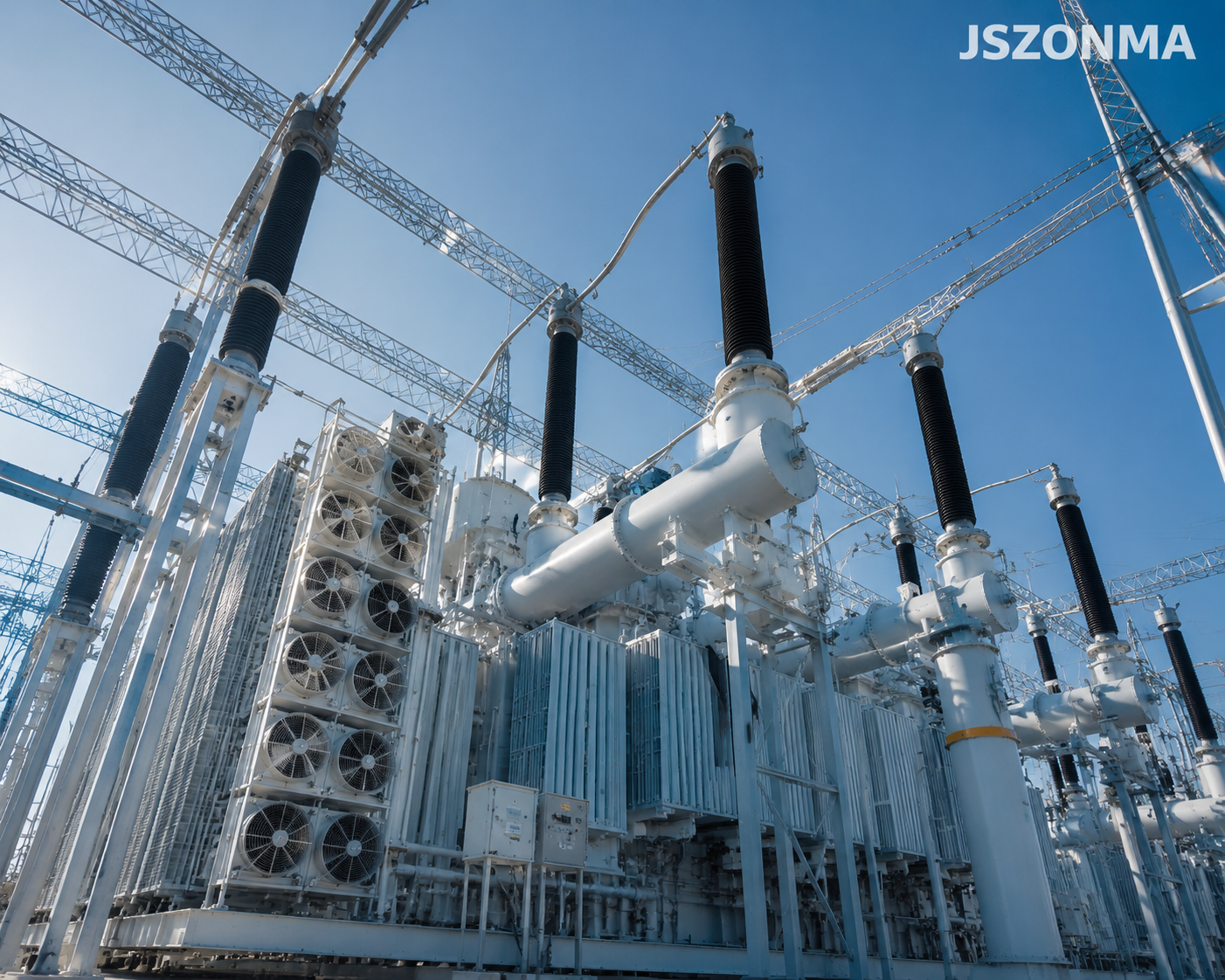
China's transformer exports have experienced explosive growth in the first eight months of 2026, with total export value reaching RMB 28.99 billion (USD 4.06 billion) from January to May alone—a staggering 29% year-on-year increase. This comprehensive analysis examines the regional export breakdown, underlying growth drivers, and what these trends mean for global buyers and industry stakeholders.
Regional Export Performance: Where Is Demand Growing Fastest?
Based on available data for large and medium-sized power transformers (January–April 2026), the regional breakdown reveals distinct market dynamics: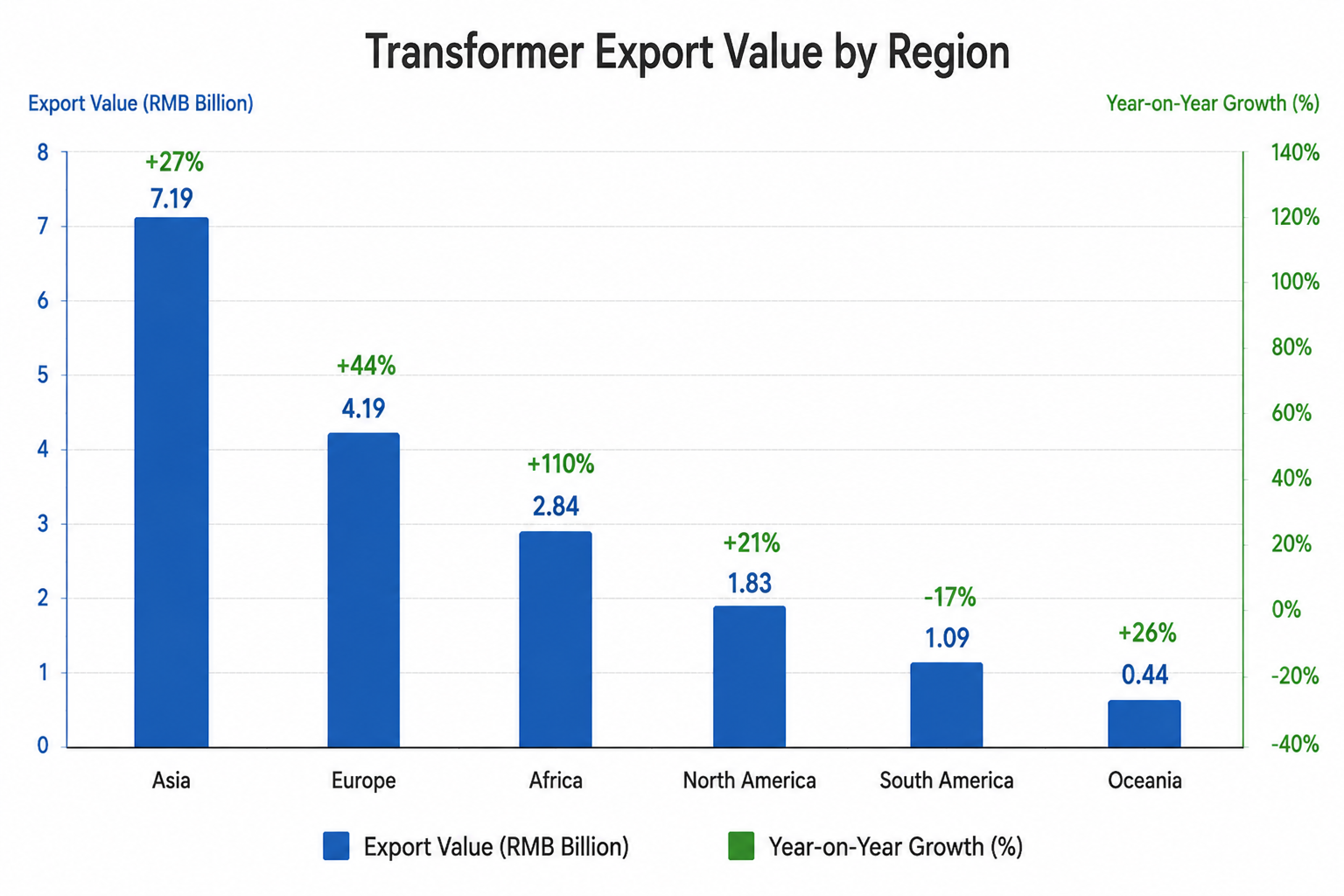
Notable highlights:
- Africa emerged as the fastest-growing market with 110% growth, with May 2026 alone showing an astonishing +252% surge for transformers 10MVA.
- The Middle East and Americas followed closely with +152% and +113% growth respectively in May.
- Europe maintained strong momentum (+44% Jan–Apr), though May showed a -12% dip, indicating some month-to-month volatility.
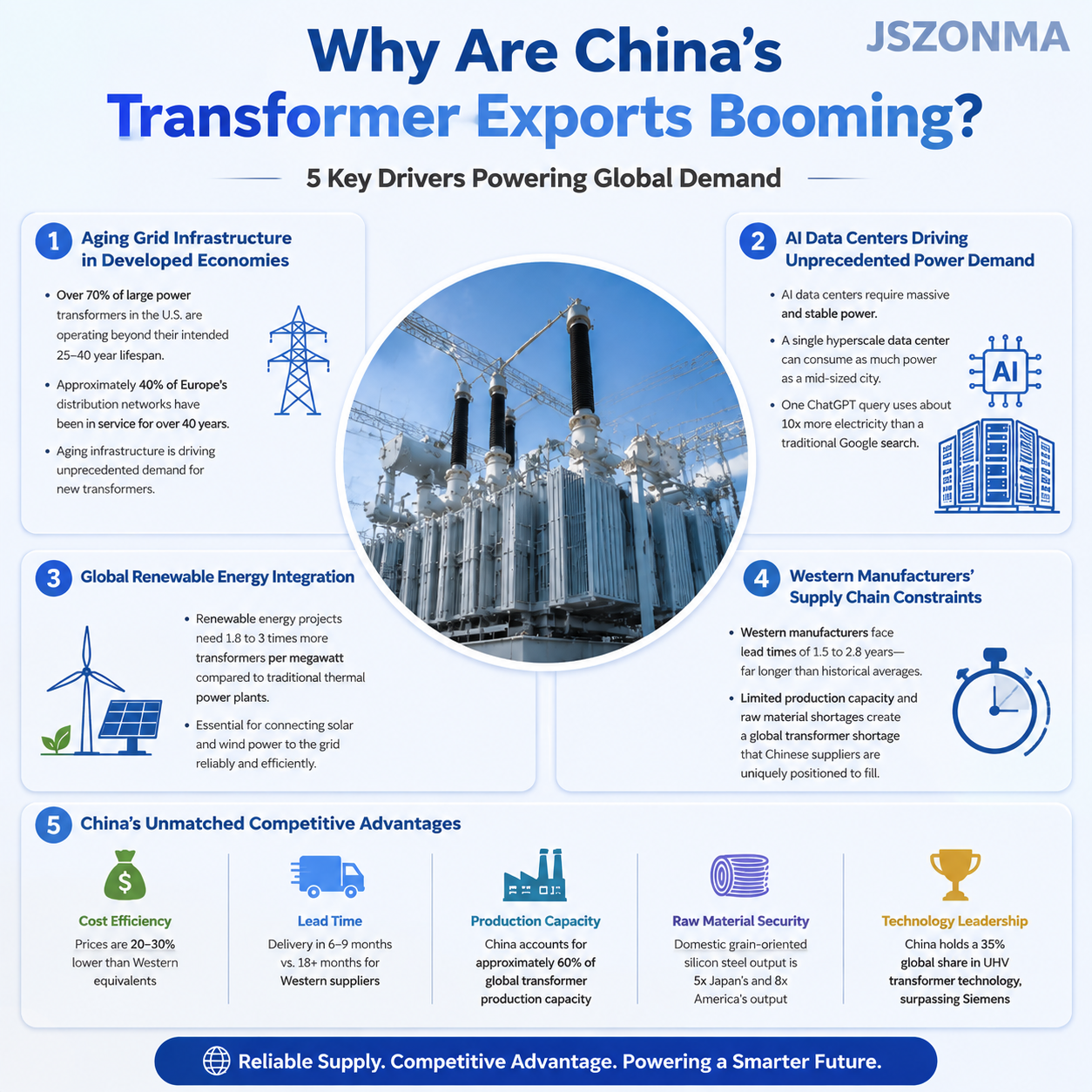
Why Are China's Transformer Exports Booming? 5 Key Drivers
The surge in China's transformer exports stems from a structural supply-demand mismatch in the global power equipment market. Here are the primary growth drivers:
1. Aging Grid Infrastructure in Developed Economies
North America and Europe are facing a grid modernization crisis:
- Over 70% of large power transformers in the U.S. are operating beyond their intended 25–40 year lifespan.
- Approximately 40% of Europe's distribution networks have been in service for over 40 years.
- in both regions have created unprecedented demand for new transformers.
2. AI Data Centers Driving Unprecedented Power Demand
The artificial intelligence boom has created a new, exponential demand for electricity:
- A single hyperscale AI data center can consume as much power as a mid-sized city.
- One ChatGPT query consumes approximately 10 times more electricity than a traditional Google search.
- to ensure stable electricity supply.
3. Global Renewable Energy Integration
The worldwide energy transition is accelerating solar and wind power installations:
- Renewable energy projects require 1.8 to 3 times more transformers per megawatt compared to traditional thermal power plants due to distributed generation layouts.
- for these specific applications.
4. Western Manufacturers' Supply Chain Constraints
Global transformer suppliers outside China are struggling to keep up:
- Western manufacturers face lead times of 1.5 to 2.8 years —far longer than historical averages.
- Limited production capacity and raw material shortages have created a global transformer shortage that Chinese suppliers are uniquely positioned to fill.
5. China's Unmatched Competitive Advantages
Chinese transformer manufacturers offer distinct advantages that global buyers find compelling:
Advantage |
Detail |
Cost Efficiency |
Prices are 20–30% lower than Western equivalents for comparable specifications |
Lead Time |
Delivery in 6–9 months vs. 18+ months for Western suppliers |
Production Capacity |
China accounts for approximately 60% of global transformer production capacity |
Raw Material Security |
Domestic production of grain-oriented silicon steel is 5x Japan's output and 8x America's output |
Technology Leadership |
China holds a 35% global share in UHV transformer technology, surpassing Siemens |
Technology Upgrades: From Product Exports to Standard Exports
China's transformer industry has evolved beyond simple cost advantages:
- for ultra-high-voltage (UHV) transformers.
- specifications.
- This "standard export" strategy positions China as a technology leader rather than just a low-cost supplier.
What This Means for Global Buyers
For procurement professionals and project managers sourcing transformers:
- Order backlogs at Chinese manufacturers already extend to 2027–2028 — early planning is essential.
- Premium pricing (up to +20%) is being offered by European clients to secure Chinese production slots, highlighting the supply tightness.
- Customized solutions like prefabricated substations are enabling faster project completion in time-sensitive applications.
Outlook: Sustained Growth Expected Through 2027
With global transformer demand showing no signs of slowing and Western capacity expansions taking 2–3 years to materialize, China's transformer export growth trajectory appears sustainable through at least 2027. Buyers should expect continued price pressure and should factor extended lead times into their procurement strategies.