EN
EN

News
SCB11 vs SCB13 Dry-Type Transformer: What's the Difference and Which One Suits Your Project Better?
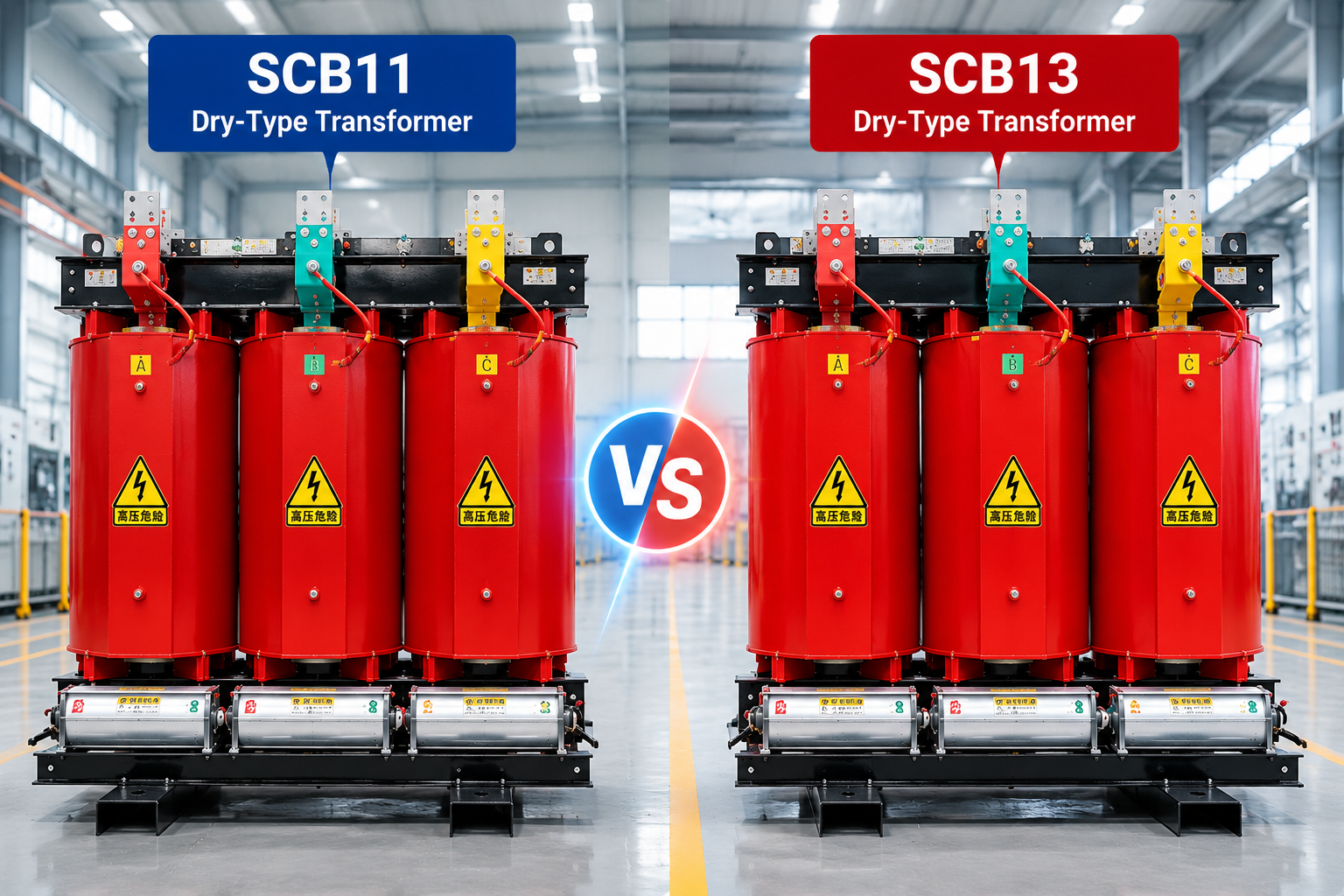
When choosing a dry-type transformer for your power distribution system, understanding the difference between SCB11 and SCB13 dry-type transformers is essential for making a cost-effective decision. Both are popular models in the SCB series, but they differ significantly in energy efficiency, operating costs, and long-term value. This article will walk you through everything you need to know—from what a dry-type transformer is, to the detailed comparison between SCB11 and SCB13, and finally, practical advice on which one to choose for your project.
1. What Is a Dry-Type Transformer?
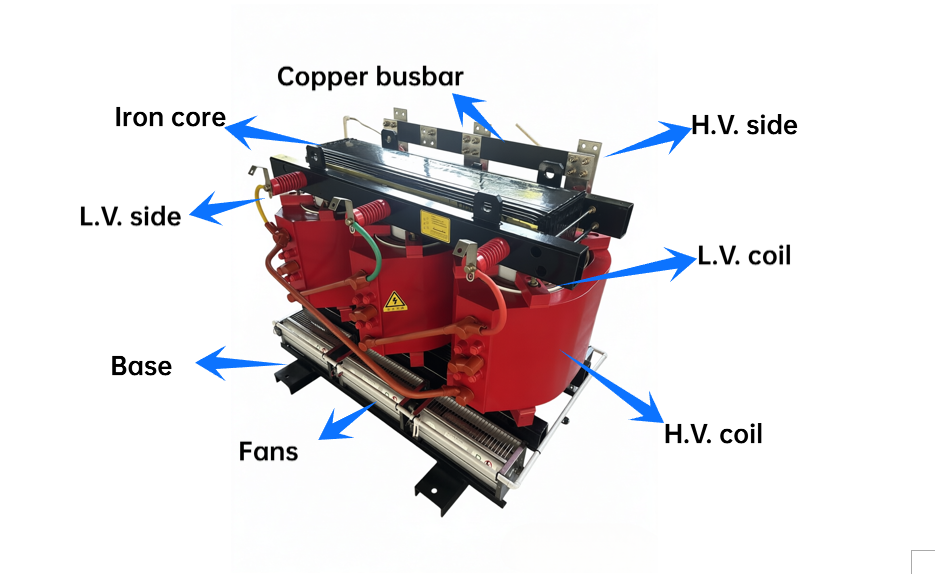
A dry-type transformer is a type of transformer that uses air as the cooling and insulating medium, rather than liquid (such as oil). The "SCB" designation stands for:
• S: Three-phase
• C: Cast resin insulation (epoxy resin-encapsulated)
• B: Foil winding
In a dry-type transformer, the windings are embedded in epoxy resin through a vacuum casting process, which provides excellent insulation, mechanical strength, and protection against moisture and dust.
Unlike oil-filled transformers, dry-type transformers have no risk of oil leakage or fire hazards, making them the preferred choice for indoor applications where safety and environmental concerns are paramount.
2. Main Advantages and Disadvantages of Dry-Type Transformers
✅ Advantages
Advantage |
Description |
Fire safety |
Epoxy resin is flame-retardant and self-extinguishing, making them suitable for indoor and high-rise buildings |
Environmentally friendly |
No oil means zero risk of oil spills or soil contamination |
Low maintenance |
No need for oil testing, filtering, or replacement |
Compact size |
Smaller footprint compared to oil-filled transformers of the same capacity |
Good overload capacity |
Can handle short-term overloads without immediate failure |
Moisture-resistant |
Epoxy casting protects windings from humidity and dust |
 Disadvantages
Disadvantage |
Description |
Higher initial cost |
More expensive than oil-filled transformers of the same capacity |
Limited capacity range |
Typically available up to around 20,000 kVA, while oil transformers can go much higher |
Higher losses at low loads |
Not as efficient as oil transformers in certain operating conditions |
Noise |
Can produce audible noise during operation (though newer models are quieter) |
3. Application Range of Dry-Type Transformers
Dry-type transformers are widely used in indoor power distribution scenarios where safety, reliability, and environmental protection are critical. Common applications include:
• Commercial buildings – shopping malls, office towers, hotels
• Public facilities – hospitals, schools, museums, airports
• Data centers – where continuous and stable power supply is essential
• Industrial plants – factories requiring reliable indoor power distribution
• Residential complexes – high-rise apartments and housing estates
• Underground substations – subways, tunnels, and basement power rooms
In short, if your project is indoors and fire safety or environmental regulations require oil-free equipment, a dry-type transformer is your best choice.
4. SCB11 vs SCB13 Dry-Type Transformer – Detailed Comparison
The core difference between SCB11 and SCB13 dry-type transformers lies in their energy efficiency level and loss performance. The numbers 11 and 13 represent the performance level code, where a higher number indicates lower losses and higher efficiency.
Below is a breakdown of the key differences:
4.1 Difference in Losses
This is the most significant difference between the two models.
Loss Type |
SCB11 |
SCB13 |
Difference |
No-load loss (iron loss) |
Higher |
Lower by approximately 20%–30% |
SCB13 saves much more power when the transformer is energized but not fully loaded |
Load loss (copper loss) |
Higher |
Lower by approximately 5%–10% |
SCB13 has a slight edge, but the difference is smaller than no-load loss |
Example – For a 1000 kVA transformer:
• SCB11: no-load loss ≈ 1590 W, load loss ≈ 8130 W
• SCB13: no-load loss ≈ 1270 W, load loss ≈ 7310 W
This means SCB13 saves about 1.3 kWh per hour during operation.
4.2 Difference in Operating Efficiency
Because SCB13 has lower no-load and load losses, its overall operating efficiency is higher. The efficiency advantage is especially noticeable in two scenarios:
- Continuous 24/7 operation – such as in data centers, hospitals, and factories, where transformers run year-round
- Light-load operation – when the transformer is running below 50% of rated capacity, the no-load loss becomes a larger proportion of total energy consumption, making SCB13's advantage even more pronounced
4.3 Difference in Noise Level
SCB13 transformers generally produce lower audible noise than SCB11 models.
Capacity |
SCB11 Typical Noise |
SCB13 Typical Noise |
1000 kVA |
55–65 dB |
50–60 dB |
The difference is about 2–5 dB, which is noticeable in quiet environments. This makes SCB13 more suitable for:
• Hospitals and healthcare facilities
• Schools and libraries
• Residential buildings and hotels
• Office towers and commercial centers
4.4 Difference in Appearance and Structure
Visually and structurally, SCB11 and SCB13 transformers are nearly identical. Both:
• Use epoxy resin vacuum casting for insulation
• Have foil windings (the "B" designation)
• Support the same insulation class (Class F or H)
• Have the same dimensions and mounting interfaces, meaning they are interchangeable in the same installation space
The internal difference lies in the core material and design:
• SCB11: Uses standard silicon steel sheets (e.g., 30Q130)
• SCB13: Uses high-permeability cold-rolled oriented silicon steel sheets (e.g., 27QG105) with optimized joint structures to reduce magnetic losses
4.5 Difference in Price
Cost Aspect |
SCB11 |
SCB13 |
Purchase price |
Lower (base model) |
Higher by approximately 8%–15% |
Example – 1000 kVA |
~$11,000–$13,000 |
~$13,000–$17,000 |
Operating cost |
Higher electricity bills |
Significantly lower electricity bills |
The price gap is offset by the energy savings from SCB13. For transformers running 24/7, the additional purchase cost can be recovered in 1 to 3 years through reduced electricity bills.
5. How to Choose Between SCB11 and SCB13
Your choice depends on your project's priorities:
✅ Choose SCB11 if:
• Your budget is very tight and initial cost is the primary concern
• The transformer will run for short hours each day (e.g., less than 8 hours)
• The load rate is consistently high (60%), meaning load loss is dominant
• The installation is in a noise-tolerant environment like a factory or outdoor yard
• This is a temporary project with a short lifespan
✅ Choose SCB13 if:
• This is a new construction or long-term project (5+ years)
• The transformer runs 24/7 or for long hours each day
• The load rate is often below 50% – where no-load loss becomes the dominant factor
• The installation is in a noise-sensitive environment (hospital, school, hotel, office)
• You want to meet current energy efficiency standards – SCB11 no longer meets GB 20052-2024 requirements and is being phased out
• You are evaluating total life-cycle cost, not just purchase price
Practical Tip: As a rule of thumb: if the transformer will operate for more than 3,000 hours per year, the energy savings from SCB13 will usually justify its higher purchase price within a few years.
6. RFQ
When requesting quotes from manufacturers, be sure to ask for the following information to make an informed comparison:
Question |
Why It Matters |
What is the no-load loss and load loss at our rated capacity? |
To verify energy efficiency claims and calculate operating costs |
What type of core material is used? |
High-permeability silicon steel confirms SCB13 performance |
What is the noise level at full load? |
Important for noise-sensitive locations |
What is the total price including delivery, installation, and commissioning? |
To compare total project cost, not just transformer price |
What is the warranty period and after-sales support? |
Longer warranties often indicate better build quality |
What is the expected payback period for the SCB13 vs SCB11? |
A good supplier will provide a cost-saving estimate |
7. Conclusion
In summary, both SCB11 and SCB13 dry-type transformers are reliable indoor power distribution solutions, but they serve different budget and performance priorities.
• SCB11 – SCB11 is the "economy" model – lower upfront cost, but higher long-term electricity bills. It is suitable for short-term projects or situations where initial capital is the main constraint.
• SCB13 – SCB13 is the "efficiency" model – higher purchase price, but significantly lower no-load losses (20%–30% reduction) and slightly lower load losses (5%–10% reduction). For most new projects, especially those with continuous operation, SCB13 is the better investment when considering total life-cycle costs.
Given that SCB11 no longer meets the latest national energy efficiency standards (GB 20052-2024) and is being phased out, SCB13 is the recommended choice for most new installations unless you have a very specific reason to choose the older model.
Need a specific quote for your project capacity? Feel free to contact multiple suppliers and compare their SCB11 vs SCB13 offers – and don't forget to ask about the payback period calculation!