EN
EN

News
Box Substation Distribution Transformer Selection Guide:Dry-Type vs Oil-Immersed – Which One Fits Your Project?
Choosing the right distribution transformer for your box substation is one of the most important decisions in any power distribution project. Select incorrectly, and you may face safety hazards, budget overruns, or even failed project inspections. This guide will walk you through everything you need to know – from what a box substation is, to a detailed comparison of dry-type and oil-immersed transformers, and finally a clear decision-making framework. Our goal is to help you make an informed choice that balances safety, cost, and performance.
——————————————————————————————
1. What Is a Box Substation?
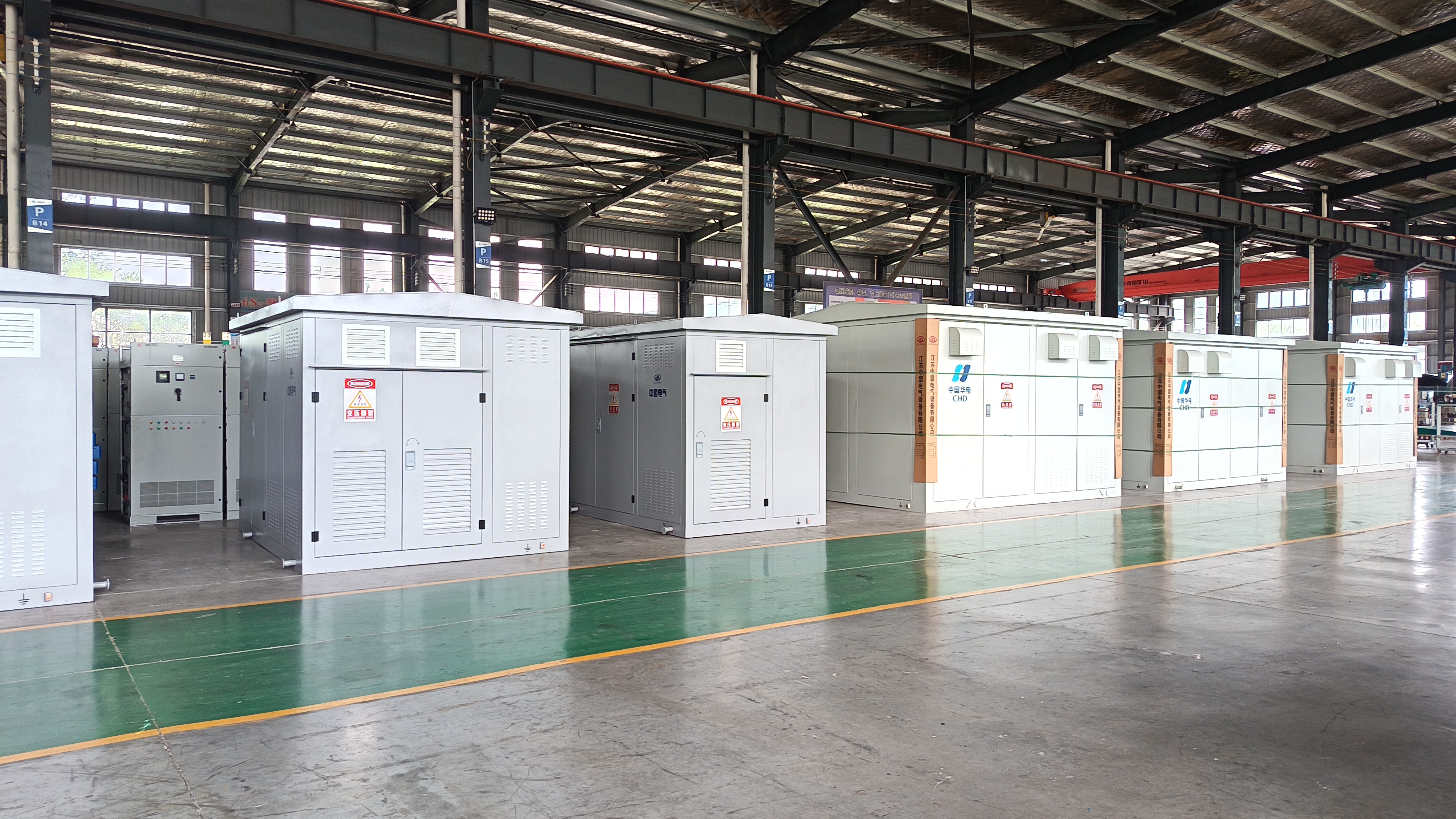
A box substation, also commonly referred to as a compact substation or pad-mounted transformer, is a complete power distribution unit enclosed in a weatherproof metal housing. It combines three essential components into a single, compact package: a transformer, high-voltage switchgear, and low-voltage distribution equipment.
Think of it as a "plug-and-play" power station. It takes medium-voltage electricity (typically 10kV or 35kV) from the grid, steps it down to a usable low voltage (such as 400V/230V), and distributes it to end-users. The "box" or enclosure protects the internal equipment from weather, dust, and unauthorized access, making it suitable for outdoor installation in space-constrained areas.
There are two main structural types of box substations:
- European-style box substation: Features separate compartments for the high-voltage section, transformer, and low-voltage section, allowing for flexible configuration of either dry-type or oil-immersed transformers.
-
American-style box substation: Uses an integrated tank design where the transformer, fuses, and switches are all housed in a single oil-filled compartment. These almost exclusively use oil-immersed transformers due to their compact, integrated structure.
——————————————————————————————
2. Benefits of Using a Box type Substation
Box substations have become the preferred choice for many projects because they offer significant practical advantages over traditional built-in-place substations.
Space-saving compact design
The integrated structure requires a much smaller footprint than traditional substations with separate rooms for each component. This makes them ideal for urban areas where land is scarce and expensive.
Faster installation and commissioning
Because the entire unit is factory-assembled and tested, it can be delivered to the site and installed quickly. This reduces on-site construction time and minimizes project delays.
Lower overall project cost
The combination of compact design, reduced civil works (no need for a dedicated building), and faster installation typically translates to lower total project costs compared to traditional substations.
High safety and protection
The steel enclosure provides a high degree of protection against environmental factors like rain, dust, and corrosion (typically IP54 or higher). It also offers tamper-proof protection for the internal electrical equipment, enhancing public safety.
Flexible placement
Box substations can be placed at the load center – the point closest to where power is consumed. This reduces the length of low-voltage cable runs, minimizes line losses, and improves voltage regulation.
——————————————————————————————
3. Typical Application Scenarios for Box Substations
Box substations are incredibly versatile and can be found in a wide range of applications. The choice between dry-type and oil-immersed transformers often depends on the specific requirements of these scenarios. Common applications include:
- Residential communities and commercial complexes: Powering lighting, HVAC, elevators, and other building utilities.
- Industrial parks and factories: Supplying power for production lines, machinery, and other industrial loads.
- Data centers and hospitals: Providing highly reliable and safe power distribution for critical operations.
- Renewable energy projects: Used in solar farms and wind power plants to step up the voltage for grid connection.
- Public infrastructure: Powering street lighting, traffic signals, and telecommunications equipment.
- Construction sites and temporary installations: Providing temporary power during the construction phase of a project.
——————————————————————————————
4. The Hidden Cost of Choosing the Wrong Transformer
Selecting the wrong transformer for your box substation is not just a technical error; it can have serious consequences that impact your entire project. "Choosing the wrong transformer can be a costly mistake" is not an exaggeration.
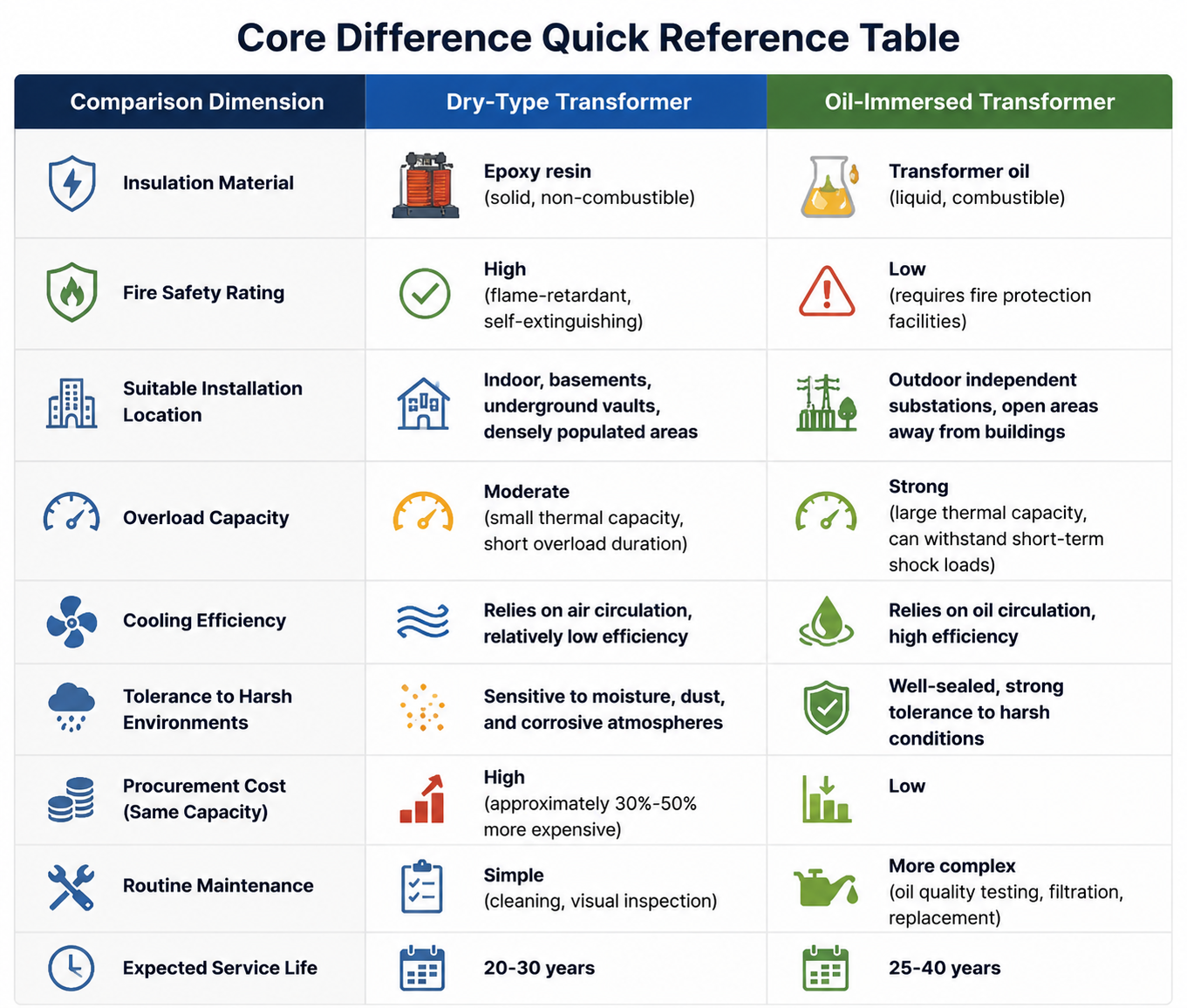
The main difference between oil filled transformer and dry type transformer
Safety First: If your installation is indoor or near people, the dry-type's high fire safety rating makes it the only viable choice. For outdoor applications, the oil-immersed transformer offers proven reliability at a lower cost.
Environment Matters: Dry-type transformers require a clean, dry environment to perform well over their full lifespan. If your site is dusty, humid, or coastal, the sealed design of an oil-immersed unit is a significant advantage.
Cost Is More Than Price: While dry-type transformers cost more to purchase, they may save money on civil works (no oil pit, no fire-rated vault). Oil-immersed units are cheaper upfront but require ongoing maintenance and proper outdoor infrastructure.
Maintenance Commitment: If you have limited technical staff or difficult site access, the low-maintenance dry-type transformer is the more practical choice. If you have a dedicated maintenance team, the oil-immersed unit's longer service life can justify the additional effort.
Safety risks
Installing an oil-immersed transformer indoors or in a densely populated area without proper fire protection creates a significant fire and explosion hazard. Transformer oil is combustible, and a fault could lead to a major incident. This could endanger lives, damage property, and result in legal liabilities.
Project cost overruns
While a dry-type transformer may have a higher initial cost, an oil-immersed unit installed in the wrong location might require expensive fire-rated enclosures, oil-containment pits, and fire suppression systems. These hidden costs can quickly erode any savings from the lower equipment price.
Operational failures and downtime
A transformer that is not suited to its environment – for example, a dry-type transformer in a highly humid or dusty location – may suffer from premature insulation failure. This leads to unplanned outages, disrupting operations and incurring significant repair or replacement costs.
Regulatory non-compliance
Building codes and safety standards, such as the National Electrical Code (NEC) in North America, strictly dictate where certain types of transformers can be installed. Choosing the wrong type can result in failed inspections, costly redesigns, and project delays.
——————————————————————————————
5. Four Key Dimensions to Help You Choose
To select the right transformer, we must analyze the options from four critical perspectives: safety, environment, cost, and maintenance. This structured approach ensures no factor is overlooked.
Dimension 1 | The Safety Red Line – Installation Location Decides Everything
This is the most critical factor. The installation location determines whether you can use a specific transformer type.
When to choose dry-type:
For indoor installations, underground vaults, high-rise buildings, hospitals, shopping malls, data centers, and any area where people are present or fire safety is paramount, a dry-type transformer is mandatory. Its epoxy resin insulation is non-flammable, virtually eliminating the risk of a large-scale fire. This aligns with regulations found in standards like the NEC (e.g., NEC 450.21-23).
When to choose oil-immersed:
Oil-immersed transformers are best suited for dedicated outdoor substations, installed in open, well-ventilated areas, away from buildings and high-traffic zones. While they contain combustible oil, the risk is manageable in outdoor settings, especially with a properly designed oil-containment pit to prevent environmental contamination in the event of a leak.
Dimension 2 | Environmental Adaptability – Which One Can Withstand Harsh Conditions?
The local climate and environmental conditions play a major role in transformer reliability and lifespan.
They are generally more robust in harsh environments. The sealed tank design protects the internal components from moisture, dust, and salt contamination, making them an excellent choice for coastal areas, high-humidity regions, and polluted industrial zones. They also handle extreme temperature variations well.
They are more sensitive to their surroundings. High humidity, excessive dust, or corrosive atmospheres can degrade their insulation over time. While the more robust cast-resin type offers excellent resistance to moisture and contamination, the more common VPI type may require additional protection like IP54 or higher-rated enclosures in such environments.
Dimension 3 | The Economic Bottom Line – Look Beyond the Initial Price
To make a sound financial decision, you must consider the Total Cost of Ownership (TCO), not just the purchase price.
Initial procurement cost:
At the same capacity, dry-type transformers are significantly more expensive, typically costing 30% to 50% more than oil-immersed units.
Civil works and installation:
Dry-type transformers, being safer, can be installed closer to the load center, potentially reducing cable costs. They also don't require oil-containment pits or fire-rated vaults, which can save on civil construction. Conversely, an oil-immersed transformer's lower purchase price might be offset by the cost of an outdoor pad and an oil-containment system.
Long-term energy efficiency:
Both types are subject to energy efficiency standards. While oil-immersed generally offers slightly lower losses, both can be highly efficient, especially when choosing modern, high-efficiency models like the S20/S22 (oil) or SCB14/SCB18 (dry). A life-cycle cost analysis that includes losses can reveal which option is more economical over a 20-30 year lifespan.
Dimension 4 | Maintenance and Operation – "Trouble-Free" vs "Requires Attention"
The level of ongoing maintenance required differs significantly between the two types, impacting both operational costs and manpower requirements.
Dry-type transformers
They are generally considered low-maintenance. Their routine needs are limited to periodic cleaning of dust and visual inspections. They do not require oil testing, filtration, or replacement. This makes them ideal for projects where maintenance access is difficult or personnel is limited.
Oil-immersed transformers
They require regular, more technical maintenance. This includes periodic oil sampling and analysis to check for contamination, moisture, and dissolved gases (which can indicate developing faults). Over time, the oil may also need filtration or replacement, adding to the long-term operating budget.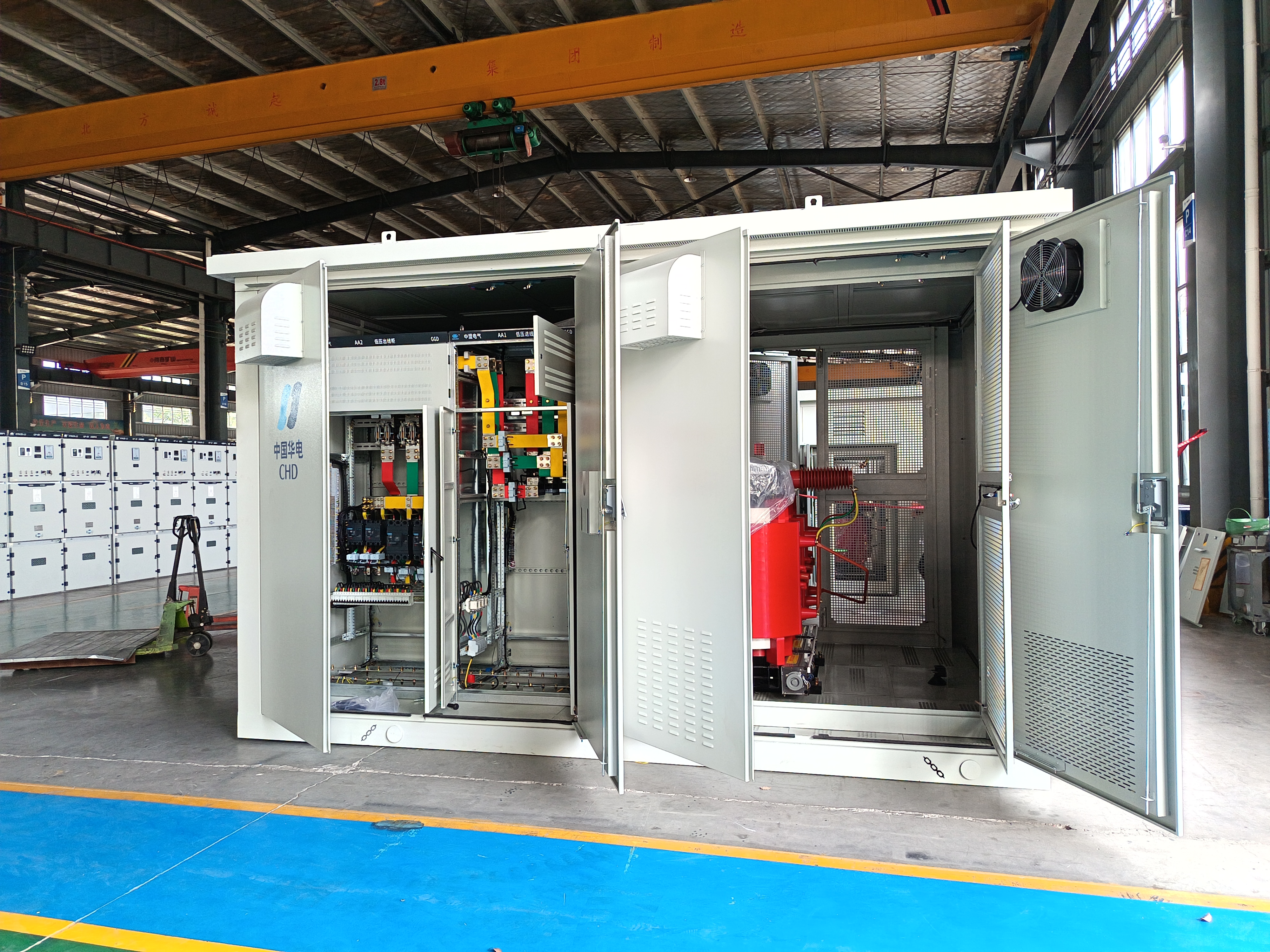
——————————————————————————————
6. Match Your Project: A Simple Decision Guide
Based on the four dimensions above, here is a clear guide to help you decide. Use this as a quick reference to match your project scenario with the right transformer type.
4 Typical Scenarios That Favor Dry-Type Transformers
- Indoor or Below-Grade Installation: Any project where the substation is located inside a building, in a basement, or in an underground tunnel. The fire safety of dry-type transformers is non-negotiable here.
- High-Occupancy Buildings: Commercial complexes, hospitals, schools, airports, and high-rise residential towers. Protecting human life is the top priority.
- Sensitive or Critical Infrastructure: Data centers, telecommunication hubs, and hospitals. The low fire risk and low maintenance of dry-type transformers contribute to high uptime and reliability.
- Environmentally Sensitive Areas: Locations where an oil spill would cause severe environmental damage, such as near water sources or in national parks.
3 Typical Scenarios That Favor Oil-Immersed Transformers
- Dedicated Outdoor Substations: A standalone unit in an open, fenced-off area, away from buildings. The low initial cost and high reliability make it the most popular choice for this application.
- High-Capacity, High-Load Applications: Large industrial plants, heavy manufacturing, and utility-scale renewable energy projects. Oil-immersed transformers are proven to handle very large capacities and demanding loads with superior cooling.
- Budget-Sensitive Projects: Where the absolute lowest upfront capital expenditure is the primary driver, provided the installation is a suitable outdoor location. The initial savings can be significant.
Special Consideration: American vs. European Box Substations
The structure of your box substation can limit your choice.
- European-Style Substations: These have separate compartments for the transformer, high-voltage, and low-voltage sections. This design offers the flexibility to install either a dry-type or an oil-immersed transformer.
- American-Style Substations: These have a "tank-type" integrated design where the transformer and switching components are all housed in a single, oil-filled tank. This design requires an oil-immersed transformer and is not suitable for dry-type units without significant redesign.
——————————————————————————————
7.RFQ
After reading this guide, many customers still have specific questions before they can make a final decision. Below are the most frequently asked questions we receive from customers who are evaluating dry-type transformers for their box substation projects. If you are a supplier, having clear, ready-to-use answers to these questions will help you build trust and close deals faster. If you are a buyer, these are exactly the questions you should be asking.
Question 1: "My box substation will be installed indoors, but in a mechanical room with good ventilation. Do I still need a dry-type transformer, or can I use oil-immersed?"
Answer: Yes, you still need a dry-type transformer. The key factor is not ventilation – it's fire safety and building code compliance. Indoors, an oil-immersed transformer poses a fire and smoke hazard even with good ventilation. Most local building codes and the National Electrical Code (NEC) mandate dry-type transformers for indoor installations, regardless of ventilation conditions. The only exception would be if you build a dedicated, fire-rated transformer vault with oil containment – which often costs more than simply choosing a dry-type unit. So for indoor box substations, dry-type is both the safer and more cost-effective choice.
Question 2: "What is the maximum capacity I can get for a dry-type transformer in a box substation?"
Answer: For box substation applications, dry-type transformers are typically available up to 2500 kVA at voltage levels of 10kV or 35kV. However, for larger capacities, the physical size and weight increase significantly, which may require a custom-sized enclosure. For most commercial, residential, and light industrial projects, capacities between 500 kVA and 1600 kVA are the most common and offer the best value. If you need a capacity larger than 2500 kVA, we recommend discussing your specific requirements with the supplier, as they may suggest alternative configurations such as dual-transformer setups or consider oil-immersed options if the installation site permits.
Question 3: "Our site is near the ocean and has high humidity. Will a dry-type transformer corrode or fail prematurely?"
Answer: This is an excellent question – and a very valid concern. Standard open-type dry-type transformers (IP00) are indeed vulnerable to moisture and salt spray, which can lead to insulation degradation over time. However, you can address this in two ways:
Choose a cast-resin dry-type transformer – the epoxy encapsulation provides excellent moisture resistance.
Specify a higher IP enclosure rating – for coastal or high-humidity environments, we recommend at least IP54 for the transformer compartment, which provides protection against dust ingress and splashing water.
Additionally, consider installing space heaters inside the transformer enclosure to keep moisture levels low during periods of downtime. With these measures, a dry-type transformer can perform reliably for 20+ years even in coastal environments.
Question 4: "How much more expensive is a dry-type transformer compared to an oil-immersed one for the same capacity?"
Answer: For the same capacity (e.g., 1000 kVA), a dry-type transformer typically costs 30% to 50% more than its oil-immersed counterpart. However, we strongly recommend looking at the total installed cost, not just the equipment price. Here's why:
With a dry-type transformer, you save on civil works – no need for a fire-rated vault, oil-containment pit, or specialized fire suppression systems.
You can place the box substation closer to the load center, reducing low-voltage cable runs and associated costs.
You save on maintenance over the transformer's lifetime.
When you add all these factors together, the upfront price gap narrows significantly, and in some urban projects with high land costs, dry-type can even be the more economical overall choice. We can provide a side-by-side life-cycle cost analysis for your specific project upon request.
Question 5: "Can I install a dry-type transformer outdoors in a box substation? Is it as reliable as oil-immersed for outdoor use?"
Answer: Yes, you can absolutely install a dry-type transformer outdoors in a box substation – provided the enclosure is properly rated. The key is not the transformer itself, but the IP rating and cooling design of the complete box substation.
For outdoor dry-type installations, we recommend:
An enclosure with at least IP54 protection against dust and rain.
Forced air cooling (AF) to handle peak summer temperatures.
Internal temperature monitoring and fan control.
That said, oil-immersed transformers remain more common for outdoor applications because they handle temperature swings and weather extremes more naturally, and they cost less. The decision comes down to your safety requirements – if the outdoor substation is near a building or public area, dry-type may still be preferred. If it's in a remote, fenced-off area, oil-immersed is usually the practical choice.
Question 6: "How long will a dry-type transformer last, and what are the main factors that affect its lifespan?"
Answer: With proper installation and maintenance, a dry-type transformer can last 20 to 30 years, and some well-maintained units have been known to operate for 30+ years. The main factors that shorten its lifespan are:
Excessive heat – every 10°C above the rated temperature rise can halve the insulation life.
Moisture ingress – high humidity or water intrusion degrades the insulation.
Dust accumulation – traps heat and reduces cooling efficiency.
Harmonic loads – excessive harmonics cause additional heating.
To maximize lifespan, we recommend: regular cleaning of dust and debris, monitoring ambient and winding temperatures, keeping the enclosure well-sealed, and periodic inspection of connections for signs of overheating.
Question 7: "Is there a difference in energy efficiency between dry-type and oil-immersed transformers?"
Answer: Both types are available in high-efficiency versions that meet or exceed international standards like DOE 2016, IEC 60076, and GB 20052. For example, modern dry-type transformers (SCB13, SCB14, SCB18 series) and oil-immersed transformers (S13, S20, S22 series) both offer very low losses.
As a general rule, oil-immersed transformers have slightly lower losses at the same efficiency level due to better cooling, but the difference is marginal – typically within 5-10%. For most projects, the efficiency difference is not significant enough to be a deciding factor. Instead, focus on whether your project needs the safety and indoor suitability of dry-type or the cost-effectiveness of oil-immersed – and then select the highest efficiency model available within your budget.
Question 8: "I have a European-style box substation. Can I switch between dry-type and oil-immersed transformers in the future?"
Answer: Yes – that is one of the key advantages of the European-style box substation. It has separate compartments for the high-voltage switchgear, transformer, and low-voltage distribution, which allows for flexible transformer configuration. You can install a dry-type transformer today and replace it with an oil-immersed unit later (or vice versa), as long as the physical dimensions and connection points are compatible.
However, American-style box substations use an integrated tank design where the transformer and switching components share a common oil-filled enclosure. These are designed specifically for oil-immersed transformers and cannot easily accommodate dry-type units without a major redesign. So when planning for future flexibility, we recommend choosing a European-style box substation if you anticipate possible transformer type changes down the road.
——————————————————————————————
8. Conclusion
Choosing between a dry-type and an oil-immersed transformer for your box substation is a decision that requires balancing safety, cost, performance, and environmental conditions. There is no single "best" transformer, but there is a "most suitable" one for your specific project.
- For projects requiring the highest level of fire safety, especially for indoor applications or critical infrastructure, the dry-type transformer is the clear and often mandatory choice.
- For outdoor, utility-scale, or budget-sensitive applications where fire risk is manageable, the oil-immersed transformer offers superior cooling, high reliability, and excellent value.
By evaluating your project against the four key dimensions—safety, environment, cost, and maintenance—and using the simple decision guide above, you can make a confident and informed selection that ensures a safe, reliable, and cost-effective power supply for years to come.
——————————————————————————————
9. Your Project, Your Choice – Share Your Application for Recommendations
Do you have a specific project in mind? Share your application scenario in the comments below – whether it's a new residential complex, an industrial plant expansion, or a critical data center – and we can help you further refine your transformer selection.