EN
EN

News
Oil-immersed Transformer Oil Leakage and Degradation:Causes, Risks, Solutions and Cost
Introduction
Transformer oil serves as the lifeblood of oil-immersed transformers, performing the dual critical functions of electrical insulation and heat dissipation. However, oil leakage and degradation are persistent challenges that plague utility operators and industrial facility managers. Statistics indicate that over half of unplanned transformer outages are directly or indirectly linked to oil-related issues. Understanding these failure mechanisms—from external seal failures to internal chemical breakdown—is essential for extending transformer service life and preventing costly emergency repairs.
Part 1: The Dual Role of Transformer Oil
Transformer oil is not merely a passive component; it is an active participant in transformer operation:
- Insulating medium: Provides dielectric strength to prevent electrical breakdown between windings and grounded components.
- Coolant: Transfers heat from windings and core to radiators through natural or forced convection.
- Diagnostic carrier: Dissolved gases in the oil serve as "fingerprints" that reveal developing internal faults before they become catastrophic.
When oil volume drops due to leakage or its chemical properties degrade, all three functions are compromised.
Part 2: The Challenge of Oil Leakage
Common Leakage Points
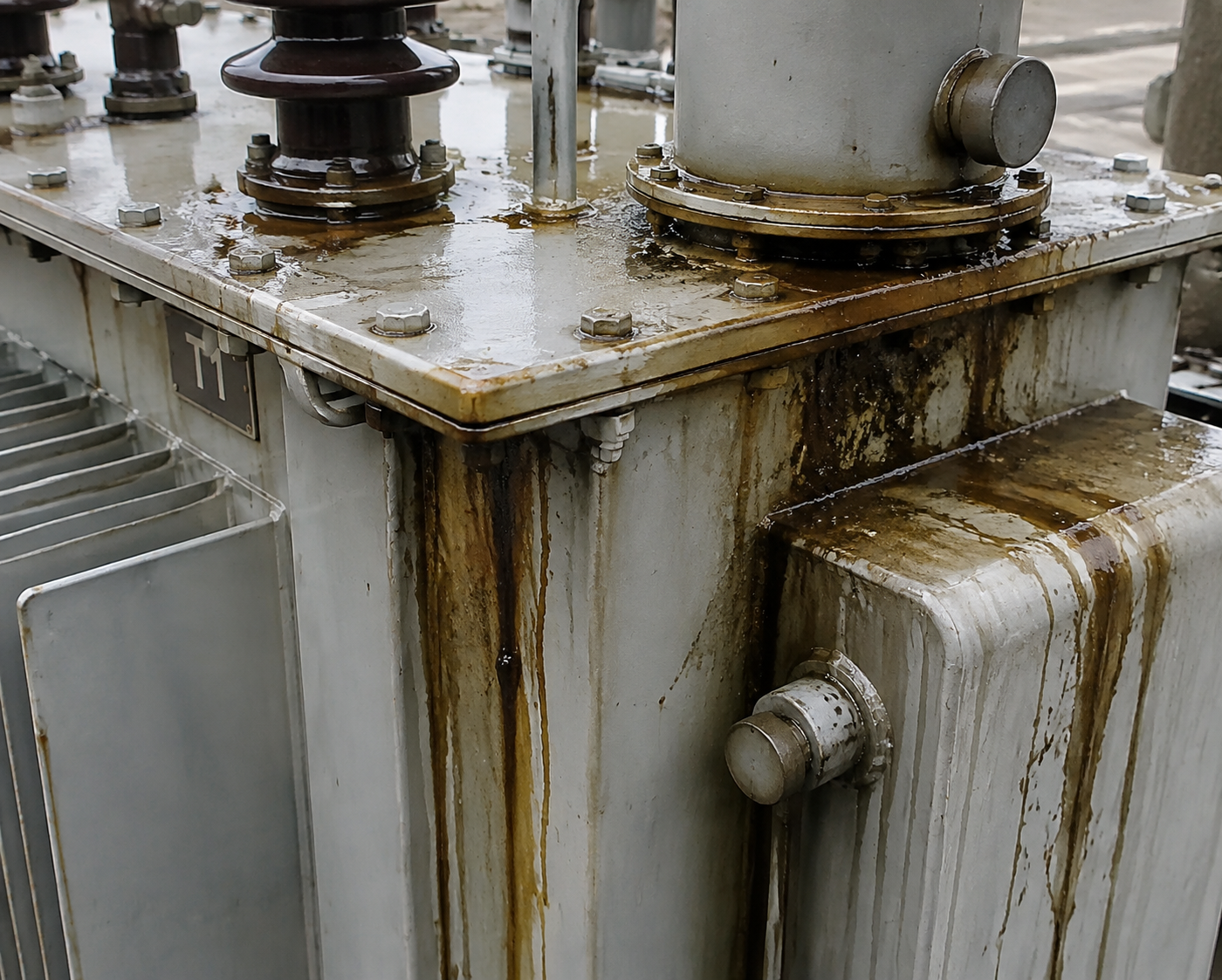
Oil leakage typically occurs at vulnerable points where seals or mechanical joints experience stress over time:
- Tank welds: Manufacturing defects or fatigue cracks in welded seams.
- Gaskets and O-rings: Rubber sealing components at the tank cover, bushing flanges, and radiator connections harden and crack with thermal cycling.
- Radiator fins and flanges: Mechanical vibration and thermal expansion loosen connections.
- Bushing terminals: Where conductor leads exit the tank, seals often degrade from UV exposure and temperature extremes.
Root Causes of Oil Leakage
Leakage rarely has a single cause. Common contributing factors include:
- Thermal cycling: Daily load fluctuations cause expansion and contraction of the tank and internal components, stressing seals and joints.
- Seal material aging: Rubber compounds lose elasticity over time, especially when exposed to high operating temperatures.
- Vibration and mechanical stress: Poor foundation mounting or external vibration from nearby equipment accelerates seal wear.
- Manufacturing defects: Incomplete welds or improperly torqued flanges may not show problems until years into service.
Risks of Oil Leakage
The consequences of oil leakage extend beyond the obvious loss of oil volume:
- Fire and environmental hazards: Spilled oil is both a fire risk and an environmental contaminant subject to regulatory penalties.
- Insulation degradation: When oil level drops below winding coverage, exposed insulation absorbs moisture from the air, significantly reducing dielectric strength.
- False oil level readings: Oil loss can create a "false level" indication on gauges, misleading operators about the true condition.
- Accelerated oxidation: Low oil levels allow more air contact, promoting faster oil degradation.
Part 3: The Challenge of Oil Degradation
Manifestations of Degraded Oil
As transformer oil ages, visible and measurable changes occur:
- Darkening color: Oxidation turns oil from clear amber to dark brown or black.
- Sludge formation: Oxidation byproducts precipitate as sediment that blocks cooling channels.
- Increased dissipation factor (tan δ): Indicates higher dielectric losses.
- Lower breakdown voltage: The oil can no longer withstand the same electrical stresses.
Chemical Mechanisms of Degradation
Thermal aging: High operating temperatures accelerate oil molecule cracking, producing low-molecular-weight acids and gases. Every 10°C increase above rated temperature halves the insulation life.
Moisture ingress: Water entering through leaks or via the breathing system reduces the oil-paper insulation's polymerization degree, weakening mechanical and electrical strength.
Corrosive sulfur: This represents one of the most insidious degradation mechanisms. Certain sulfur compounds in transformer oil—particularly dibenzyl disulfide (DBDS)—react with copper windings to form copper sulfide (Cu₂S), a conductive deposit that forms on insulating paper. This creates a conductive bridge that can lead to sudden insulation breakdown. The problem gained industry attention when changes to oil refining processes in the 1990s introduced DBDS as an oxidation stability additive. Today, IEC 62535 is the standard test method for detecting corrosive sulfur in transformer oil.
Hot spot risks: Research has shown that the risk of corrosive sulfur attack increases significantly when oil or hot spot temperatures exceed 80°C, oxygen concentration is between 1,000 ppm and typical sealed conservator levels, and dielectric stress is high. High-voltage transformers, generator step-up units, and HVDC transformers face the highest risk.
Consequences of Degraded Oil
- Dielectric failure: Reduced breakdown voltage leads to internal arcing and winding faults.
- Cooling blockage: Sludge deposits clog oil flow paths, creating a vicious cycle of overheating and further degradation.
- Accelerated insulation aging: Acidic byproducts attack cellulose insulation, reducing its mechanical strength and lifespan.
Part 4: Diagnostic Tools & Monitoring
Online Monitoring
- Oil level gauges and moisture sensors: Provide real-time data on oil condition.
- Online DGA monitors: Continuously track dissolved gas concentrations to detect developing faults.
Offline Laboratory Testing — The Gold Standard
Regular laboratory oil analysis is the most reliable method for assessing oil health:
Routine tests:
- Breakdown voltage
- Water content
- Acidity (neutralization number)
- Interfacial tension
- Dielectric dissipation factor
Specialized tests:
Dissolved Gas Analysis (DGA): Identifies fault types through characteristic gas patterns:
- Partial discharge, corona
- Low-temperature oil decomposition
- High-temperature oil decomposition, hot spots
- Arcing—the most critical indicator
- Cellulose (paper) degradation
Corrosive sulfur testing: According to IEC 62535, this detects the presence of reactive sulfur compounds that attack copper windings.
Testing frequency recommendations:
- Every 3–6 months
- Annually
- Quarterly monitoring may be warranted
- First-year baseline testing, then regular intervals based on criticality
Part 5: Solutions & Preventive Actions
Leakage Repair
Cold welding with composite materials: For live leaks where shutdown is not feasible, polymer composite materials can seal leaks without de-energizing. In one case, a $130 material investment saved a $30,000 shutdown-and-weld repair. In another instance, a $500 repair product achieved similar results.
Gasket replacement: Replacing aging seals with modern fluorocarbon (FKM) compounds that resist high temperatures and oil degradation.
Oil conservator upgrades: Installing nitrogen blankets or oil-bag systems reduces air contact and moisture ingress.
Oil Purification and Regeneration
Oil purification: Removes moisture, particulate matter, and dissolved gases using vacuum dehydration and filtration. This can restore oil properties significantly at 20–40% of new oil cost.
Oil regeneration: More advanced than purification, this process uses adsorption media to remove acid and sludge, restoring oil to near-new condition. A real-world case study of a 132/33kV substation in Turkey showed:
Parameter |
Before Regeneration |
After Regeneration |
Breakdown Voltage |
24 kV |
72 kV |
Water Content |
54 ppm |
7 ppm |
Acidity |
0.28 mg KOH/g |
0.01 mg KOH/g |
Interfacial Tension |
12 mN/m |
42 mN/m |
The regeneration of 50,000 liters cost $46,000 compared to $102,000 for oil replacement, saving the utility over $56,000 and avoiding 5 days of downtime per transformer.
Long-term Prevention
- Temperature management: Keep top oil temperature below 85°C and winding hot spots below 98°C.
- New oil quality control: Strictly screen incoming oil for corrosive sulfur content.
- Regular electrical testing: Adhere to preventive testing cycles (e.g., DL/T 596 or IEEE standards).
- Metal passivation: Where corrosive sulfur is detected, adding passivators such as Irgamet 39 (alkylated benzotriazole) can mitigate risk. Research indicates a minimum of 5 mg/L is needed to effectively suppress sulfur corrosion.
Part 6: How Much Does It Cost to Repair a Transformer?
Costs vary widely depending on the severity of the issue, transformer size and voltage class, location, and whether work is performed on-site or returned to the shop.
Cost Components
- Labor: On-site technician time, engineering support, and transportation.
- Materials: Replacement oil, gaskets, filters, and repair compounds.
- Testing: Laboratory oil analysis ($300–$800 per sample).
- Downtime: Lost production or service interruption—often the largest hidden cost.
Price Ranges by Repair Scenario
Based on 2025–2026 North American and international market data:
Repair Scenario |
Estimated Cost (USD) |
Notes |
Small leak cold weld repair |
$1,500 – $5,000 |
On-site, no oil draining, 1–2 days |
Full gasket replacement (MV) |
$3,000 – $10,000 |
Requires oil drain and tank lifting |
On-site oil filtration/dehydration |
$2,000 – $8,000 |
Cost per gallon typically $0.50–$1.50 |
Oil regeneration (10,000 liters) |
$8,000 – $12,000 |
50–65% savings vs. replacement |
Oil replacement (10,000 liters) |
$18,000 – $22,000 |
Includes new oil, labor, and disposal |
Seal repair on utility transformer |
~$26,700 |
Actual bid for Cutler-Hammer unit repair |
Shutdown leak repair with welding |
~$30,000 |
Requires outage and oil drain |
Rewinding or major overhaul (shop) |
$20,000 – $150,000+ |
Typically 20–50% of new transformer cost |
Cost Optimization Strategies
- Prioritize purification over replacement: In most cases, purification costs 40–80% less than full oil replacement.
- Test before deciding: If acid value < 0.3 mg KOH/g and dielectric loss < 2%, purification is the clear economic choice.
- Consider the 60% rule: If repair costs exceed 60% of the price of a new transformer, replacement is often more cost-effective over the long term.
- Invest in regular DGA testing: A $300–$800 test can prevent a $30,000–$150,000 major repair by catching problems early.
Part 7: Frequently Asked Questions (FAQ)
Q1: What is the most common cause of oil leakage in oil-immersed transformers?
A: The most common cause is aging or failure of rubber gaskets and O-rings at the tank cover, bushings, and radiator flanges, exacerbated by thermal cycling (expansion and contraction) during daily load changes. Poor welding quality on the tank body is another primary cause. Seal materials harden and crack over time, particularly in high-temperature environments, allowing oil to escape.
Q2: How can I tell if my transformer oil has deteriorated without laboratory testing?
A: Visual and olfactory checks can provide early clues:
- Dark brown/black colorindicates severe oxidation or carbonization.
- Presence of sludgeat the bottom of the radiator or tank.
- A pungent, acrid smellsuggests the oil has undergone high-temperature cracking.
Note: Laboratory testing is still required for quantitative accuracy and to detect developing faults before they become critical.
Q3: What is corrosive sulfur in transformer oil, and why is it dangerous?
A: Corrosive sulfur refers to certain reactive sulfur compounds in the oil—particularly DBDS—that chemically react with copper windings to form copper sulfide (Cu₂S). This conductive substance deposits on insulating paper, creating a conductive bridge that reduces dielectric strength and can lead to sudden insulation breakdown (creepage discharge). The problem has been recognized since the 1990s when oil refiners changed processes and introduced DBDS as an additive. IEC 62535 is the standard test for detecting corrosive sulfur.
Q4: Can I just add new oil to a leaking transformer instead of repairing the leak?
A: No, this is only a temporary measure and does not solve the root cause. Adding new oil while a leak exists continues to allow moisture and air ingress, accelerating degradation of both old and new oil. More importantly, if the leaked oil has already caused insulation exposure, simply adding oil will not restore the lost dielectric strength. The leak must be sealed, and the oil conditioned or replaced.
Q5: How often should DGA testing be performed on an oil-immersed transformer?
A: According to IEEE C57.104 and IEC 60599 standards:
- Critical transformers (essential loads or difficult to replace): Every 3–6 months.
- Standard power transformers: Annually.
- Transformers over 20 years old: May require quarterly monitoring.
- New transformers: Initial testing within the first year to establish baseline values.
If the transformer has experienced a through-fault (e.g., short circuit) or shows abnormal operating temperatures, immediate unscheduled DGA is required.
Q6: Is it cheaper to repair a leak or replace the entire transformer?
A: In most cases, repairing a leak is significantly cheaper. For example, a $3,000–$10,000 gasket replacement can extend the life of a $50,000 transformer by 10–15 years. However, if the core or windings are damaged (indicated by high C₂H₂ or C₂H in DGA results), replacement may be more cost-effective. A general rule: if repair costs exceed 60% of a new unit's price, replacement is recommended.
Q7: Can oil purification or regeneration be performed online without shutdown?
A: Yes, modern oil regeneration systems can be connected to the transformer while it remains online, allowing processing without service interruption. This is a significant advantage over oil replacement, which typically requires de-energizing, draining, and refilling—taking days of downtime. On-site regeneration is available for large power transformers and can be completed in 1–3 days per unit.
Conclusion
Oil leakage and degradation are not merely maintenance nuisances—they are the primary threats to oil-immersed transformer reliability and service life. Leakage is the "external wound" that allows moisture and contaminants to enter; degradation is the "internal disease" that progressively destroys insulating properties. Left unaddressed, one accelerates the other.
The economic case for proactive oil management is overwhelming. A $300–$800 DGA test can detect a developing fault before it becomes a $30,000–$150,000 catastrophic failure. Oil regeneration at $8,000–$12,000 for 10,000 liters can restore oil to near-new condition, compared to $18,000–$22,000 for replacement. And a $130 cold weld repair can save a $30,000 shutdown-weld job.
The most effective strategy is a lifecycle approach centered on oil stewardship:
- Regular oil testing and trending
- Prompt leak repair with modern cold-weld materials
- Scheduled oil purification or regeneration based on condition, not time
- Temperature monitoring and load management
- Corrosive sulfur screening for new oil and existing units over 35 kV
Actionable next step: Review your most recent transformer oil test reports. Check oil level and color during your next visual inspection. If you haven't performed DGA in the past year, schedule it now—the cost is negligible compared to the risk of an unplanned outage.