 EN
EN
Introduction
The reliability of a mine's power supply directly affects production safety and operating efficiency. As the core equipment for power conversion, the transformer's selection determines whether the entire mining power system can run stably. However, off-grid mines and grid-connected mines differ fundamentally in power source structure and operation mode, so the focus of transformer selection is also different. This article outlines the key points of transformer selection for both scenarios.
Main Differences Between Off-Grid and Grid-Connected Mining Projects
An off-grid mine relies completely on its own power sources (diesel generators, solar PV, energy storage, etc.) and is not connected to an external grid. The system must balance power generation and consumption in real time on its own. This means power source fluctuations (such as the intermittent nature of solar PV) must be absorbed by energy storage and backup generators, placing higher demands on supply continuity.
A grid-connected mine is linked to an external grid, which serves as the main or backup power source and provides stable voltage and frequency support. The mine can buy power from the grid and, where conditions allow, partly self-supply through renewable generation. The system is relatively less complex.
Oil-Immersed vs. Dry-Type Transformers for Mining Projects
The choice of transformer for a mining project depends first on the safety level of the installation site.
Oil-immersed transformers use insulating oil as the cooling and insulation medium. They have strong overload capacity and good heat dissipation, making them suitable for surface substations, open-pit areas, and other low-risk, heavy-load scenarios. Their purchase cost is lower, the technology is mature, and they offer good value in high-capacity power supply conditions. However, insulating oil carries risks of leakage and fire, and oil quality must be tested regularly.
Dry-type transformers use epoxy resin casting for insulation. They are oil-free, flame-retardant, and fire-resistant, making them suitable for underground tunnels and working faces with high gas concentrations or confined spaces. They are compact, dust-proof, and moisture-proof, with simple routine maintenance. The downsides are higher purchase cost and relatively limited overload capacity.
In short: choose dry-type first for high-risk underground areas; oil-immersed can be preferred for surface and low-risk scenarios.
Application Scenario Comparison
Item |
Oil-Immersed |
Dry-Type |
Insulation medium |
Insulating oil |
Epoxy resin casting |
Overload capacity |
Strong |
Relatively limited |
Fire risk |
Leakage / fire risk |
Flame-retardant, fire-resistant |
Typical site |
Surface substation, open-pit |
Underground tunnels, confined spaces |
Maintenance |
Regular oil testing |
Simple routine maintenance |
Purchase cost |
Lower |
Higher |
What to Consider When Selecting Transformers for Off-Grid Mining Projects
1. Adaptation to power source fluctuations. Off-grid systems often use a hybrid setup of "diesel generation + solar PV + energy storage." PV output fluctuations and diesel generator start/stop both cause voltage and frequency changes. The transformer needs good voltage regulation capability; an on-load tap-changing model may be necessary to handle frequent changes on the power source side.
2. Load impact withstand capability. Large equipment such as crushers and ball mills in mines can draw starting currents several times the rated value. An off-grid system lacks the strong support of a grid, so the transformer should have enough overload margin to prevent system voltage from dropping sharply when motors start. Capacity selection should be based on the actual load curve with reasonable redundancy.
3. Transport and installation conditions. Roads to remote mining sites are often limited, so transformer transport dimensions, weight, and on-site assembly feasibility must be considered. If an oil-immersed transformer requires on-site oil filling, oil treatment equipment and conditions must also be available.
What to Consider When Selecting Transformers for Grid-Connected Mining Projects
1. Short-circuit impedance matching. During grid-connected operation, transformer short-circuit impedance must be coordinated with the grid's short-circuit capacity. Too low impedance leads to excessive short-circuit current, increasing the burden on switchgear; too high impedance causes excessive voltage regulation. Verification should be based on the expected short-circuit current provided by the grid.
2. Vector group selection. Mining loads include a high share of non-linear equipment such as frequency converters and soft starters, and harmonic currents may affect transformer operation. The Dyn11 vector group performs better than Yyn0 in resisting harmonics and suppressing third harmonics, making it a common choice for distribution transformers in grid-connected mines.
3. Capacity configuration and expansion reserve. Load growth in grid-connected mines is usually relatively stable. Transformer capacity can be set at "actual load × 1.1–1.2," with expansion space reserved based on the mine's life-cycle plan. Oversized capacity not only increases no-load losses but also lowers the power factor.
Case Example: Nishbash Coal Mine Project, Uzbekistan
For the Nishbash coal mine project in Uzbekistan, we supplied three 3150 kVA, 10/0.4 kV grid-connected European-style prefabricated substations. The high-voltage switchgear, low-voltage switchgear, and transformers inside these substations were all manufactured by us. For this project, we tailored the most suitable equipment based on the mine's own characteristics, together with other factors such as altitude, temperature, and humidity.
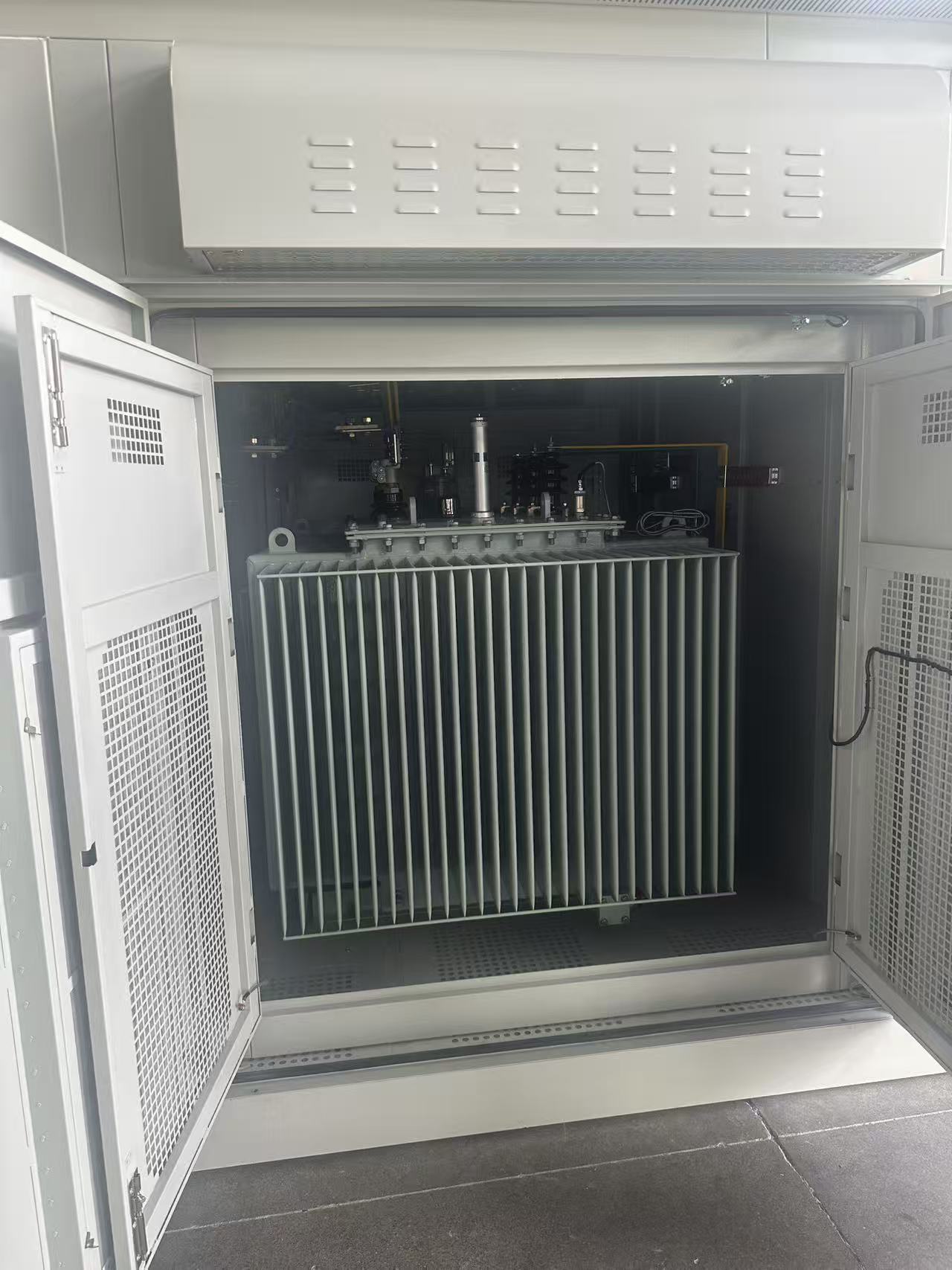
In particular, when selecting the transformer, we gave full consideration to the grid-connected requirements. We ultimately chose an oil-immersed transformer with a Dyn11 vector group and 5.5% short-circuit impedance.
FAQ
Q1. Must mining transformers use mining-specific models?
For underground areas and areas with explosion risks, transformers meeting mining standards (general type or flameproof type) must be used. Surface substations and open-pit areas can use standard industrial transformers, but they must meet protection rating and anti-corrosion requirements.
Q2. Can dry-type transformers be used outdoors?
Yes, but a protective enclosure is required, usually with a protection rating of IP54 or above, to handle dust and humid conditions.
Q3. Can an off-grid mine use a standard grid-connected transformer?
Not recommended. The power source characteristics and load impact patterns of off-grid systems differ significantly from grid-connected ones. A standard grid-connected transformer may not handle frequent voltage fluctuations and starting current impacts.
Conclusion
The core difference between transformer selection for off-grid and grid-connected mines lies in the different demands that power source characteristics place on the transformer. Off-grid scenarios require transformers with stronger voltage adaptation and overload margin to handle the fluctuations of self-built power sources and load impacts. Grid-connected scenarios focus more on impedance matching, harmonic suppression, and coordination with grid protection. In both scenarios, safety level is always the first dividing line between oil-immersed and dry-type — dry-type underground, oil-immersed on the surface. This principle does not change whether the mine is off-grid or grid-connected.
Table of Contents
- Introduction
- Main Differences Between Off-Grid and Grid-Connected Mining Projects
- Oil-Immersed vs. Dry-Type Transformers for Mining Projects
- What to Consider When Selecting Transformers for Off-Grid Mining Projects
- What to Consider When Selecting Transformers for Grid-Connected Mining Projects
- Case Example: Nishbash Coal Mine Project, Uzbekistan
- FAQ
- Conclusion