 EN
EN

Introduction: A Technological Shift in Distribution Transformers
Distribution transformers are the backbone of power delivery systems worldwide. They step down voltage for end-users, and their efficiency directly affects grid reliability, operating costs, and carbon emissions. For decades, the laminated core has been the standard, with stacked silicon steel sheets forming the magnetic circuit. But this design has inherent limitations: asymmetric magnetic paths, material waste, and energy losses at core joints.
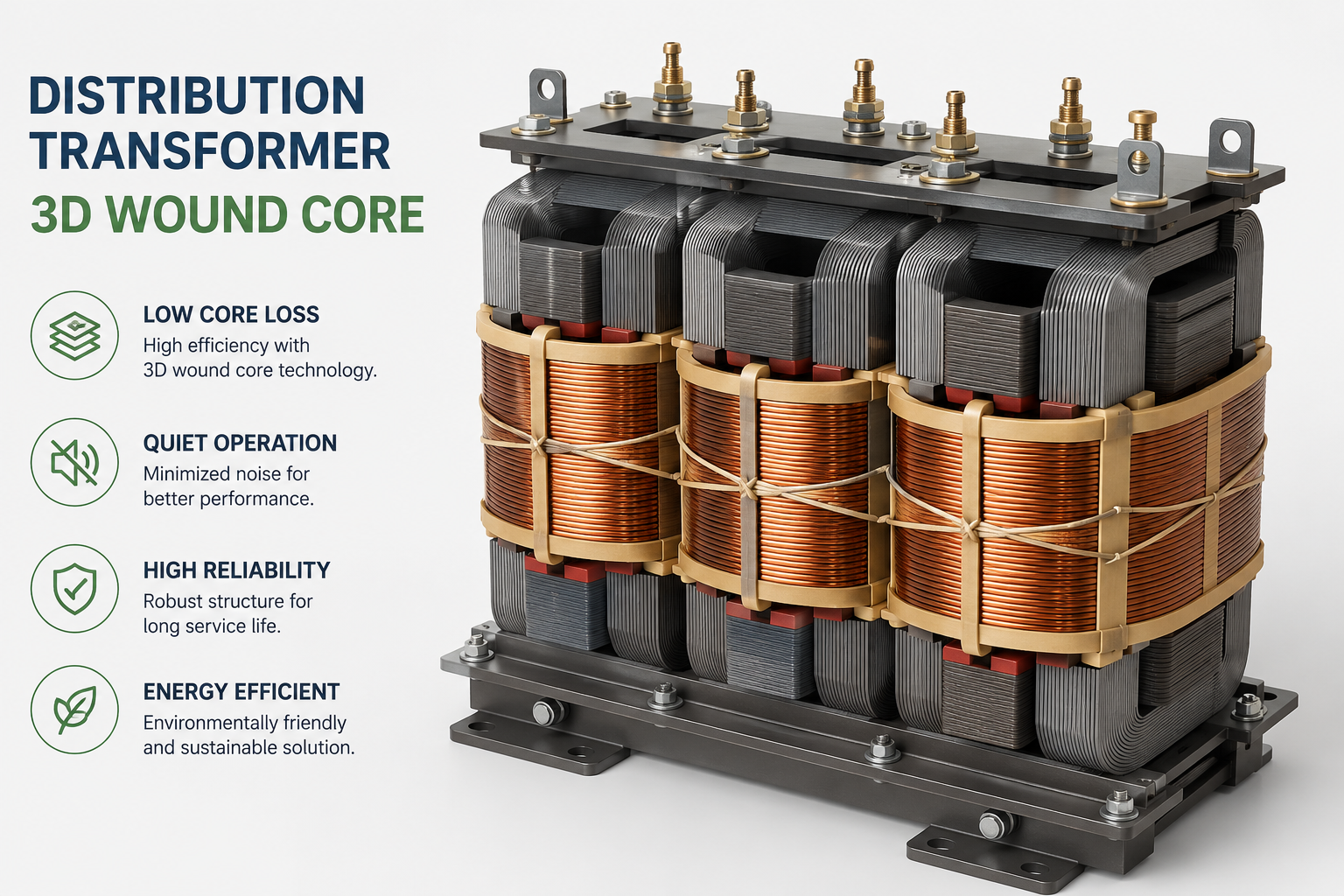
Enter three-dimensional wound core (3DWC) technology. This innovation replaces the flat, stacked structure with a triangular, three-dimensional core made of three identical wound frames assembled into an equilateral triangle. The result is a fully symmetrical magnetic circuit, shorter flux paths, and dramatically improved performance. In this article, we explore how 3D wound core technology is redefining the performance benchmark for distribution transformers across five key dimensions.
Part1. From Flat to 3D: What Makes the Wound Core Different?
The Limitations of Traditional Laminated Cores
In a conventional laminated core, silicon steel sheets are cut and stacked flat. This approach has three major problems:
• Asymmetric Magnetic Circuits — In a three-phase flat core, the side columns have a magnetic path about 20% longer than the center column. This creates imbalances in no-load current and reduces efficiency.
• Joint Gaps Create Magnetic Resistance — Every joint between stacked sheets increases magnetic reluctance (resistance to magnetic flux). This drives up no-load loss and excitation current.
• Material Waste — The cutting process generates waste, particularly at the V-shaped corners of the sheets. Typical material utilization is far below 100%.
The 3D Wound Core Solution
The three-dimensional wound core consists of three individual rectangular frames, each continuously wound from grain-oriented silicon steel or amorphous alloy strip. These three frames are assembled into a triangular arrangement, creating a three-dimensional magnetic circuit with:
• Equal magnetic path lengths for all three phases — true symmetry
• No joints — continuous winding eliminates gaps
• Perfect alignment between flux direction and material grain orientation
The manufacturing process also includes high-temperature vacuum annealing (around 800°C), which eliminates internal stresses in the steel and further improves magnetic properties.
Part2. Performance Gains Across Five Dimensions
1. Energy Efficiency: Cutting No-Load Losses
The efficiency gains from 3D wound core technology are substantial. Test data shows:
• No-load loss reduction: Compared to S9 laminated core transformers, 3D wound core models reduce no-load loss by about 50%. Compared to national standards, reductions of 25–35% are typical.
• No-load current reduction: Up to 70–92% lower than conventional designs. This directly improves power factor and reduces grid losses.
• Material savings: The 3D design saves approximately 25% of silicon steel and 2–3% of copper compared to laminated cores.
The core process coefficient (a measure of magnetic inefficiency) drops from 1.3–1.5 in laminated cores to about 1.05 in 3D wound cores. This alone contributes a 10–20% loss reduction.
For context, a typical 315kVA unit using this technology can save about 3,996 kWh annually, cutting CO₂ emissions by roughly 3.54 tonnes per year.
2. Short-Circuit Withstand Capability
The triangular arrangement provides inherent mechanical strength. The three frames support each other, and the symmetrical magnetic circuit distributes electromagnetic forces evenly during short-circuit events. This results in better mechanical stability and a higher pass rate in short-circuit withstand tests.
3. Noise Reduction: A Quieter Transformer
Laminated cores generate noise from magnetostriction — the slight expansion and contraction of steel under alternating magnetic fields — compounded by vibrations at the joints. The 3D wound core, being a jointless continuous structure, operates much more quietly.
Measured noise reduction: 7–10 decibels lower than laminated core transformers. Some models achieve noise levels as low as 47 dB, approaching near-silent operation. This makes 3D wound core transformers ideal for indoor installations, residential areas, and other noise-sensitive environments.
4. Three-Phase Balance and Harmonic Reduction
Because the three magnetic paths are exactly equal in length, the three phases operate in perfect balance. This reduces third-harmonic currents and improves overall power quality. In contrast, conventional laminated cores typically have a 20% longer magnetic path on the side columns, creating inherent imbalance.
5. Compact Footprint
The triangular arrangement is not only efficient but also compact. The body occupies about 10–15% less floor space, and height is reduced by approximately 10–20% compared to conventional units. This is especially valuable for substation installations where space is at a premium.
Part3. The Next Frontier: Amorphous Alloy + 3D Wound Core
Amorphous alloy steel, with its ultra-low loss characteristics (about 70% lower loss than conventional silicon steel), combines exceptionally well with 3D wound core geometry. By solving challenges around continuous winding, annealing, and mechanical strength, manufacturers have successfully commercialized amorphous alloy 3D wound core transformers.
China has pioneered this combination, with domestic manufacturers now producing 3D wound core transformers up to 110kV voltage levels and 80,000kVA capacities. These products meet or exceed the latest GB 20052-2024 energy efficiency standards, which set mandatory limits for distribution transformers.
Frequently Asked Questions (FAQ)
Q1: What is a three-dimensional wound core transformer?
A: It is a distribution transformer whose iron core consists of three continuously wound frames assembled into a triangular 3D shape. This design eliminates core joints, creates a symmetrical magnetic circuit, and reduces losses compared to traditional flat laminated cores.
Q2: How much energy can a 3D wound core transformer save?
A: Compared to an S9 laminated core transformer, no-load loss can drop by about 50%, and no-load current by up to 70–85%. For a typical 315kVA unit, annual savings are about 4,000 kWh per unit.
Q3: Are 3D wound core transformers quieter?
A: Yes. Noise levels are typically 7–10 dB lower than laminated core units, with some models operating as low as 47 dB.
Q4: What voltage levels are available for 3D wound core transformers?
A: They are available from 6kV up to 110kV, covering most distribution and sub-transmission applications.
Q5: What is the difference between amorphous alloy and silicon steel 3D wound cores?
A: Amorphous alloy cores have even lower loss (about 70% less than silicon steel) but are more challenging to manufacture due to the material's thinness and brittleness. Silicon steel 3D wound cores are more widely produced and cover higher voltage/capacity ranges.
Q6: Do 3D wound core transformers cost more?
A: Initial cost is typically higher than conventional laminated core units, but the energy savings over the transformer's lifespan often offset the premium, particularly in applications with high no-load hours.
Conclusion: A New Benchmark for Distribution Transformer Performance
The three-dimensional wound core is more than an incremental improvement — it represents a fundamental rethinking of how the transformer core should be built. By eliminating joints, achieving true three-phase symmetry, and leveraging advanced materials like amorphous alloy, this technology delivers:
1. 50% lower no-load losses
2. 70–90% lower no-load current
3. 7–10 dB lower noise
4. 25% material savings
5. Better short-circuit withstand capability
6. True three-phase balance
With new energy efficiency standards like GB 20052-2024 mandating higher performance, and carbon reduction goals driving the shift to green grid equipment, 3D wound core technology is increasingly recognized as the new benchmark for distribution transformers.
The shift from flat to 3D is not just about geometry — it is about a smarter, more sustainable way to move power from the grid to the people who depend on it.
Application Scenarios Overview
Application Area |
Key Advantage |
Typical Use Case |
Data Centers |
Ultra-low no-load loss & compact design |
24/7 continuous power supply with minimal energy waste |
Renewable Energy Stations |
High efficiency & noise reduction |
Wind/solar farms near residential areas |
Urban Substations |
Compact footprint & low noise |
Space-constrained city installations |
Rail Transit |
Short-circuit withstand & reliability |
Metro/subway traction power systems |
Rural Grid Upgrade |
Material savings & long lifespan |
Cost-effective rural distribution network modernization |
Industrial Parks |
Three-phase balance & harmonic reduction |
Sensitive industrial equipment protection |
Table of Contents
- Introduction: A Technological Shift in Distribution Transformers
- Part1. From Flat to 3D: What Makes the Wound Core Different?
- Part2. Performance Gains Across Five Dimensions
- Part3. The Next Frontier: Amorphous Alloy + 3D Wound Core
- Frequently Asked Questions (FAQ)
- Conclusion: A New Benchmark for Distribution Transformer Performance
- Application Scenarios Overview