EN
EN
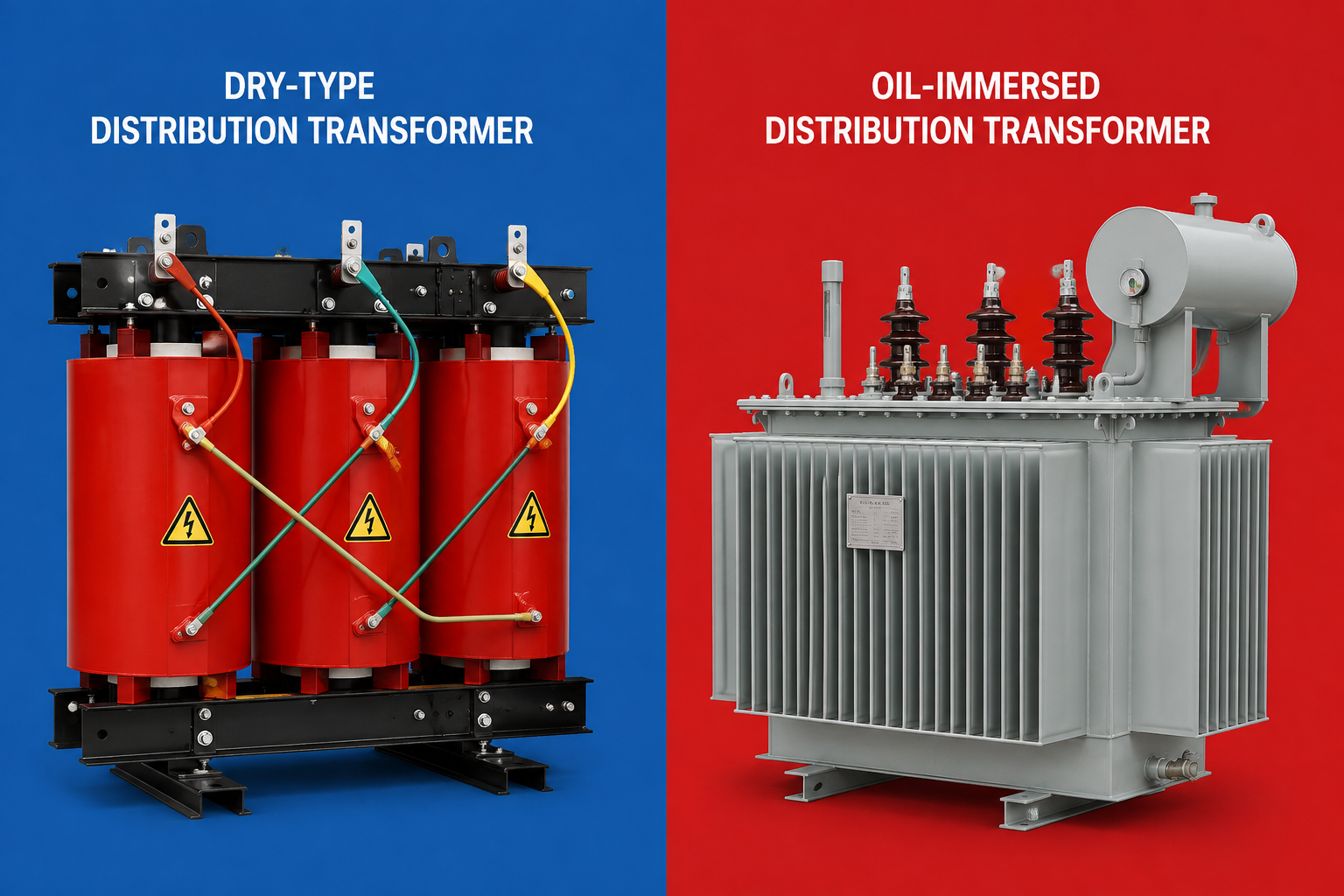
When building a solar power plant or setting up factory power distribution, one of the most common—and critical—decisions is choosing between a dry-type transformer and an oil-immersed transformer. Get it wrong, and you could face anything from higher operating costs to failed fire safety inspections. Get it right, and you'll have reliable, efficient power for decades.
Here's the bottom line upfront:
For indoor installations or occupied spaces, prioritize dry-type transformers. For outdoor, large-capacity, high-load applications, oil-immersed transformers are the industry standard.
Part1. Dry-Type vs Oil-Immersed: Key Differences at a Glance
Feature |
Dry-Type Transformer |
Oil-Immersed Transformer |
Insulation/Cooling |
Epoxy resin + air (natural or forced cooling) |
Mineral oil or natural ester (vegetable oil) circulation |
Fire & Explosion Risk |
No flammable liquid—fire-retardant |
Contains flammable oil—requires fire walls/containment pits |
Overload Capability |
Moderate—limited by air cooling efficiency |
Excellent—oil dissipates heat efficiently; can handle 130%–150% short-term overload |
Typical Voltage/Capacity |
≤35 kV, up to ~3,150 kVA |
All voltage classes; ideal for large capacities (3,150 kVA) |
Maintenance |
Low—periodic dust cleaning, no oil sampling |
Requires annual DGA oil testing, filtration every 3–5 years, oil replacement ~year 15 |
Initial Cost (CAPEX) |
Higher—20%–50% more per kVA |
Lower—15%–20% cheaper for same specifications |
Lifespan |
15–20 years (heat accelerates aging) |
20–30 years |
Location Fit |
Indoor—basements, hospitals, malls, commercial rooftops |
Outdoor yards, pad-mounts, utility stations, solar farms |
Part2. Choosing the Right Transformer for Your Project
- Scenario 1: Commercial & Industrial Rooftop Solar → Choose Dry-Type
For C&I rooftop solar installations on factories, warehouses, or office buildings, fire safety is the top concern. These systems are installed on or near occupied spaces where fire codes are strict. Dry-type transformers contain no combustible oil, so they eliminate fire and leakage risks. They are also compact, quieter, and easier to install in tight rooftop spaces.
Why it works: No oil means no spill risk, easier fire inspections, and peace of mind for building owners. They are also nearly maintenance-free, which is ideal for commercial settings where specialized maintenance staff may not be available.
- Scenario 2: Utility-Scale Ground-Mount Solar Farms → Choose Oil-Immersed
Large, ground-mounted solar plants (10MW+) are typically built in open areas like deserts, mountains, or agricultural land. These sites have harsh outdoor conditions—intense sunlight, temperature swings, dust, and rain. Oil-immersed transformers thrive here. Their oil-circulation cooling system handles high heat and continuous heavy loads far better than air-cooled dry-types.
Why it works: Oil-immersed units are tough, durable, and cost less upfront. They can handle the daily "bell curve" of solar output—peaking at noon—without overheating or derating. Case in point: a 10MW solar plant using an oil-immersed transformer maintained a stable 85°C at peak summer output, while an equivalent dry-type hit 105°C and triggered thermal protection, reducing output to 80%.
- Scenario 3: Factory Power Distribution (Heavy/Large Loads) → Choose Oil-Immersed
Factories often have large motors, crushers, or other equipment that creates sudden current surges and voltage dips. Oil-immersed transformers have excellent short-circuit withstand capability and thermal inertia—they can ride through these "shock loads" without damage. And at higher kVA ratings, oil-immersed units are significantly cheaper than dry-types, making them the budget-friendly choice for industrial plants.
Why it works: High overload capacity + lower cost = a perfect match for demanding industrial environments where budget is a concern.
- Scenario 4: Fire-Sensitive/Environmentally Sensitive Areas → Choose Carefully
If your project is near flammable materials (like grasslands or chemical plants) or in an environmentally sensitive zone (near water sources or forests), standard mineral-oil transformers may pose unacceptable risks.
Options to consider:
Dry-type: The safest choice for fire-sensitive indoor or occupied areas.
Vegetable-oil (natural ester) transformers: This is a game-changer. Vegetable oil has a high flash point (around 360°C), is biodegradable (near 100%), and non-toxic. It offers the cooling performance of an oil-immersed unit with much lower fire and environmental risk, making it suitable for sensitive areas where mineral oil would be prohibited.
Part3. When Should You Consider Replacing a Dry-Type with an Oil-Filled Transformer?
Based on the selection logic above, here are the main scenarios where a switch makes sense:
1. Outdoor Relocation: If you're moving the transformer from an indoor location to an outdoor, open site where fire codes no longer mandate dry-type, switching can save significant upfront and operating costs for larger capacities.
2. Capacity Upgrade Needed: If your factory or solar farm is expanding and the existing dry-type transformer is under-sized, replacing it with a larger oil-immersed unit (if allowed by the installation site) is often more cost-effective than buying a very large dry-type.
3. Recurring Overheating Issues: If your dry-type transformer frequently alarms on high temperature during peak summer loads—leading to forced derating or shutdowns—an oil-immersed unit with its superior heat dissipation can eliminate this problem.
4. High Power Factor/Harmonic Concerns: In PV systems, inverters generate harmonics and fluctuating loads. Oil-immersed transformers designed specifically for solar applications have better harmonic tolerance and withstand voltage fluctuations.
Critical Warning – When You CANNOT Switch:
Never install an oil-immersed transformer indoors, in basements, in high-rise buildings, or in any occupied space where local fire codes prohibit combustible liquids.
Avoid mineral-oil transformers near water sources or in residential areas unless you have full containment (bunds/oil pits) and local permits for spill risk.
Frequently Asked Questions (FAQ)
Q1: Is an oil-immersed transformer always cheaper than a dry-type?
Not always, but usually. For the same capacity and voltage rating, oil-immersed transformers typically cost 15%–20% less upfront. However, when you factor in the cost of mandatory fire protection (fire walls, oil containment pits, and fire-fighting equipment), the total installed cost can be comparable. For large outdoor projects, oil-immersed still wins on overall economics.
Q2: Can I install an oil-immersed transformer indoors if I use "less flammable" vegetable oil?
In many jurisdictions, yes—but with conditions. Natural ester (vegetable oil) transformers have a flash point above 300°C (vs. ~140°C for mineral oil) and are classified as "less flammable" under standards like IEC 60076-14 and IEEE C57.147. Some local fire codes permit them indoors if a secondary containment and automatic fire suppression system are installed. However, always consult your local Authority Having Jurisdiction (AHJ)—approvals vary by region.
Q3: Which transformer has a longer lifespan—dry-type or oil-immersed?
Oil-immersed transformers generally last longer—20 to 30 years, compared to 15 to 20 years for dry-types. The reason is simple: oil provides better thermal management, keeping insulation temperatures lower and slowing aging. That said, a dry-type running in a cool, clean indoor environment can sometimes reach 25 years, while a poorly maintained oil-immersed unit can fail early due to moisture or sludge buildup.
Q4: Does the chosen transformer affect my PV plant's overall efficiency?
Yes, through transformer losses. Both types have similar efficiency ratings at full load (typically 98%–99% for modern units), but the loss curve differs. Oil-immersed transformers usually have lower no-load (core) losses but slightly higher load (copper) losses. For a solar plant that operates at partial load for a significant portion of the day, the selection should be based on the actual load profile to minimize total energy losses over time. This is why we typically recommend oil-immersed units for solar farms with high capacity factors.
Q5: What is the biggest hidden cost of switching from dry-type to oil-immersed?
The ongoing maintenance and compliance cost. You'll need annual dissolved gas analysis (DGA) oil testing, periodic filtration, and a contingency plan for oil spills. In addition, many jurisdictions require a formal environmental spill response plan and regular inspections of containment pits. These costs are often overlooked during the initial CAPEX comparison but can add significantly to OPEX over the transformer's life.
Q6: How do I calculate if a replacement makes financial sense?
A simple payback period analysis works well. The formula is:
Payback (years) = (Cost of new oil-immersed + removal/disposal cost of old dry-type) / (Annual energy savings + avoided repair costs + any avoided capacity upgrade costs).
If the payback is under 5 years, the switch is generally considered economically viable. Most solar and industrial projects see payback in 3–7 years, depending on local electricity prices.
Quick Decision Guide
Ask yourself these three questions:
1. Where will it be installed?
Indoor / occupied / fire-sensitive → Dry-Type
Outdoor / open yard / substation → Oil-Immersed (consider vegetable oil for sensitive sites)
2. What's the voltage and load profile?
≤35 kV and moderate load → Dry-Type is acceptable
35 kV or 3,150 kVA or high/continuous load → Oil-Immersed is the clear choice
3. What's your priority—lowest CAPEX or lowest risk/OPEX?
Lowest cost & maintenance staff available → Oil-Immersed
Minimize fire risk & maintenance hassle → Dry-Type (higher upfront, lower long-term OPEX)
Conclusion
There is no universally "better" transformer—only the right one for your specific project conditions. For large outdoor solar farms and heavy industrial loads, oil-immersed transformers win on cost, cooling, and overload capacity. For indoor commercial rooftops and occupied buildings, dry-type transformers are the safe, compliant, and low-maintenance choice. And when environmental sensitivity and fire safety converge, vegetable-oil transformers offer the best of both worlds.
Remember: Choose based on installation environment, load requirements, and regulatory compliance—not habit or price alone.