 EN
EN
1. Introduction
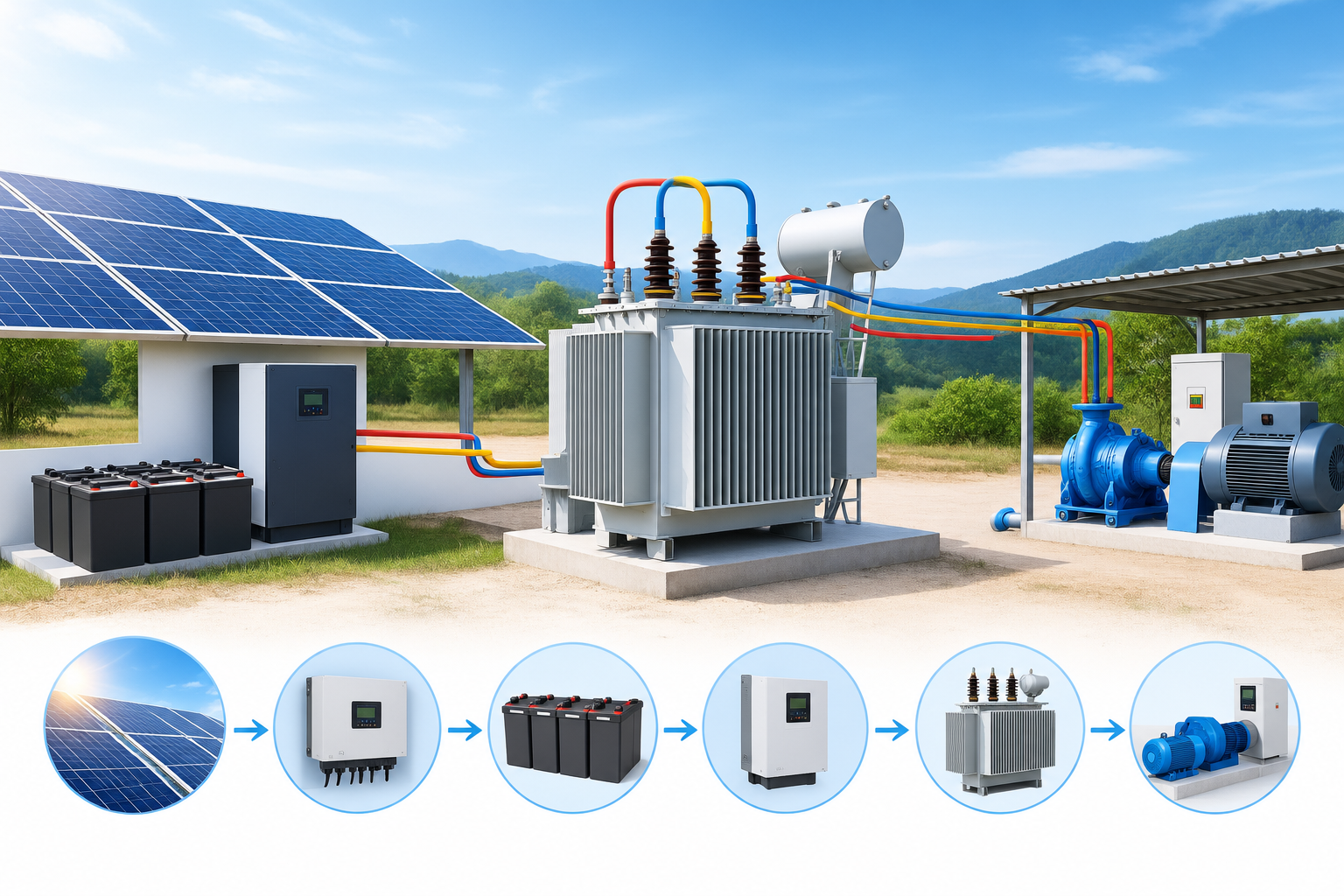
An off-grid solar system typically consists of solar panels, a charge controller, a battery bank, and an inverter. Most small residential systems use single-phase power, which is enough for everyday appliances.
So why do some off-grid systems need a three-phase distribution transformer? The answer comes down to specific needs: powering three-phase equipment, reducing line losses over long distances, providing electrical isolation, and balancing loads across three phases. In short, a three-phase transformer plays a key role in voltage matching, power quality, isolation, and load balancing—but only when the application actually requires it.
2. What Is an Off-Grid System
An off-grid system works as a self-sufficient micro power plant. Solar panels generate electricity during the day, surplus energy is stored in batteries, and an inverter converts DC power into AC power for loads.
The key difference from a grid-connected system is that there is no utility grid as backup. Every kilowatt-hour must be generated, stored, and managed locally, so each component directly affects reliability and stability.
3. Do All Off-Grid Systems Need a Three Phase Transformer?
No. Most residential off-grid systems use single-phase power and do not need a three-phase transformer.
A three-phase transformer is only required in specific situations:
- Three-phase loads: such as three-phase pumps, motors, or industrial equipment.
- Long transmission distance: stepping up voltage reduces line losses.
- Electrical isolation: separating the inverter side from the load side for safety.
- High system capacity: three-phase distribution is more efficient at tens of kilowatts or above.
In short: small home systems don't need one; industrial, agricultural, and large microgrid applications may.
4. Key Benefits of Using Transformers in Off-Grid Solar Systems
① Voltage Conversion to Reduce Line Losses
Step up voltage for transmission, step it down at the load, and cut energy wasted in cables.
② Galvanic Isolation for Enhanced Safety
No direct electrical connection between input and output, protecting the inverter and batteries from load-side faults and DC components.
③ Three-Phase Load Balancing
Distributes single-phase loads more evenly across three phases, preventing one phase from being overloaded.
④ Providing Three-Phase Power Supply
Enables three-phase equipment to operate when paired with a three-phase inverter.
⑤ Power Quality Improvement
Filters out high-frequency harmonics and interference for cleaner output waveforms.
5. FAQ
Q1: Does my small off-grid system need a three-phase transformer?
No. Household appliances are mostly single-phase, and a single-phase inverter is sufficient.
Q2: Will a transformer waste electricity?
Yes. Transformers have no-load losses, so the decision involves a trade-off—especially in off-grid systems where every watt-hour matters.
Q3: What is the difference between a transformer and an inverter?
An inverter converts DC to AC. A transformer only changes AC voltage; it cannot change DC/AC nature.
Q4: Where does three-phase power come from in an off-grid system?
Either from a three-phase inverter directly, or from three single-phase inverters combined.
Q5: When is a transformer absolutely necessary?
When driving three-phase motors or pumps, transmitting over long distances, or requiring electrical isolation.
6. Conclusion
A three-phase distribution transformer is not a standard component in off-grid solar systems—it is a solution for specific requirements. Its main purposes are voltage matching, isolation, three-phase load balancing, and power quality improvement. For typical residential systems, it is usually unnecessary. But for three-phase industrial equipment, long-distance distribution, or high-safety applications, it is a critical component. Choosing whether to use one is essentially a trade-off between efficiency and cost on one hand, and functionality and reliability on the other.
References
1. U.S. Department of Energy. "Off-Grid or Stand-Alone Renewable Energy Systems." Energy.gov, 2026. https://www.energy.gov/energysaver/grid-or-stand-alone-renewable-energy-systems
2. OutBack Power Technologies. "Application Note: 3-Phase 480V." OutBack Power, 2017. http://outbackpower.com/downloads/documents/appnotes/3ph_480v_app_note.pdf
3. GreenTech Renewables. "SMA Tripower – Off Grid." Greentech Renewables, 2017. https://www.greentechrenewables.com/comment/2892
4. Crossref. "Method for Operating AC Microgrids in Off-Grid or Standalone and Grid-Connected Modes." Journal of Energy and Power Technology, 2022. https://api.crossref.org/works/10.21926/jept.2201008