 EN

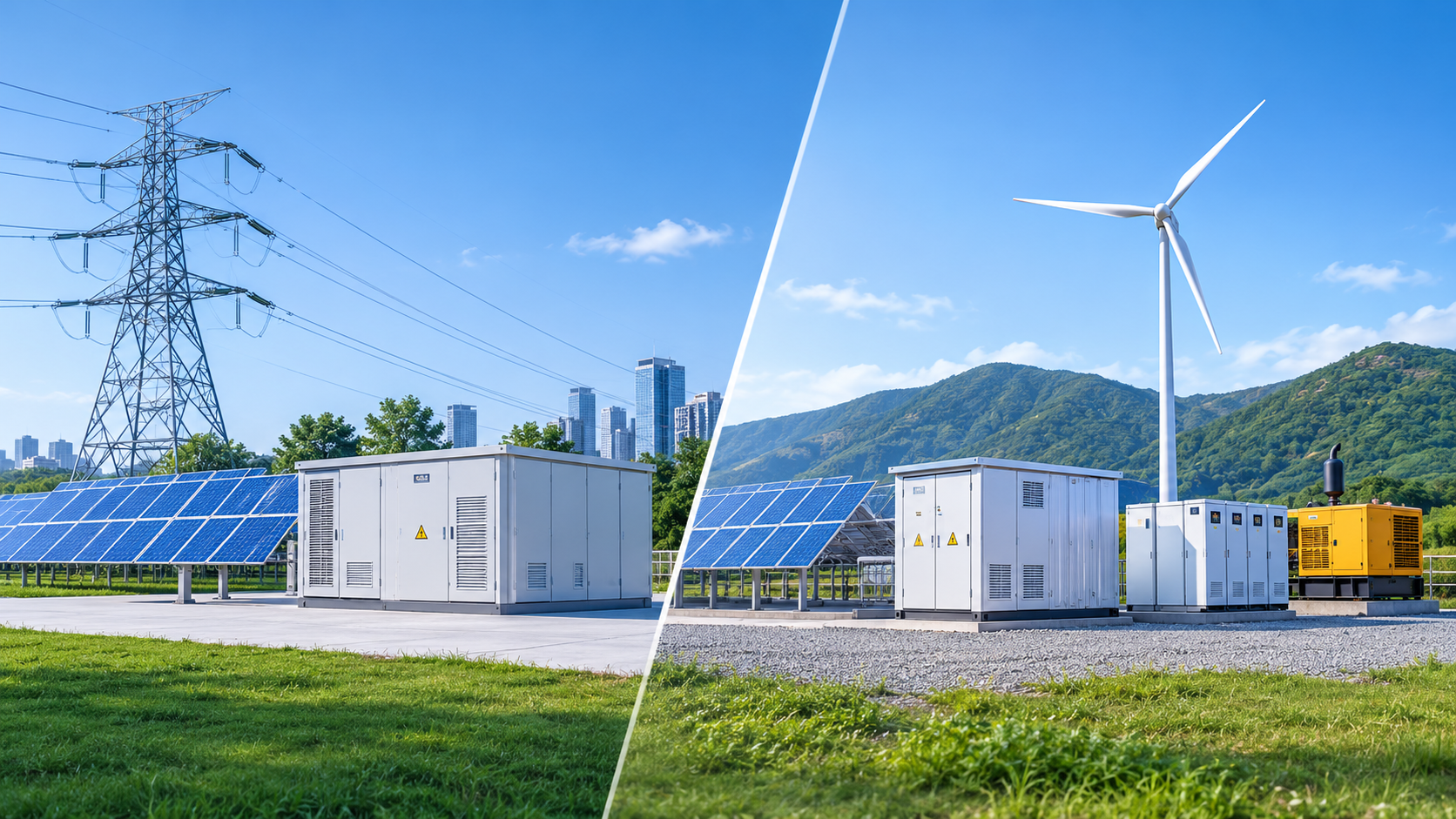
Microgrids have two basic operating modes: grid-connected and off-grid. The two differ clearly in control logic, equipment selection, and protection settings. Understanding these differences is the basis for equipment selection in the early stage of a project.
1. How the Two Types of Microgrids Work
In grid-connected operation, the microgrid is connected to the external main grid through the point of common coupling (PCC). The main grid is responsible for keeping voltage and frequency stable. The distributed generators and energy storage inside the microgrid follow the grid and mainly cooperate rather than support. The external grid acts like a very large voltage source and frequency source, and it absorbs the fluctuations of the microgrid.
In off-grid operation, the PCC is disconnected, and the microgrid becomes a small independent power system. There is no external source to rely on. The energy storage, PV, diesel generators, and other sources inside the microgrid must establish voltage and frequency themselves and continuously balance generation and load. The control mode changes from following the grid to actively supporting, and the difficulty rises significantly.
Switching between the two modes is divided into planned switching and unplanned switching. Planned switching has preparation time: internal generation and load can be adjusted first, and then the microgrid can be disconnected smoothly. Unplanned switching is often triggered by a grid fault. After detecting the abnormality, the controller must quickly disconnect and let the energy storage or backup source take over, while shedding some non-critical loads to prevent the small system from overloading and collapsing. When switching back from off-grid to grid-connected, voltage, frequency, and phase synchronization must be completed first. Otherwise, a surge current will occur at the moment of closing and may damage equipment.
2. Technical Challenges of Off-Grid Operation During a Power Outage
After the utility power fails and the system moves to off-grid operation, the biggest change is that system inertia disappears. The main grid has many rotating machines, which naturally provide inertia and can buffer frequency changes caused by sudden load changes. An off-grid microgrid is small, and power electronic devices such as energy storage converters cannot provide the same physical inertia. Frequency and voltage respond faster and with larger amplitude to disturbances.
This brings three specific problems. First, fast regulation of frequency and voltage. In off-grid mode, the energy storage converter needs to switch from grid-following to grid-forming and actively establish the voltage and frequency reference. This is much harder to control than in grid-connected mode. Second, smoothness of unplanned switching. If voltage or frequency drops too much during switching, sensitive loads may trip or be damaged. Therefore, switching control needs to identify the state and change strategy within milliseconds. Third, changes in the grounding system. When grid-connected, grounding is arranged by the main grid. After going off-grid, the grounding method may change, which directly affects the fault current path and the correctness of protection operation.
3. Different Requirements for Transformers, Switchgear, and Protection Systems
Transformers
In a grid-connected architecture, transformer capacity is mainly determined by the exchange power between the microgrid and the grid, and the vector group and ratio are selected to match the grid voltage. In an off-grid architecture, the transformer must also keep voltage stable under low load and impact loads, so additional requirements are placed on voltage regulation capability and impedance design. When short-circuit capacity is limited, transformer impedance also helps limit fault current. Zhongmeng's distribution transformers and dry-type transformers can adjust vector groups and voltage regulation configurations according to microgrid capacity and load characteristics, adapting to the different priorities of the two architectures.
Switchgear
The boundary between grid-connected and off-grid operation is usually set at the PCC. The switch at this point needs bidirectional breaking capability: it must quickly cut off when the grid fails to prevent the microgrid from feeding power back into the faulted grid, and it must also open reliably when off-grid operation is needed. Zhongmeng's high- and low-voltage switchgear and prefabricated cabin equipment are pre-assembled and tested in the factory. On site, only the lines need to be connected, which suits microgrid projects that require fast deployment.
Protection Systems
This is the area with the biggest difference between the two architectures. In grid-connected operation, fault current is mainly supplied by the main grid, and the short-circuit current level is relatively high. After switching to off-grid operation, short-circuit current is supplied only by the distributed sources inside the microgrid and may be only a fraction of the grid-connected value. If protection settings are still set for grid-connected conditions, the relay may fail to detect faults in off-grid mode and may not operate. Therefore, the protection system must have adaptive capability in both modes, or at least be able to switch protection setting groups when the mode changes. The grid interface also needs bidirectional protection to cover faults on both the grid side and the microgrid side. Zhongmeng's protection and control devices can be integrated with switchgear and transformers in a complete package, reducing coordination risks between equipment from different suppliers.
4. Voltage, Frequency, and Load Variation Issues in Off-Grid Systems
In off-grid mode, voltage and frequency are no longer supported by the main grid. They are regulated in real time by the main control sources, such as energy storage converters or diesel generators. The usual operating target is to keep frequency near 50 Hz and voltage deviation within a range acceptable to the loads. In actual operation, however, changes in PV output and the starting and stopping of large loads both cause disturbances.
Load variation is the most direct test for an off-grid system. When a relatively large motor starts, it may instantly pull down the system voltage. When PV output drops suddenly due to cloud cover, frequency may rise. Off-grid control must remain stable under such continuous disturbances. At the same time, battery energy storage must quickly charge and discharge power to smooth fluctuations, and when necessary, shed some non-critical loads by priority. Standards already require the off-grid to grid-connected switching time to be no more than 10 ms, but this places very high consistency requirements on the response speed of controllers and switchgear.
5. Electrical Parameters to Confirm in the Early Stage of a Project
The clearer the early-stage parameters are, the less rework there will be in equipment selection and protection setting. The following parameters should be confirmed first:
Short-circuit current level. The maximum and minimum short-circuit currents must be obtained separately for grid-connected and off-grid conditions. In grid-connected mode, they are provided by the grid and distributed sources together. In off-grid mode, they are provided only by distributed sources. The two may differ by several times. This is the direct basis for choosing switchgear breaking capacity and setting protection values.
Grounding method. The grounding methods on the grid side and the microgrid side should be coordinated. The neutral grounding method determines the magnitude and path of single-phase ground fault current and also affects the choice of transformer vector group. After off-grid operation, grounding conditions may change, so the grounding arrangement before and after switching should be defined at the design stage.
Transformer parameters. These include rated capacity, voltage ratio, vector group, impedance voltage, and voltage regulation method. Capacity can be selected according to the maximum continuous exchange power between the microgrid and the external grid, and the ability to start impact loads in off-grid mode should also be checked.
Harmonic characteristics. The harmonic spectrum, order, and content of inverters and nonlinear loads should be known in advance. Harmonics affect power quality and may also cause additional transformer heating and capacitor resonance. During selection, the corresponding harmonic withstand capability or mitigation measures should be matched.
Allowable frequency and voltage ranges. The operating boundaries in both grid-connected and off-grid states, as well as the allowable transient deviations during switching, should be defined. These indicators directly determine the converter control strategy and protection settings.
Load classification and maximum impact load. An off-grid system has limited capacity. Critical loads and non-critical loads need to be distinguished, and the starting method and starting current of the largest single motor should be confirmed. This determines the overload capability required of the energy storage converter and the threshold of the off-grid load-shedding strategy.
Zhongmeng product integration points: The above parameters ultimately need to be implemented in specific equipment. Distribution transformers handle voltage conversion and impedance matching. Switchgear handles PCC opening/closing and circuit protection. Customized power distribution equipment integrates transformers, switchgear, protection and control, and monitoring into prefabricated cabins or pad-mounted substations, reducing coordination errors during on-site assembly. If short-circuit current, grounding method, harmonics, and load characteristics are confirmed in the early stage of the project, complete equipment can be customized to actual operating conditions instead of making passive compromises on standard products.
6. Application Scenarios
Application Scenario |
Key Equipment |
Key Requirements |
Microgrid Mode |
Zhongmeng Solution |
PV Power Plant |
PV arrays, inverters, distribution transformers |
Voltage regulation, harmonic filtering, reverse power protection |
Grid-connected primarily, off-grid for island mode |
Custom transformers with On-Load Tap Changer; prefabricated substations |
Wind Farm |
Wind turbines, step-up transformers, switchgear |
Reactive power compensation, fault ride-through capability |
Grid-connected with off-grid backup |
Dry-type transformers; high-voltage switchgear with fast tripping |
Energy Storage System |
Battery racks, BMS, bidirectional converters |
Fast frequency response, seamless mode switching within 10 ms |
Grid-forming in off-grid mode |
Integrated protection and control cabinets; prefabricated cabins |
Telecom Base Station |
Diesel generator, PV panels, battery bank |
Reliable backup power, load priority management |
Off-grid capable with grid-tie when available |
Pad-mounted substations; compact switchgear for space-constrained sites |
Mining Operation |
Diesel generators, large motor starters, distribution panels |
Impact load tolerance, robust short-circuit protection |
Off-grid primary, grid-connected when grid extends to site |
Heavy-duty transformers with high impedance; customized protection relay settings |
7. Frequently Asked Questions
Q: What is the main difference between grid-connected and off-grid microgrids?
A: The main difference lies in control logic. In grid-connected mode, the external main grid provides voltage and frequency reference, and the microgrid follows the grid. In off-grid mode, the microgrid must establish its own voltage and frequency through internal energy storage and generators, making control significantly more complex.
Q: Why is the protection system different between the two architectures?
A: Short-circuit current levels differ dramatically. In grid-connected mode, the main grid supplies high fault current. In off-grid mode, only distributed sources supply fault current, which may be only a fraction of the grid-connected value. Protection settings designed for grid-connected conditions may fail to detect faults in off-grid mode, so adaptive protection or switchable setting groups are required.
Q: What switching time is required when transitioning from off-grid to grid-connected?
A: Industry standards require the off-grid to grid-connected switching time to be no more than 10 ms. This places very high demands on the response speed of controllers and switchgear, and requires precise synchronization of voltage, frequency, and phase before reconnection.
Q: What role do transformers play in a microgrid?
A: Transformers handle voltage conversion and impedance matching between the microgrid and the external grid. In off-grid mode, they must also maintain voltage stability under low load and impact load conditions. Transformer impedance can additionally help limit fault current when short-circuit capacity is constrained.
Q: Which electrical parameters should be confirmed in the early stage of a microgrid project?
A: The key parameters include: short-circuit current levels for both modes, grounding method, transformer parameters (capacity, ratio, vector group, impedance), harmonic characteristics, allowable frequency and voltage ranges, and load classification with maximum impact load. Confirming these early reduces rework in equipment selection and protection setting.
Table of Contents
- 1. How the Two Types of Microgrids Work
- 2. Technical Challenges of Off-Grid Operation During a Power Outage
- 3. Different Requirements for Transformers, Switchgear, and Protection Systems
- 4. Voltage, Frequency, and Load Variation Issues in Off-Grid Systems
- 5. Electrical Parameters to Confirm in the Early Stage of a Project
- 6. Application Scenarios
- 7. Frequently Asked Questions