 EN
EN
Introduction
If you are shopping for a dry type transformer in 2026, you have probably noticed that prices vary widely—sometimes by 40% or more for the same rated power. Is the cheaper unit a bargain, or a future breakdown waiting to happen? Is the expensive one overpriced, or genuinely better?
The truth is, dry type transformer price is never just about kVA rating. Material choices, design standards, certifications, and even delivery location all play a role. This article breaks down 7 concrete factors that directly impact your final quote. By the end you will know exactly what to compare when evaluating bids—and avoid paying for features you do not need.
But before we dive into the 7 factors, let us briefly look at the other main family of transformers—oil-immersed types—because understanding where dry type fits in the market helps explain why it costs what it does.
Oil-Immersed Transformers: Applications, Pros & Cons (For Context)
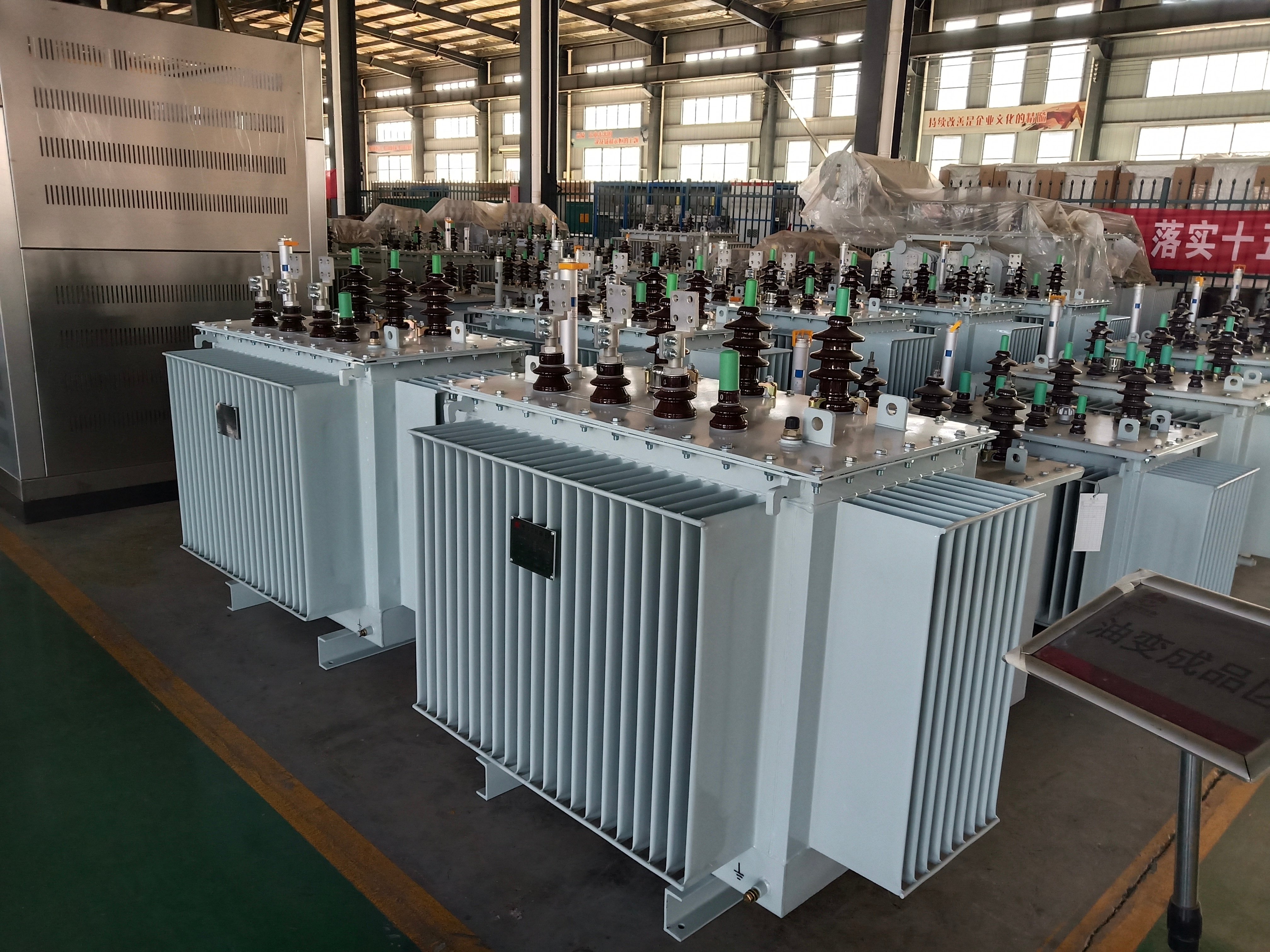
Many buyers start by comparing dry type versus oil-filled units. While this article focuses on dry type pricing, a quick background on oil-immersed transformers gives you a clearer perspective.
Common Applications of Oil-Immersed Transformers
Oil-immersed transformers are widely used in:
Application Area |
Typical Settings |
Outdoor substations |
Utility grids, power plants, wind farms |
Heavy industrial plants |
Steel mills, mining, cement factories |
High-voltage transmission |
Step-up/down stations above 35kV |
Remote or harsh environments |
Areas with extreme temperatures (with special oil) |
Cost-sensitive projects |
Large-scale rural electrification |
These units rely on mineral oil or synthetic ester liquids for both insulation and cooling. The oil circulates naturally or with pumps, carrying heat away from the core and coils
Advantages of Oil-Immersed Transformers
Advantage |
Why It Matters |
Lower initial cost |
For the same kVA, oil-filled units are typically 30–50% cheaper than dry type—mainly because they use cheaper materials and simpler coil insulation. |
Better overload capacity |
Oil has high thermal mass, so these transformers can handle short-term overloads without immediate damage. |
Compact footprint |
For very high ratings (e.g., 10MVA+), oil units take less floor space than dry type equivalents. |
Proven long-term reliability |
Decades of field data exist; maintenance routines are well understood. |
Disadvantages of Oil-Immersed Transformers
Disadvantage |
Why It Is a Concern |
Fire and environmental risk |
Mineral oil is flammable. Leaks can contaminate soil and water. Indoor installation is often restricted by fire codes. |
Higher maintenance |
Oil needs periodic testing (moisture, dissolved gases, dielectric strength). Leaks must be repaired promptly. |
Bulk and weight |
Heavy oil-filled tanks require stronger foundations and specialized lifting gear. |
Shorter life in some conditions |
High moisture or oxygen ingress degrades oil quality faster than dry insulation ages. |
So, Why Choose Dry Type Instead?
Despite the higher upfront cost, dry type transformers are preferred when:
- Fire safety is critical (indoor malls, hospitals, high-rise buildings, data centers)
- Environmental regulations ban oil near water sources
- Maintenance access is limited (dry type needs minimal upkeep)
- Indoor space has ventilation but no oil containment pit
In short: you pay more for a dry transformer because you are buying safety, cleanliness, and low maintenance—not just electrical performance.
Now, let us examine exactly where that extra cost goes.
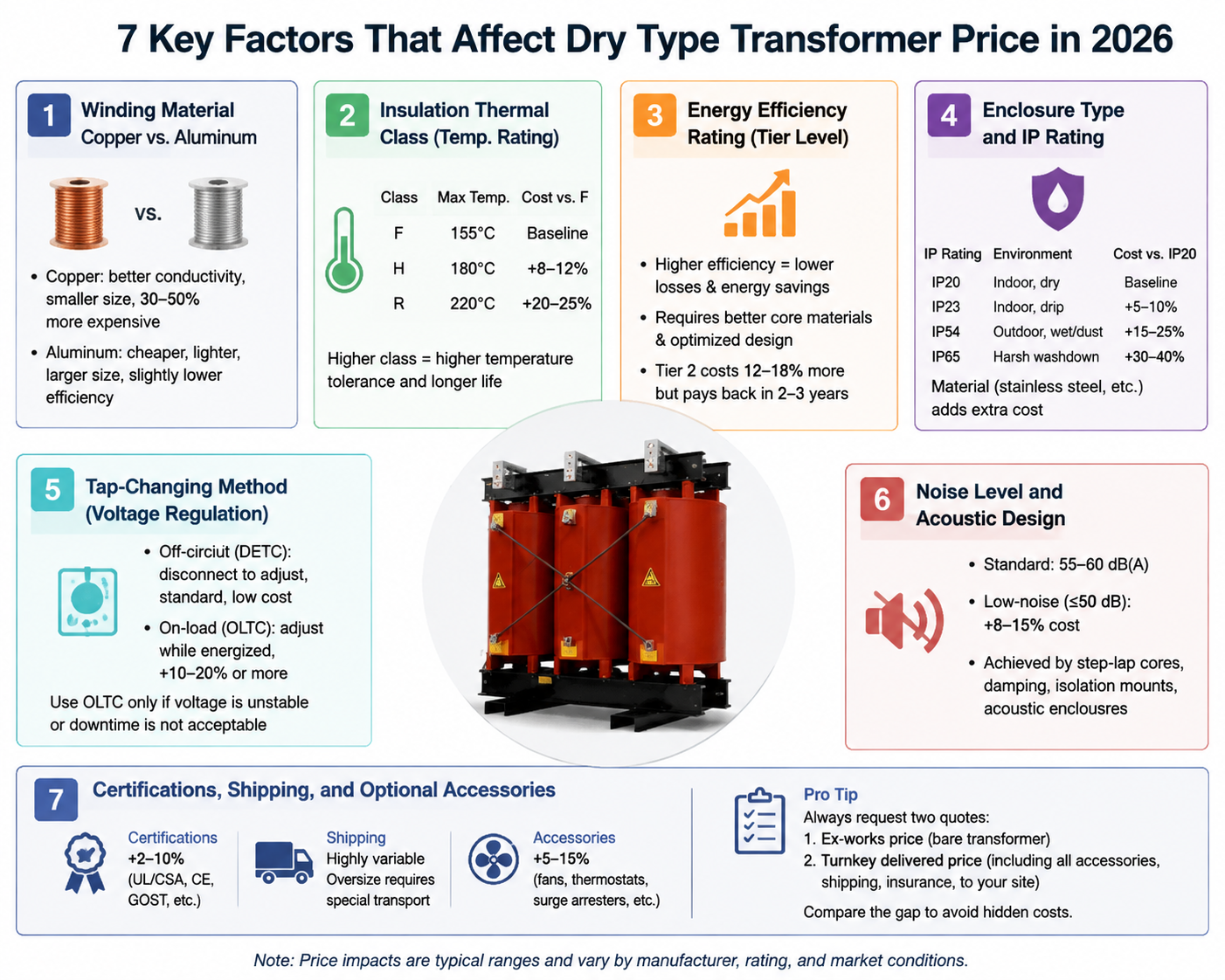
7 Key Factors That Affect Dry Type Transformer Price in 2026
Factor 1: Winding Material – Copper vs. Aluminum
The single biggest material cost driver is the winding metal.
- Copper windings offer lower electrical resistance, better conductivity, and smaller physical size. However, copper prices in 2026 remain historically high (around $9,000–$10,000/tonne). A copper-wound transformer typically costs 30–50% more than an aluminum-wound one of the same rating.
- Aluminum windings are cheaper and lighter, but they require a larger cross-section area to carry the same current. This makes the transformer bulkier and slightly less efficient (higher I²R losses).
Buyer tip: If your load cycle is continuous and efficiency matters most, choose copper. If your budget is tight and space is not a constraint, aluminum may be acceptable—but ask for a loss guarantee from the supplier.
Factor 2: Insulation Thermal Class (Temperature Rating)
Dry transformers use solid insulation systems rated by temperature limits:
Class |
Max Operating Temp |
Common Material |
Cost Premium |
F (155°C) |
155°C |
Polyester / epoxy |
Baseline |
H (180°C) |
180°C |
NOMEX® / aramid paper |
+8–12% |
R (220°C) |
220°C |
Silicone / advanced composites |
+20–25% |
Higher temperature classes allow the transformer to run hotter without degrading insulation life. This is valuable in hot climates (e.g., Middle East, Southeast Asia) or when forced-air cooling is unreliable. However, for most indoor applications in temperate regions, Class F is sufficient—paying for Class H may be unnecessary.
Factor 3: Energy Efficiency Rating (Tier Level)
Regulations worldwide are tightening. In 2026, key standards include:
- USA: DOE 2024 efficiency levels (still enforced, with pending updates)
- EU: Ecodesign Regulation (EU) 2023/826 (Tier 2 requirements for medium transformers)
- China: GB 20052-2024 (new energy-efficiency grades)
Higher efficiency means lower no-load losses (core losses) and load losses (copper losses). To achieve this, manufacturers use:
- Higher-grade silicon steel (e.g., M4 or M3 grain-oriented)
- Amorphous metal cores (extremely low losses, but cost 1.5–2× more)
- Optimized core geometry (step-lap joints, reduced air gaps)
Typical price difference: A Tier 2 (high-efficiency) dry transformer costs 12–18% more than a Tier 1 (standard) unit. But the energy savings often pay back that premium in 2–3 years of 24/7 operation.
Factor 4: Enclosure Type and IP Rating (Protection Level)
Where will your transformer sit?
IP Rating |
Environment |
Enclosure Features |
Cost Increase vs. IP20 |
IP20 |
Indoor, clean, dry |
Basic perforated metal cover |
Baseline |
IP23 |
Indoor with dripping water |
Drip-proof hoods |
+5–10% |
IP54 |
Outdoor or dusty/wet |
Fully sealed, gasketed, weatherproof |
+15–25% |
IP65 |
Harsh washdown areas |
High-pressure water-resistant |
+30–40% |
Also consider enclosure material:
- Galvanized steel – standard, cheapest
- Stainless steel (304/316) – for coastal or chemical environments – adds 8–15%
- Aluminum – lightweight but less strong – similar cost to galvanized
Remember: The enclosure is often quoted as an accessory, so check whether the base price includes it or not.
Factor 5: Tap-Changing Method (Voltage Regulation)
Transformers need to compensate for input voltage fluctuations. There are two common methods:
- Off-circuit (DETC) (De-Energized Tap Changer): You must disconnect the transformer to adjust taps. This is standard and adds minimal cost.
- On-load (OLTC) (On-Load Tap Changer): You can adjust voltage while the transformer is energized. This requires a mechanical switching mechanism plus a control panel. An OLTC typically adds 10–20% to the total transformer price—and more if it includes remote monitoring or automatic regulation.
For most commercial buildings, off-circuit taps are perfectly adequate. Only invest in OLTC if your grid voltage is highly unstable or if your process cannot tolerate even momentary interruptions.
Factor 6: Noise Level and Acoustic Design
Urban installations often have strict noise limits—sometimes as low as 45 dB(A) at 1 meter for residential areas.
A standard dry transformer without special treatment runs at around 55–60 dB(A). To reduce noise, manufacturers must:
- Use step-lap core joints (quieter than butt-lap)
- Apply vibration-damping coatings to the core
- Install elastic isolation mounts under the tank
- Add acoustic enclosures (sound-absorbing panels)
Each of these measures adds cost. A low-noise design (≤50 dB) can increase the price by 8–15% compared to a standard model. Always confirm the guaranteed noise level in the technical datasheet—and ask whether the measurement is under no-load or full-load conditions.
Factor 7: Certifications, Shipping, and Optional Accessories
This is where many buyers get surprised by final invoices.
Cost Element |
Impact on Price |
Notes |
UL/CSA (North America) |
+5–10% per unit |
Requires special design verification and factory audits |
CE (Europe) |
+2–5% |
Mostly documentation and compliance testing |
GOST/CU-TR (Russia/Eurasia) |
+3–7% |
Often requires local certification bodies |
Oversize shipping |
Highly variable |
Units above 3m wide require special trucks; above 4.5m may need escort vehicles |
Accessories (fans, thermostats, surge arresters) |
+5–15% total |
These are often "optional" but essential for operation—ask for a full package quote |
Pro tip: Always request two quotes from each supplier:
1. Ex-works price (bare transformer, no shipping, no accessories)
2. Turnkey delivered price (including all attachments, packing, insurance, and delivery to your site)
Compare these two numbers—the gap tells you how much "hidden" cost you are bearing.
Frequently Asked Questions (FAQ)
Q1: What is the average dry type transformer price per kVA in 2026?
There is no single average because prices depend on voltage class, copper/aluminum choice, and efficiency tier. However, a ballpark for a standard 1,000 kVA, 11/0.4 kV, copper-wound, Class F, IP20 unit is roughly $8,000–$14,000 USD. For an exact figure, always request a customized quotation based on your site conditions.
Q2: How does dry type transformer price compare to oil immersed transformer price for the same rating?
Generally, a dry type transformer costs 30–50% more than an oil-immersed one of the same kVA. The difference is even larger at higher voltages. This price gap reflects the more expensive insulation materials, robust enclosure, and fire-safe design. However, when you factor in fire protection systems (sprinklers, containment pits) required for oil units, the total installed cost gap narrows significantly.
Q3: Which factors affecting dry type transformer cost are most often overlooked by buyers?
Two factors are frequently missed: (1) shipping logistics—oversized units can double freight costs; (2) accessory bundles—temperature controllers and fans are often excluded from the base price. Always ask for a complete bill of materials (BOM) to compare like-for-like.
Q4: Can I reduce dry type transformer price by choosing aluminum windings?
Yes—aluminum windings can save you 20–30% upfront. But consider the trade-offs: larger footprint, slightly higher losses (meaning higher electricity bills over 20+ years), and lower overload capacity. Run a total cost of ownership (TCO) calculation over 10 years before deciding. In many cases, the extra cost of copper pays for itself within 5–7 years.
Q5: Why do dry type transformer price quotes from different manufacturers vary so much?
Apart from the 7 factors above, variations come from:
- Production volume: Large manufacturers have better raw-material procurement costs.
- Quality of core steel: Cheaper suppliers may use lower-grade silicon steel with higher losses.
- Testing and quality control: Reputable brands run full routine and type tests (IEC 60076, IEEE C57.12.01)—each test adds cost but ensures reliability.
Always compare technical specifications, not just the final number. If a quote seems too good to be true, request the test reports and material certificates.
Q6: Will dry transformer prices go up or down in the second half of 2026?
Market analysts expect copper prices to remain volatile, while silicon steel supply is stabilizing. Labor costs in manufacturing hubs (China, India, Vietnam) are steadily rising. Overall, most industry forecasts predict a moderate increase (3–6%) in dry transformer prices through late 2026—primarily driven by raw materials and logistics, not demand. If your project has a fixed schedule, consider placing an order with a price-lock clause.
Conclusion
Pricing a dry type transformer in 2026 is not as simple as looking at a per-kVA rate. As we have seen, the final invoice is shaped by winding metal, insulation class, efficiency grade, enclosure, tap-changer, noise control, and a host of certification/shipping add-ons. A cheap quote might omit essential features; an expensive one might include capabilities you will never use.
Your smart buying strategy:
1. Define your real operating environment (indoor/outdoor, ambient temperature, dust/water exposure).
2. Choose the minimum efficiency tier required by local law—and decide if a higher tier gives a good ROI.
3. Ask every supplier for a detailed breakdown of materials, tests, and accessories.
4. Compare total delivered cost, not ex-works price.
Need a tailored quotation or technical consultation?
Our team provides free dry transformer sizing and cost estimation for projects of any scale—from 100 kVA to 20 MVA. We serve clients in over 40 countries with clear, no-jargon proposals.
Contact us today for a no-obligation quote—and ask about our 2026 price-lock service for bulk orders.
Last updated: August 2026 | All prices in USD, subject to market fluctuations.
Table of Contents
- Introduction
- Oil-Immersed Transformers: Applications, Pros & Cons (For Context)
-
7 Key Factors That Affect Dry Type Transformer Price in 2026
- Factor 1: Winding Material – Copper vs. Aluminum
- Factor 2: Insulation Thermal Class (Temperature Rating)
- Factor 3: Energy Efficiency Rating (Tier Level)
- Factor 4: Enclosure Type and IP Rating (Protection Level)
- Factor 5: Tap-Changing Method (Voltage Regulation)
- Factor 6: Noise Level and Acoustic Design
- Factor 7: Certifications, Shipping, and Optional Accessories
- Frequently Asked Questions (FAQ)
- Conclusion