 EN

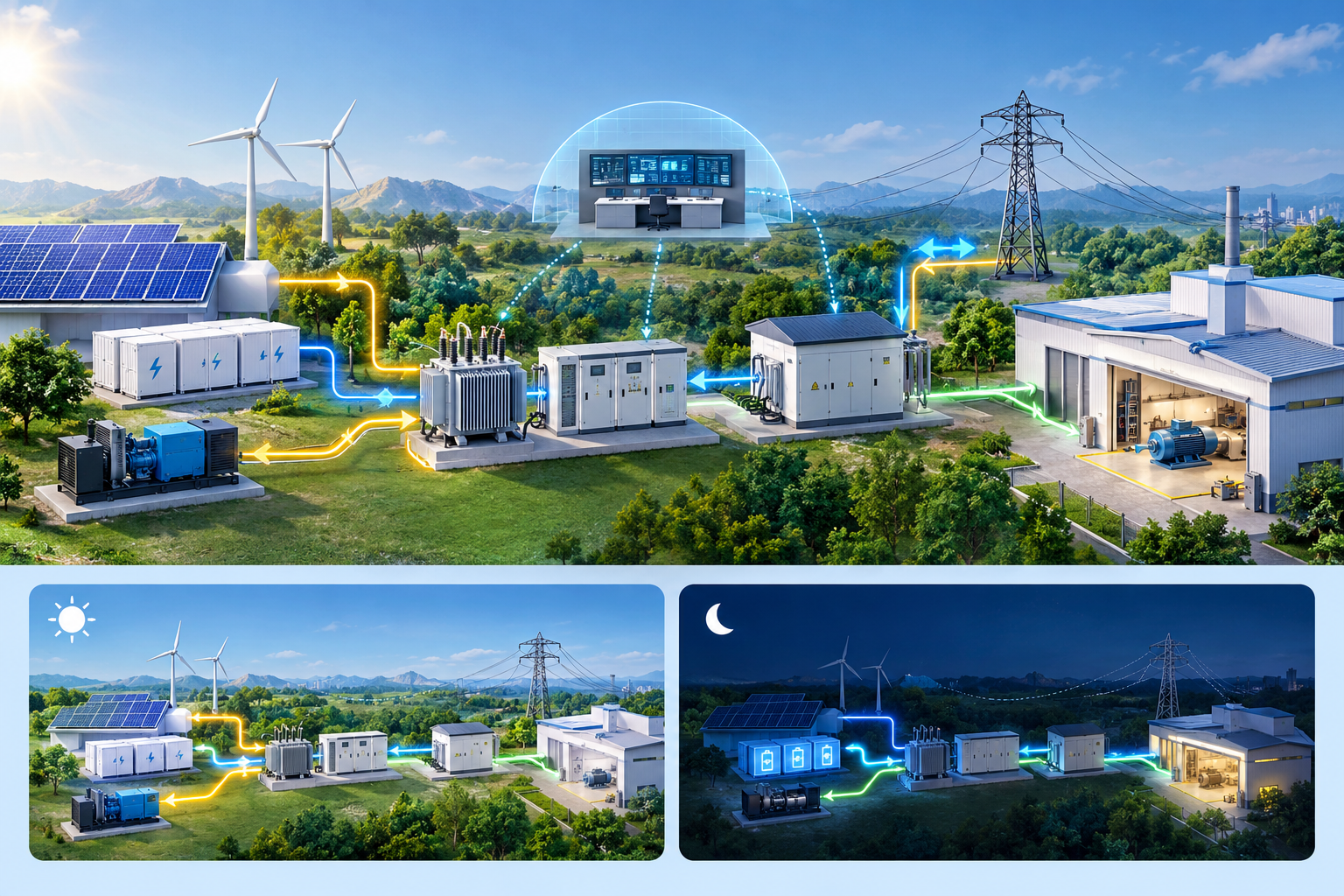
At noon, rooftop solar panels generate electricity. How does that power pass through inverters, transformers, and switchgear and finally reach a motor in a workshop safely? At night, when a battery storage system discharges, which equipment does the current pass through to complete the conversion “from DC to AC, from low voltage to high voltage, and back to low voltage”?
To understand a microgrid, we should not stop at a component list of “solar + battery + control system.” What really makes these components work together as one controllable system and delivers power reliably to end loads is the electrical backbone formed by distribution equipment.
This article starts with the basic idea of a microgrid, follows the path of power flow, explains the roles of distribution transformers, switchgear, and box-type substations, and gives practical ideas for equipment selection based on project needs.
The Difference Between a Microgrid and a Traditional Grid: Not “Whether It Has Sources,” but “Whether It Is Controllable”
Connecting a few solar panels and a battery pack together does not mean you have built a microgrid. A typical microgrid must have three elements at the same time: a clear electrical boundary, loads and local energy resources grouped inside that boundary, and a controller that can control the system as a whole.
It usually also has a point of common coupling (PCC) connected to the public grid, and a control system for energy management. The IEEE definition also stresses that a microgrid is “a local power system with a clear electrical boundary that operates as a single controllable entity with respect to the grid.”
The logic of a traditional large grid is “remote large power plants—transmission grid—distribution grid—users.” Power flows in one direction, and control is centralized at the dispatch center.
The logic of a microgrid is “local resources—local distribution—local loads.” Power can flow in both directions, and the operation mode can switch between grid-connected and islanded modes.
Therefore, the key difference between a microgrid and a traditional grid is not size or whether it contains renewable energy. It is whether it can operate autonomously inside its boundary and switch between modes. This ability must be carried out physically by distribution equipment.
Grid-Connected and Off-Grid Microgrids: Two Operating Modes, One Set of Distribution Requirements
Based on the relationship with the public grid, microgrids can be divided into grid-connected and off-grid types. A grid-connected microgrid is connected to the public grid under normal conditions.
It can buy power from the grid and, when rules allow, export extra power to the grid for peak shaving or power regulation. When the external grid fails, a microgrid with protection and control capability can disconnect from the PCC, enter islanded operation, and continue to supply critical loads.
An off-grid microgrid does not depend on the public grid. It relies entirely on local generation and storage resources to maintain supply. It is common in islands, mining areas, remote communities, and similar sites.
The two types have different focus areas for distribution equipment. The main challenge for a grid-connected microgrid is the certainty and safety of mode switching: disconnecting from the PCC requires switchgear to operate quickly and reliably; during islanding, grounding methods and protection settings may need to be adjusted; before reconnection, voltage, frequency, and phase synchronization conditions must be met.
An off-grid microgrid pays more attention to voltage support and overload margin under weak-grid conditions: without the inertia support of a large grid, the capacity selection, voltage regulation method, and protection coordination of transformers and switchgear need to be more conservative and robust.
In either case, distribution equipment is not an “accessory.” It is the boundary executor that determines whether the microgrid can operate safely as designed.
Main Components of a Microgrid: From Sources to Loads, the Middle Link Is Essential
A complete microgrid usually includes the following parts:
Distributed generation: Solar PV and wind power are common renewable sources. Diesel generators are often used as backup or peak-shaving sources, especially in off-grid or weak-grid scenarios where they provide bottom-line supply.
Energy storage: Battery storage balances power, adjusts peak and valley loads, and provides backup support. It is a key buffer that makes a microgrid “controllable.”
Control system: The energy management system decides how much power each source and storage unit should output based on generation forecasts, load conditions, and price signals. It also decides when to switch between grid-connected and islanded modes.
Loads: Microgrid loads are usually ranked by priority. Critical loads are supplied first during islanding, while normal loads can be reduced or paused for a short time.
However, the above components cannot “talk” to each other directly. PV inverters output low-voltage AC. Battery converters may work on the DC side. Diesel generators have their own voltage and frequency characteristics. End loads may need AC power at 0.4 kV or a higher voltage level.
Between sources and loads, there must be a distribution system that performs voltage conversion, power collection, circuit switching, and fault isolation. Without this layer, a microgrid is just a group of separate devices. It cannot form an electrical system that supplies loads reliably.
How Power Reaches End Loads Through Transformers and Distribution Equipment
Following the path of power flow, the role of distribution equipment becomes clear.
Take the most common AC-bus microgrid as an example. After PV arrays are converted to AC by inverters, they connect to the low-voltage or medium-voltage AC bus together with the AC side of the battery converters and the output of diesel generators.
The multiple sources collected by the bus are not directly “paralleled to the loads.” They first go through distribution transformers to match voltage levels. If the microgrid connects to the public grid at 10 kV or 35 kV, the transformer steps down the external grid voltage to the internal bus voltage, or steps up local generation to feed the PCC.
After the transformer, power enters switchgear (or ring main units) for distribution. Each feeder corresponds to a group of loads or the next distribution node. Circuit breakers and protection devices in the switchgear isolate faulted circuits during overcurrent, short circuit, or islanding switching, so that non-faulted areas continue to receive power.
For outdoor projects or sites with limited space, the transformer and switchgear are often integrated into a box-type substation, forming a compact distribution node placed near the loads.
Every link in this chain affects the controllability of the microgrid. The transformer determines whether voltage matching and bidirectional power flow can work smoothly. The switchgear determines whether a faulted feeder is isolated or affects other circuits. The box-type substation determines whether the whole distribution node can be deployed quickly in limited space and adapt to outdoor environments.
The control system gives “commands,” and distribution equipment performs “actions.” Without reliable transformers and switching equipment, even the most advanced energy management strategy cannot take effect in the physical world.
Roles of Distribution Transformers, Switchgear, and Box-Type Substations
Distribution Transformers
Distribution transformers perform voltage conversion in two directions in a microgrid. During grid-connected operation, they step down the medium voltage of the public grid to the microgrid bus voltage, or step up local generation to feed the grid. During islanded operation, they keep the bus voltage within an acceptable range for loads.
Unlike transformers in a normal distribution grid, transformers in a microgrid must handle bidirectional power flow: power may flow from the high-voltage side to the low-voltage side, or in reverse. This means protection settings, voltage regulation range, and even winding design need to consider bidirectional conditions. Otherwise, protection may operate incorrectly or voltage may exceed limits.
In integrated solar-storage-charging sites, transformers inside box substations may even experience alternating forward heavy load and reverse heavy load on the same day. This places higher demands on overload margin and heat dissipation.
Switchgear
Switchgear is the “joint” of a microgrid. It performs multiple functions: source connection, feeder distribution, PCC switching, and fault isolation.
During the transition from grid-connected to islanded mode, switchgear must reliably open after detecting grid abnormalities and maintain the integrity of internal circuits during islanding. When a fault occurs, circuit breakers should selectively remove the faulted circuit instead of expanding the outage area.
The multi-point connection of distributed sources in a microgrid makes the direction and magnitude of short-circuit current more complex. Protection settings for switchgear need to be rechecked for multi-source scenarios. Metal-clad withdrawable high-voltage switchgear has good adaptability in microgrid distribution nodes because of its flexible operation and high supply reliability.
Box-Type Substations
Box-type substations integrate transformers, high- and low-voltage switchgear, protection, and metering devices into a prefabricated outdoor enclosure.
For microgrids, the value of a box substation is not only “compactness,” but also deployment speed and environmental adaptability. Traditional substations require on-site foundation work and batch installation of equipment, and construction can take months.
Prefabricated box substations complete module assembly and joint testing in the factory. On site, only foundation fixing and cable connection are needed. Installation and commissioning time can be shortened to a few days, and overall construction cost is reduced accordingly.
In coastal, high-humidity, or dusty environments, the protection rating, anti-corrosion design, and temperature control system of the box substation directly determine the long-term reliability of the distribution node. For park microgrids built in phases, modular box substation solutions can also reserve interfaces for future expansion and avoid excessive one-time investment.
How to Select Distribution Equipment Based on Project Needs
There is no “universal answer” for microgrid distribution equipment selection. It should match the project from four dimensions.
First, work backward from the operating mode to equipment capability. For grid-connected microgrids, focus on the mode-switching speed of switchgear and protection coordination logic. Confirm whether the PCC switch can open reliably when an islanding command is given. For off-grid microgrids, pay more attention to transformer overload capacity and voltage regulation range to handle load shocks without large-grid support.
If the project requires “seamless switching between grid-connected and islanded modes,” switchgear and protection devices need fast detection and action capability.
Second, match transformer capacity to capacity and voltage level. Microgrid engineering design usually requires selecting transformer capacity based on the maximum continuous exchange power with the external grid, and low-loss equipment should be preferred.
In engineering practice, box substation capacity can be estimated at about 1.25 times the installed capacity, with a load rate controlled between 40% and 70%. This avoids no-load losses from oversized capacity or curtailment from undersized capacity. For park microgrids with high renewable penetration, low-loss solutions such as amorphous alloy cores should be considered first to improve self-consumption benefits.
Third, choose the box substation form based on the scenario. Ground-mounted PV or storage stations are suitable for standardized step-up prefabricated box substations. Industrial parks or commercial complexes can use compact, low-noise prefabricated substations. Coastal or chemical scenarios must treat anti-corrosion rating and protection rating as pre-screening conditions, not later fixes. Projects built in phases should prioritize modular box substations and reserve interfaces for future expansion.
Fourth, include smart interfaces in the selection criteria. Distribution equipment in a microgrid does not operate alone. Box substations and switchgear should have monitoring capabilities for temperature, power, and other data, and should support connection to the energy management system. This allows the control system to make dispatch decisions based on the actual state of distribution nodes.
If communication and data interfaces are ignored during selection, later “intelligence” will remain only at the control layer and will not reach the equipment layer.
Jiangsu Unita Distribution Products and Microgrid System Components
Returning to the full picture of microgrid system components: distributed generation and storage provide the “energy source,” the control system provides the “decision capability,” and distribution transformers, switchgear, and box-type substations together form the “execution backbone” that delivers energy safely to loads according to decisions.
Jiangsu Unita’s product layout in the power transmission and distribution equipment field matches this backbone closely: distribution transformers handle voltage conversion and bidirectional power flow adaptation in microgrids; high- and low-voltage switchgear handle source connection, feeder distribution, PCC switching, and fault isolation; box-type substations (including PV/wind step-up box substations and prefabricated cabin substations) integrate the above equipment into distribution nodes that can be deployed quickly outdoors and adapt to different environments.
For users planning microgrid projects, a practical starting point is not to list power source equipment first. Instead, follow the power path from the PCC to the end loads and confirm step by step: which level needs voltage conversion, which level needs protection and switching, which node is suitable for box substation integration, and whether these devices have interfaces to work with the control system.
Only when this distribution chain is clearly designed can the “controllability” of a microgrid have a physical foundation, and can the benefits of distributed energy and storage truly reach end loads.
Application Scenarios of Distribution Equipment in Microgrid Projects
The following table summarizes the distribution equipment requirements across five typical microgrid application scenarios:
Scenario |
Key Equipment |
Specific Requirements |
Recommended Solution |
Typical Capacity |
PV Power Station |
Box-type substation, step-up transformer |
Step-up conversion, grid connection, weather protection |
Prefabricated step-up box substation |
500–3150 kVA |
Wind Farm |
Switchgear, distribution transformer |
Variable load handling, bidirectional power flow |
Metal-clad withdrawable switchgear |
800–5000 kVA |
Energy Storage System |
Transformer, switchgear |
Frequent charge/discharge cycling, fast response |
Low-loss transformer + smart switchgear |
630–2500 kVA |
Telecom Base Station |
Compact box substation |
Uninterrupted supply, remote monitoring |
Modular prefabricated substation |
100–500 kVA |
Mining Site |
Heavy-duty switchgear, transformer |
High overload margin, dust/moisture protection |
High-IP box substation, rugged switchgear |
1000–8000 kVA |
Frequently Asked Questions (FAQ)
Q1: What are the main distribution equipment components in a microgrid system?
The main distribution equipment in a microgrid includes distribution transformers (for voltage conversion and bidirectional power flow adaptation), high- and low-voltage switchgear (for source connection, feeder distribution, PCC switching, and fault isolation), and box-type substations (which integrate the above into compact, rapidly deployable outdoor distribution nodes).
Q2: Why must distribution transformers in a microgrid handle bidirectional power flow?
Unlike a traditional distribution grid where power flows in one direction, a microgrid may import power from the public grid or export locally generated power back to it. This means the transformer must operate correctly with power flowing in either direction, which affects protection settings, voltage regulation range, and winding design.
Q3: What functions does switchgear perform in a microgrid?
Switchgear serves as the central junction of a microgrid, handling source connection (linking distributed generation and storage to the bus), feeder distribution (delivering power to specific load groups), PCC switching (connecting or disconnecting from the public grid during mode transitions), and fault isolation (selectively removing faulted circuits to minimize outage area).
Q4: What are the advantages of box-type substations for microgrid projects?
Box-type substations integrate transformers, switchgear, protection, and metering into a prefabricated enclosure. Their key advantages are rapid deployment (factory-tested modules require only foundation fixing and cable connection on site), environmental adaptability (with appropriate protection ratings for coastal, humid, or dusty conditions), and modular expandability for phased project development.
Q5: How should distribution equipment be selected for a microgrid project?
Selection should consider four dimensions: (1) operating mode requirements (grid-connected vs. off-grid), (2) transformer capacity matching (typically 1.25 times installed capacity, with load rate between 40–70%), (3) box substation form matching the deployment scenario (standard, compact, or modular), and (4) smart interface capability for connection to the energy management system.
Table of Contents
- The Difference Between a Microgrid and a Traditional Grid: Not “Whether It Has Sources,” but “Whether It Is Controllable”
- Grid-Connected and Off-Grid Microgrids: Two Operating Modes, One Set of Distribution Requirements
- Main Components of a Microgrid: From Sources to Loads, the Middle Link Is Essential
- How Power Reaches End Loads Through Transformers and Distribution Equipment
- Roles of Distribution Transformers, Switchgear, and Box-Type Substations
- How to Select Distribution Equipment Based on Project Needs
- Jiangsu Unita Distribution Products and Microgrid System Components
- Application Scenarios of Distribution Equipment in Microgrid Projects
- Frequently Asked Questions (FAQ)