 EN
EN
Introduction
When selecting a distribution transformer connection for modern commercial and industrial facilities, one of the most critical yet often overlooked decisions is the choice between Dyn11 vs. Yyn0 transformer connections. This choice directly affects transformer harmonic mitigation, system efficiency, and long-term reliability. As nonlinear loads such as variable frequency drives, uninterruptible power supplies, LED lighting systems, and electric vehicle chargers become increasingly prevalent, harmonic distortion in power systems has escalated into a primary concern for electrical engineers and facility managers. The connection group—whether Dyn11 transformer with its delta-connected primary or Yyn0 transformer with its wye-connected primary—determines how effectively the transformer can suppress harmonic currents, particularly the troublesome third-harmonic components. This article provides a comprehensive distribution transformer harmonic analysis, comparing these two most common vector groups used in low-voltage distribution networks, and offers clear selection guidance based on the latest Chinese and international standards.
1. Understanding Transformer Vector Groups: Dyn11 and Yyn0 Basics
Before diving into harmonic performance, it is essential to understand what these designations mean.
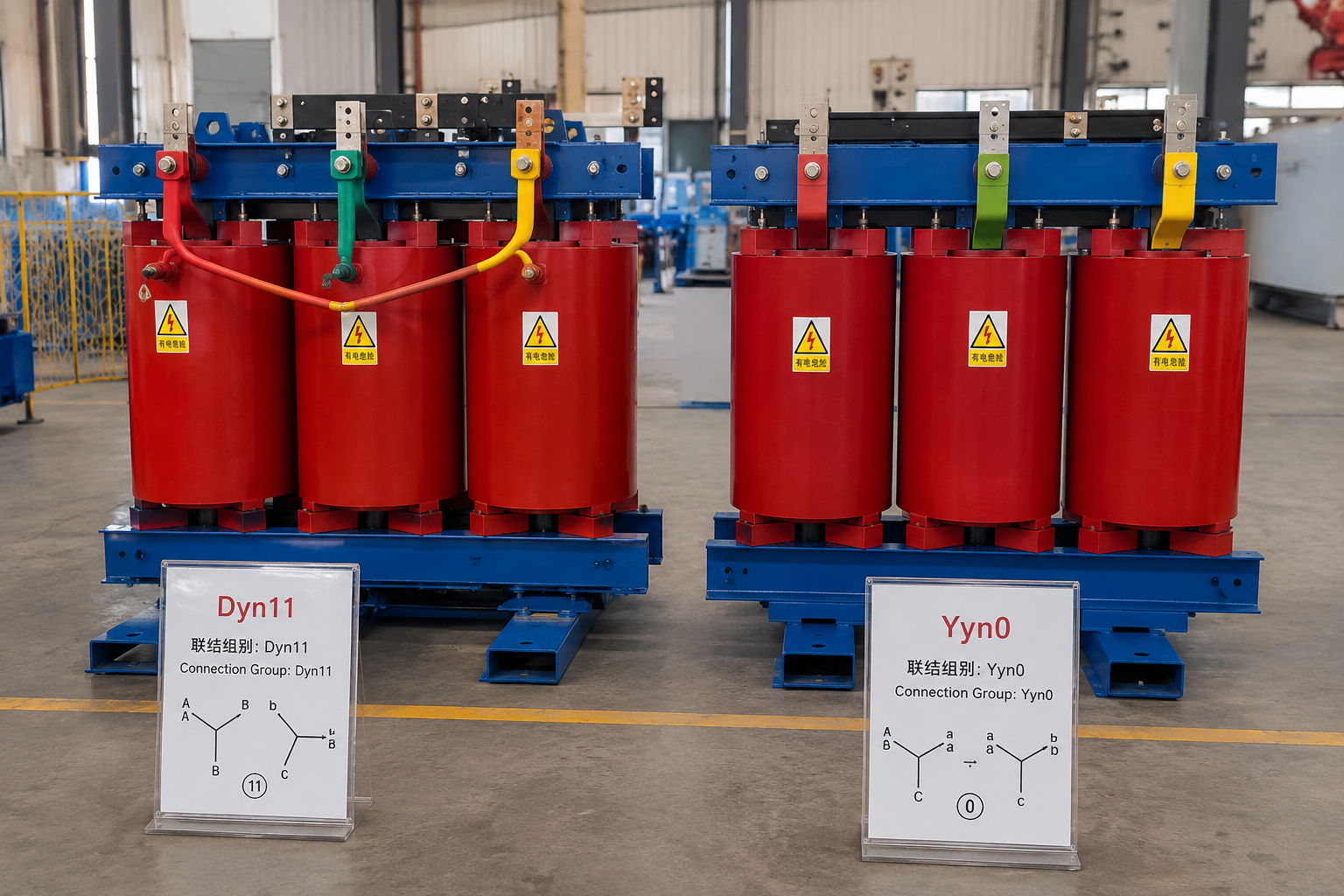
Vector group notation uses the clock-face method to describe the phase displacement between primary and secondary line voltages. The letter indicates winding configuration:
• Y (or y) – Star (wye) connection
• D (or d) – Delta (triangle) connection
• N (or n) – Neutral point brought out
Yyn0 configuration:
• Primary winding: Star-connected, no neutral brought out (Y)
• Secondary winding: Star-connected, with neutral brought out (y)
• Phase displacement: 0 o'clock (0°), meaning primary and secondary voltages are in phase
Dyn11 configuration:
• Primary winding: Delta-connected (D)
• Secondary winding: Star-connected, with neutral brought out (y)
• Phase displacement: 11 o'clock (330°), meaning secondary voltage lags primary by 30°
These two configurations dominate the Chinese distribution transformer market, and understanding their harmonic behavior is crucial for proper power transformer selection criteria.
2. Harmonic Suppression Mechanisms: The Core Difference
2.1 The Fundamental Flaw of Yyn0: Third Harmonics Have Nowhere to Go
In a Yyn0 transformer, the primary winding is star-connected without a neutral point. This creates a critical problem for third harmonic current mitigation:
• Third-harmonic currents (150 Hz in 50 Hz systems) are zero-sequence components—they flow in the same direction in all three phases
• For zero-sequence currents to flow, a neutral return path is required
• Since the primary star connection has no neutral point, third-harmonic currents cannot circulate
• Consequently, when the magnetizing current remains sinusoidal, the core flux becomes flattened, inducing a distorted secondary voltage rich in third-harmonic components
• Similarly, harmonic currents generated by downstream nonlinear loads cannot be effectively blocked from reflecting back into the primary power source
Technical implication: The Yyn0 transformer offers virtually no inherent harmonic distortion reduction for third-order harmonics, making it a poor choice for systems with significant nonlinear loads.
2.2 The Dyn11 Advantage: The Delta Loop That Traps Third Harmonics
The Dyn11 transformer's delta-connected primary provides a closed-loop path for third-harmonic currents—this is the essence of its harmonic suppression transformer capability.
Dual suppression mechanism:
1. Magnetic flux cancellation: Third-harmonic currents induced in the delta winding create ampere-turns that directly oppose the third-harmonic magnetomotive force from the secondary side. This cancels the harmonic flux in the core.
2. Circulating current trap: Third-harmonic voltages induced in each phase of the delta winding are in phase with each other. Since the delta connection forms a closed loop, these voltages drive a circulating third-harmonic current within the delta windings. This current dissipates the harmonic energy locally and prevents it from entering the external power grid.
Result: The core flux remains nearly sinusoidal, and the secondary phase voltage waveform quality is substantially superior to that of the Yyn0 transformer. This makes Dyn11 the preferred choice for transformer selection for nonlinear loads.
2.3 Higher-Order Harmonic Performance
While both connection types offer some degree of suppression for higher-order harmonics (e.g., 5th, 7th, 11th), the mechanisms differ:
Harmonic Order |
Yyn0 Performance |
Dyn11 Performance |
3rd (and 3n multiples) |
Poor – no circulation path |
Excellent – delta trap |
5th, 7th |
Moderate – some cancellation |
Moderate – similar |
11th, 13th |
Limited |
Limited |
For practical purposes, the 3rd harmonic is the dominant concern in most distribution systems, and this is precisely where Dyn11 excels.
3. Beyond Harmonics: Additional Advantages of Dyn11
The Dyn11 connection's superiority extends well beyond electrical harmonics mitigation. Here are five additional dimensions where Dyn11 outperforms Yyn0:
Comparison Factor |
Dyn11 |
Yyn0 |
Neutral current capacity |
Up to 75% of phase current or higher |
Limited to 25% of rated phase current |
Single-phase short-circuit protection sensitivity |
High – large short-circuit current enables sensitive protection |
Low – high zero-sequence impedance limits fault current |
Unbalanced load tolerance |
Excellent – can handle severe phase imbalance |
Poor – capacity derating required |
No-load losses |
Approximately 10% lower than Yyn0 |
Higher |
Load losses |
Approximately 20% lower than Yyn0 |
Higher |
Maximum capacity limitation |
No special restriction |
GB 1094 limits to 1600 kVA |
These factors make Dyn11 particularly attractive for commercial buildings, data centers, and industrial facilities where both harmonic filtering transformer performance and operational flexibility are critical.
4. Does Yyn0 Still Have a Place?
Given the overwhelming advantages of Dyn11, one might ask whether Yyn0 retains any practical application.
Historical context: Yyn0 was widely used in older distribution systems where nonlinear loads were minimal and harmonic concerns were secondary. In such environments, its simpler construction and familiar protection coordination were considered acceptable.
Current status: The latest Chinese standard, GB 51348-2019 Code for Electrical Design of Civil Buildings, explicitly recommends Dyn11 for systems with significant harmonic sources. The international distribution sector has largely migrated toward Dyn11 as the default choice for new installations.
Remaining use cases: Yyn0 may still be found in:
• Legacy systems where replacement is not economically justified
• Very small capacity applications (below 100 kVA) with purely linear loads
• Specific retrofitting scenarios where system compatibility constraints exist
However, for any new distribution transformer installation, especially those serving modern commercial or industrial facilities, the technical consensus strongly favors Dyn11.
5. Frequently Asked Questions (FAQ)
Q1: Why is the Dyn11 transformer better for harmonic mitigation than the Yyn0 transformer?
The Dyn11 transformer's delta-connected primary winding provides a closed-loop circulating path for third-harmonic currents. These currents flow within the delta windings and are cancelled magnetically, preventing harmonic distortion from propagating into the secondary voltage waveform or back into the primary supply grid. The Yyn0 transformer, with its star-connected primary and no neutral point, cannot offer this circulation path, making it inherently inferior for third-harmonic suppression.
Q2: What is the difference between Dyn11 and Yyn0 transformer connections in terms of zero-sequence impedance?
The zero-sequence impedance of a Yyn0 transformer is significantly higher because zero-sequence currents have no neutral return path on the primary side. This high impedance limits single-phase fault currents and reduces protection sensitivity. In contrast, the Dyn11 transformer's delta connection presents a much lower zero-sequence impedance path for circulating harmonic and fault currents, which improves both harmonic suppression and fault detection.
Q3: Can a Yyn0 transformer be used in commercial buildings with UPS and LED lighting loads?
While technically possible, it is strongly discouraged. UPS systems, LED drivers, and other switch-mode power supplies generate substantial third-harmonic currents. A Yyn0 transformer cannot effectively trap these currents, leading to distorted voltage waveforms, overheated neutral conductors, and premature transformer aging. GB 51348-2019 explicitly recommends against Yyn0 for such applications, and industry best practice is to specify a Dyn11 transformer.
Q4: Does the Dyn11 transformer have higher initial cost compared to the Yyn0 transformer?
The initial purchase cost of a Dyn11 transformer is marginally higher than an equivalent Yyn0 transformer due to the additional winding insulation and connection complexity. However, this small premium is easily justified by superior harmonic suppression, lower losses (approximately 10–20% savings in no-load and load losses), enhanced overload capability, and reduced total cost of ownership over the transformer's 20–30 year service life.
Q5: How do I select the right transformer vector group for my industrial facility?
When selecting the right transformer connection for harmonic mitigation, consider the following decision factors:
• Identify all nonlinear loads (VFDs, rectifiers, UPS, chargers) and estimate total harmonic distortion levels
• If third-harmonic distortion exceeds 5% of total load current, Dyn11 is mandatory
• Evaluate neutral loading—Yyn0 cannot support neutral currents exceeding 25% of phase current
• Check local code requirements (GB 51348-2019 recommends Dyn11 for commercial buildings)
• For sensitive equipment (medical imaging, data centers), Dyn11 provides superior voltage waveform quality
• For purely linear loads (resistance heating, conventional motors) under 100 kVA, Yyn0 may be considered only in legacy contexts
6. Conclusion and Selection Recommendations
Core Conclusion
The choice between Dyn11 and Yyn0 transformer connections is decisively clear for modern applications requiring effective harmonic mitigation. The Dyn11 transformer's delta-connected primary provides an inherent physical mechanism—the third-harmonic circulating current loop—that the Yyn0 transformer simply cannot replicate. For any distribution system serving nonlinear loads, which today includes virtually all commercial buildings, data centers, healthcare facilities, and industrial plants, Dyn11 transformer harmonic performance is demonstrably superior.
Practical Selection Guidelines
Application Scenario |
Recommended Connection |
Rationale |
Office buildings, shopping malls (UPS, LED, VFDs) |
Dyn11 |
Harmonic suppression + unbalanced load handling |
Data centers, hospitals, precision manufacturing |
Dyn11 |
Power quality critical + strict harmonic limits |
Residential complexes with linear loads < 100 kVA |
Yyn0 (rare) |
Only where legacy compatibility exists |
New industrial facilities with mixed loads |
Dyn11 |
Future-proofing + regulatory compliance |
Retrofit requiring direct replacement |
Case-by-case |
Match existing system only if justified |
Final Recommendation
For all new distribution transformer selection, specify Dyn11 as the default vector group. The modest incremental cost is overwhelmingly outweighed by superior harmonic suppression, lower lifetime losses, enhanced protection sensitivity, and compliance with modern standards. The Yyn0 connection should be reserved exclusively for legacy system preservation or highly specialized applications where all technical and commercial factors have been thoroughly evaluated.
Table of Contents
- Introduction
- 1. Understanding Transformer Vector Groups: Dyn11 and Yyn0 Basics
- 2. Harmonic Suppression Mechanisms: The Core Difference
- 3. Beyond Harmonics: Additional Advantages of Dyn11
- 4. Does Yyn0 Still Have a Place?
- 5. Frequently Asked Questions (FAQ)
- 6. Conclusion and Selection Recommendations
- Final Recommendation