EN

Air at High Altitude Is Not the Same Cooling Medium as at Low Altitude
In low-altitude areas, cooling is often understood as a question of "is it big enough": a larger heat sink, a more powerful fan, wider vents, and the temperature will come down. This intuition mostly works at low altitude, because air density is sufficient and moving air can effectively carry heat away from equipment surfaces.
At high altitude, things change. As altitude rises, air pressure drops, and air density falls with it. This means that the same volume of moving air carries fewer air molecules at high altitude and can carry away less heat. A device that cools normally at low altitude, when moved to high altitude, may still have its fan running at full speed, but the "effective amount of air" actually doing the cooling has already been reduced. Studies show that for every 1,000 meters of altitude gain, convective heat transfer through air drops by about 9%. For transformers, inverters, and energy storage cabinets that rely on air cooling, this is not a small safety margin issue. It is a systematic decline in cooling capacity.
Why "Strengthening" a Low-Altitude Solution Is Still Not Enough
When facing high-altitude cooling problems, a common reaction is to increase the cooling configuration: bigger fans, more heat sinks, more vents. But simply "strengthening" often does not achieve the expected result, because the root cause is not that the cooling configuration is "not big enough," but that the air itself has changed.
Pressure Loss Faced by Fans
When a fan operates in a low-pressure environment, the static pressure it can produce drops. If duct resistance stays the same, the fan's ability to push air through cooling channels weakens. In other words, it is not that the fan is not spinning fast enough, but that it "cannot push" enough mass of air to the places that need cooling. Simply increasing speed cannot fully make up for the loss of mass flow caused by lower density.
Hot Spots Are More Dangerous Than Overall Temperature Rise
The effect of lower air density is not uniform. At the end of air ducts, deep inside heat sinks, or in areas blocked by structures, airflow is already weaker, and the high-altitude environment makes cooling at these locations even worse. As a result, the average temperature of the equipment may look acceptable, but local hot spots may already be outside the safe range. This uneven temperature distribution is harder to solve by "making the heat sink bigger" than overall temperature rise.
Custom Cooling Must Redesign How Air "Behaves"
A cooling solution that truly adapts to high altitude must treat low air pressure as a design premise from the beginning, not as a "strengthening item" added later. In a high-altitude project at 4,500 meters, Jiangsu Unita redesigned the flow path and driving method of cooling air, rather than simply replacing fans with larger ones.
"Low-Pressure Compensated" Air Duct Circulation
Unita's engineering team redesigned fan selection and duct paths, with the goal of compensating for airflow loss in low-pressure environments. This means duct direction, cross-section changes, and fan operating points all need to be re-matched to the air characteristics at high altitude, so that air of limited density can still pass through heat-generating components with enough mass flow, instead of "bypassing" key cooling areas along the path of least resistance.
Coordinated Design of Temperature Control and Anti-Condensation
Another easily overlooked problem in high-altitude environments is the large temperature difference between day and night. During the day, equipment needs cooling; at night, temperature drops sharply, and condensation may form inside the enclosure, threatening electrical insulation. In its high-altitude custom solutions, Unita also configures intelligent temperature control and dehumidification modules, so that cooling management and anti-condensation control run under the same logic, rather than each independently "adding equipment."
Testing in Real Projects
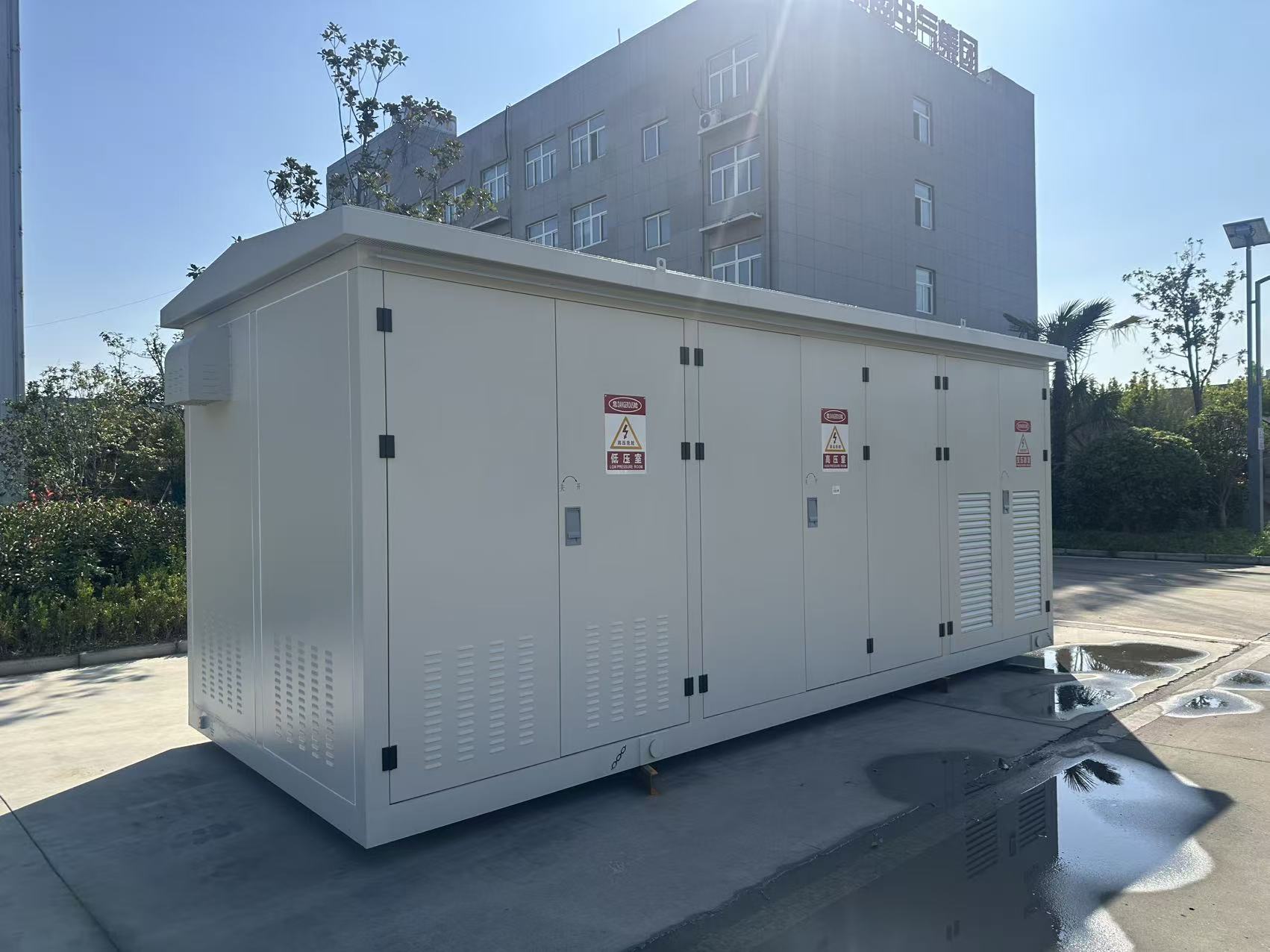
In a 24.5 MW solar project for Qinghai Trina Solar at an altitude of 2,800 meters, Unita customized 10 photovoltaic step-up box-type substations for the project. To address lower cooling efficiency and insulation requirements in high-altitude, low-pressure environments, electrical clearance and structural protection were adjusted at the same time. After grid connection, the equipment maintained stable operation under high-altitude conditions. At a photovoltaic power station on the Qinghai-Tibet Plateau at an altitude of 4,500 meters, custom box-type transformers achieved precise temperature-rise control after trial operation. On-site engineers continued to collect data over a full climate cycle for ongoing correction of later solutions.
These cases do not show that "Unita's heat sinks are bigger." They show a more basic fact: high-altitude cooling needs to be handled as an independent engineering problem. Air density has changed, the behavior of cooling air has changed, and the solution must be recalculated at the level of air ducts, fan operating points, and temperature control strategy. Taking a low-altitude solution, "strengthening" it, and sending it to high altitude solves the surface problem of insufficient configuration, but does not address the root cause of declining cooling efficiency under low pressure. For off-grid projects, this is especially critical, because off-grid systems often have no spare capacity to absorb derating or shutdown caused by overheating. The starting point of cooling design must be the real air at high altitude, not experience from low-altitude areas.
Application Scenarios for High-Altitude Cooling Solutions
Application Scenario |
Typical Altitude |
Equipment Type |
Key Considerations |
Solar Power Station |
2,500 - 4,500 m |
Box-type Transformer |
Duct redesign, insulation adjustment |
Wind Farm |
3,000 - 5,000 m |
Converter Cabinet |
Fan operating point matching |
Energy Storage System |
2,000 - 4,000 m |
Battery Container |
Anti-condensation coordination |
Telecom Base Station |
3,500 - 5,500 m |
Equipment Shelter |
Integrated thermal management |
Mining Operation |
4,000 - 5,000 m |
Power Distribution |
Dust and low-pressure combined |
Frequently Asked Questions
Q: At what altitude does standard cooling become insufficient?
While there is no single cutoff, convective heat transfer decreases by approximately 9% per 1,000 meters of altitude gain. For most air-cooled equipment, the cumulative effect becomes significant above 2,000 meters, making custom redesign necessary rather than optional.
Q: Why can't I simply install a bigger fan to solve high-altitude cooling?
A bigger fan moves more volume, but the fundamental issue is reduced air density. Each unit volume of air carries less heat. Additionally, fan static pressure drops in low-pressure environments, limiting the ability to push air through ducts and heat sinks regardless of fan size.
Q: How does Unita approach custom cooling for high-altitude projects?
Unita redesigns the entire cooling system from the ground up, treating low air pressure as a primary design parameter. This includes re-engineering duct paths, re-matching fan operating points to high-altitude conditions, and integrating temperature control with anti-condensation management in a unified system.
Q: What role does day-night temperature variation play at high altitude?
High-altitude locations experience extreme diurnal temperature swings. During the day, intense solar radiation demands strong cooling. At night, rapid temperature drops can cause condensation inside enclosures, threatening electrical insulation. This dual challenge requires coordinated thermal and humidity management.
Q: Is high-altitude cooling more critical for off-grid projects?
Yes. Off-grid systems typically have no backup power source. If overheating causes equipment derating or shutdown, the entire system loses power with no grid fallback. This makes robust, purpose-designed cooling essential for off-grid reliability.