 EN
EN

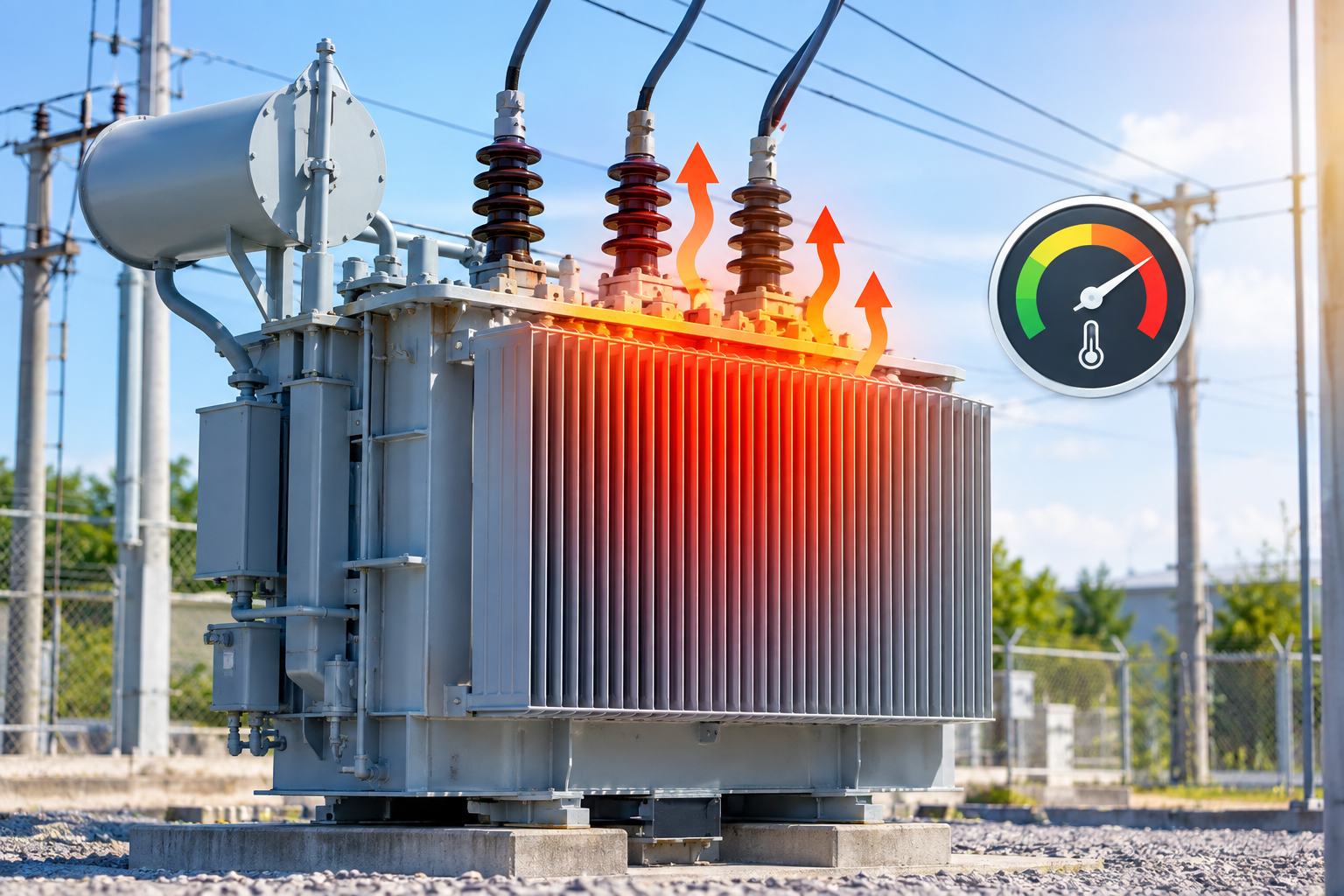
Overloading a distribution transformer is not a question of "if it will fail," but "how fast it will fail." When the load exceeds the nameplate rating, the temperature inside the transformer rises quickly, and insulation aging speeds up dramatically. Continuous overloading can cut the design life of a transformer from about 30 years down to 11–15 years. In severe cases, it can burn out within hours. This article explains the physical process, the warning signs you can observe, the specific risks, and the full timeline from heavy load to failure.
1. What Is Distribution Transformer Overloading
Overloading means the load on the transformer is higher than its nameplate rating. Based on the load rate (actual load divided by rated capacity), engineering practice usually divides operation into four ranges: light load (below 20%), heavy load (80%–100%), general overload (100%–120%), and severe overload (above 120%).
Common causes of overloading include: steady growth in residential electricity use, seasonal load peaks (such as air conditioning in summer or heating in winter), single-phase overload caused by unbalanced three-phase loads, and an increase in harmonic loads. It is important to note that short-time overload and continuous overload carry very different risks. Short-time overload is still manageable if the hot spot temperature does not cross the critical limit. Continuous overload, however, starts an irreversible aging process.
2. What Happens Inside the Transformer During Overload
The core physical mechanism of overloading is loss of control over heat. When a transformer runs, copper loss (winding resistance loss) and iron loss (hysteresis and eddy current loss) both generate heat. As load current increases, copper loss grows with the square of the current, and the rate of heat generation quickly exceeds the cooling capacity.
The direct result of heat buildup is a rise in winding hot spot temperature. Transformer insulation is based on paper and transformer oil. Its mechanical strength and dielectric strength are very sensitive to temperature. IEEE C57.91 clearly states that loading above the nameplate rating causes insulation damage, gas generation in the oil, and eventual loss of life.
The chemical effect of higher temperature is also critical. High temperature causes transformer oil to break down and form sludge. This sludge deposits on windings and the core, blocks heat dissipation, and creates a vicious cycle: "overheating — sludge — even more heat." Paper insulation undergoes thermal degradation at continuously high temperatures. Its degree of polymerization drops, and mechanical strength is gradually lost.
On the electrical side, overloading increases the voltage drop across the transformer's internal impedance. The secondary voltage becomes noticeably low, and end users may experience voltage sag and poor power quality. At the same time, the sharp rise in copper loss causes operating efficiency to fall. The energy cost of running overloaded is far higher than the cost of increasing capacity.
3. Observable Signs of Overloading
Transformers rarely fail without warning. The following signs usually appear over hours or days:
Abnormal temperature is the most direct signal. For oil-immersed distribution transformers, an upper oil temperature consistently above 85°C requires attention. Approaching or exceeding 95°C means the transformer is at a dangerous edge. Infrared temperature measurement can reveal local hot spots on the tank, indicating possible temperature concentration inside the windings.
Changes in sound also deserve attention. If the normal, even humming sound becomes dull, louder, or irregular, it suggests the core or windings are under abnormal mechanical stress.
Oil and appearance signs include: oil color becoming darker, cloudy, or containing suspended particles; abnormal drop in oil level (overloading speeds up seal aging and causes leaks); and faster color change in the breather silica gel. If the tank wall bulges or leaks oil, internal pressure has already risen significantly.
Electrical signs include: secondary voltage clearly low and fluctuating with load; high-voltage fuses blowing frequently or low-voltage circuit breakers tripping often; and three-phase current deviation exceeding 10%. The last sign usually comes from unbalanced three-phase loads. The result is that one phase winding carries overload while the other two phases are still underused.
4. Specific Risks and Consequences of Overloading
The risks of overloading can be divided into three levels by time scale.
Short-term risks (minutes to hours) center on immediate insulation breakdown. When the winding hot spot temperature exceeds the critical value, bubbles may form in the paper insulation. The dielectric strength of a bubble is far lower than that of oil-impregnated paper. In areas of concentrated electric field, this can easily cause partial discharge or even full breakdown. Bushings may leak oil or release gas due to internal pressure buildup.
Medium-term risks (days to months) involve the accumulation of progressive damage. Turn-to-turn insulation ages faster under repeated thermal cycling and gradually develops into turn-to-turn short circuits. Tap changers wear down from frequent operation and thermal stress, and voltage regulation becomes less reliable. Windings may deform mechanically under the combined effect of electromagnetic force and thermal stress, further reducing insulation margin.
Long-term consequences (years) appear directly as irreversible loss of life. A modeling study of 100 kVA distribution transformers showed that under continuous load above 80%, the remaining life of three transformers was 13.22 years, 11.36 years, and 15.13 years respectively — far below the 30-year design life. Another study based on actual operating data from 2023–2024 showed that among 100 commonly used distribution transformers, the proportion of non-repairable failures caused by overloading was as high as 90%. In addition, the higher failure rate of overloaded transformers directly threatens power supply reliability. A single failure can affect an entire feeder and thousands of users.
5. Failure Timeline: From Heavy Load to Burnout
The most effective way to understand the progressive nature of overloading is to build a failure timeline by load range.
Stage 1: Load 80%–100% (heavy load range)
Aging rate begins to deviate from the baseline. Daily equivalent aging time rises from about 1 hour under normal conditions to several hours. A 100 kVA transformer under continuous heavy load can lose 14%–25% of its relative life, with a daily aging rate between 3.45 and 5.83 hours. The transformer can still run at this stage, but its life is being consumed at an accelerated rate.
Stage 2: Load 100%–120% (general overload range)
Hot spot temperature clearly exceeds limits. Every overload period accumulates irreversible damage. If such peaks occur daily, life loss accumulates faster and faster, and the annual loss rate can reach several times the normal value.
Stage 3: Load above 120% (severe overload range)
Hot spot temperature may exceed the 140°C critical point, and the risk of bubble formation rises sharply. At this stage, the transformer enters a "pre-failure" state, and the probability of tripping or burning out increases rapidly. On New Year's Eve 2012, 23 distribution transformers in the rural network of Xining burned out during the evening peak from 20:00 to 24:00. The direct cause was that Spring Festival electricity load rose 2–3 times above normal, combined with worse three-phase imbalance. This caused the neutral line to overheat and break, leading to sudden changes in winding voltage and current.
Stage 4: Protection operation or catastrophic failure
Ideally, the low-voltage circuit breaker or high-voltage fuse operates during severe overload, cutting off power to prevent greater loss. But when protection devices are incorrectly set, damaged, or deliberately bypassed, failure can appear as burnt windings, oil breakdown and gas generation, and in serious cases, fire. Once an internal arc occurs in an oil-immersed distribution transformer, combustible gas from oil decomposition can accumulate inside the tank, creating an explosion risk.
6. How to Prevent and Reduce Overloading
At the monitoring level, establish regular records of transformer load current and oil temperature. Infrared temperature measurement can serve as a low-cost screening method to identify local hot spots. For critical distribution areas, online monitoring systems can provide real-time load rate data and support early warning.
At the operation level, balancing three-phase loads is the most cost-effective short-term measure. In many overload cases, the root cause is not insufficient total capacity, but concentrated single-phase load. This overloads one phase winding while the other two phases still have margin.
At the planning level, capacity upgrades based on load forecasting are the fundamental solution. The economic load rate of a transformer is usually between 60% and 80%. Reserving 20%–30% capacity margin can handle peak loads and future growth. For areas with strong seasonal overload, adding transformers or adjusting supply zones can be considered.
At the protection level, it is critical to ensure that high-voltage fuses and low-voltage circuit breakers match the transformer capacity. After a protection device operates, it is strictly forbidden to "solve" the tripping problem by installing a larger fuse or bypassing the protection. This cancels the transformer's last line of defense.
7. Common Questions
Will short-time overload burn out a transformer immediately?
Not necessarily, but every short-time overload consumes life. When short-time overload happens often, its cumulative effect is the same as continuous overload.
If the temperature drops after overload, is everything fine?
Thermal aging is cumulative and irreversible. Cooling down only avoids immediate breakdown. It does not restore insulation life that has already been lost.
Is 80% load rate a hard limit?
This is an engineering recommendation. Above it, the aging rate increases significantly. The exact threshold depends on ambient temperature, cooling method, and load profile. However, continuous operation above 80% should be treated as an early warning signal in asset management.
Conclusion
The nature of distribution transformer overloading is a process of cumulative damage driven by thermal aging. Each time the temperature crosses a critical point, insulation life is consumed at a faster rate. For operators and facility managers, recognizing early signs, understanding the failure timeline, and building active load monitoring and adjustment mechanisms are the key steps to extending transformer life, avoiding unexpected outages, and reducing total lifecycle cost.
Table of Contents
- 1. What Is Distribution Transformer Overloading
- 2. What Happens Inside the Transformer During Overload
- 3. Observable Signs of Overloading
- 4. Specific Risks and Consequences of Overloading
- 5. Failure Timeline: From Heavy Load to Burnout
- 6. How to Prevent and Reduce Overloading
- 7. Common Questions
- Conclusion