 EN
EN

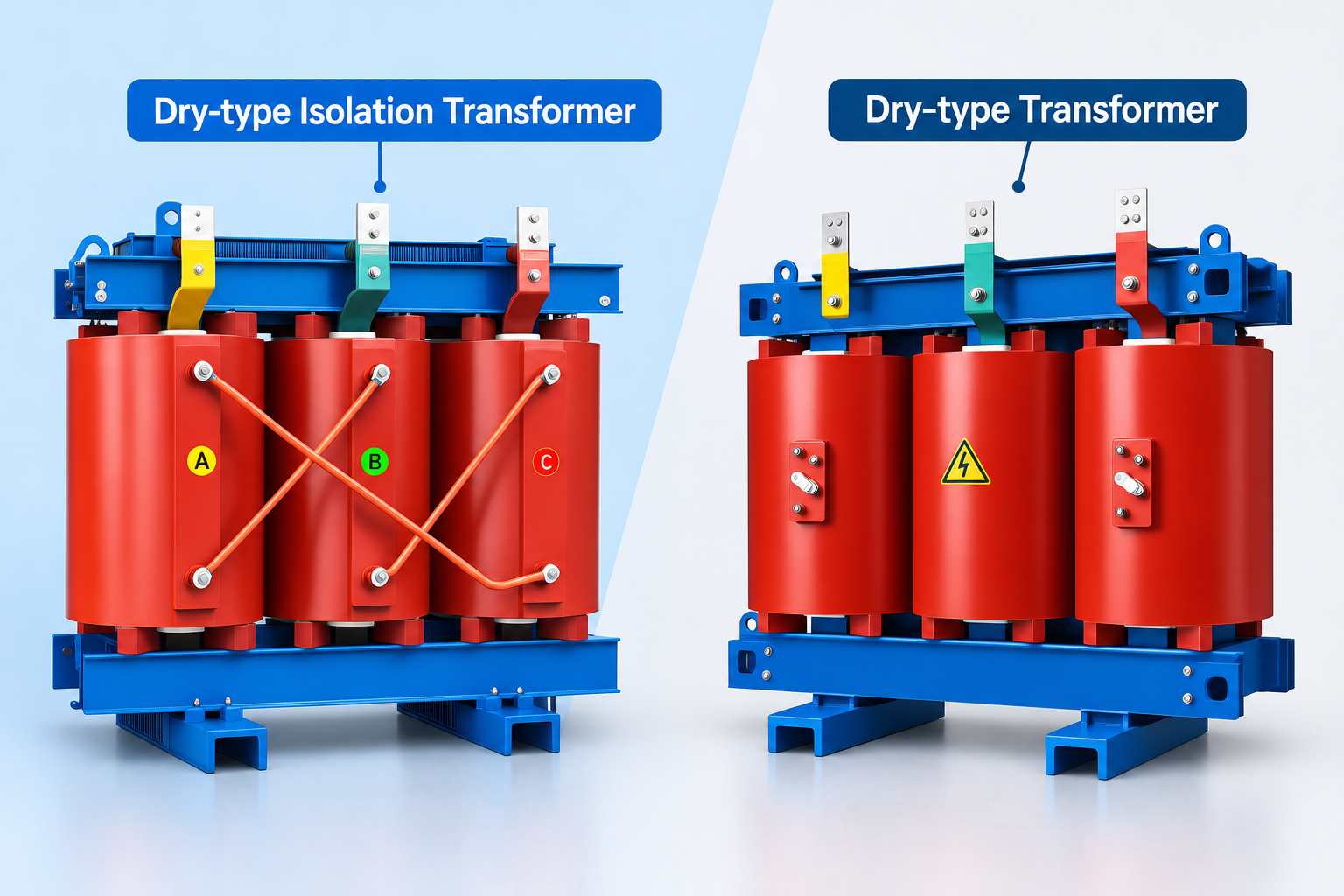
Many people run into this question when buying or selecting a distribution transformer: What exactly is the relationship between an isolation transformer and a dry-type transformer? Is an isolation transformer the same as a dry-type transformer?
If you have wondered about this too, you are not alone. This question is common because the words "isolation" and "dry-type" are often used together, but they actually describe transformers from two completely different angles.
Here is the key answer first: An isolation transformer is not necessarily a dry-type transformer, and a dry-type transformer is not necessarily an isolation transformer. They overlap, but neither one is a sub-category of the other.
Below, we explain this clearly from five angles: classification logic, definitions, differences, connections, and applications.
1. First, Understand the Classification Logic: Why Is This Question Confusing?
To understand the relationship between the two, you need to know one key point: there is more than one way to classify transformers.
How is a dry-type transformer classified?
A dry-type transformer is classified by its cooling medium and insulation medium. Under this standard, transformers fall into two main groups: dry-type transformers and oil-immersed transformers.
Simply put, a dry-type transformer's core and windings are not immersed in insulating oil. They are cooled by air circulation. An oil-immersed transformer, by contrast, has its body immersed in insulating oil, and the oil circulates to remove heat.
How is an isolation transformer classified?
An isolation transformer is classified by its function or purpose. It is named from the angle of "what is this transformer used for?"
Other transformers in the same category include: autotransformers, voltage stabilizer transformers, rectifier transformers, and control transformers. The core function of an isolation transformer is electrical isolation, not voltage conversion.
The relationship: overlapping, not parallel
Because the classification angles are different, isolation transformers and dry-type transformers overlap. One can contain the other:
An isolation transformer can be dry-type: A transformer with epoxy resin casting and a 1:1 isolation function is both an isolation transformer and a dry-type transformer.
An isolation transformer can also be oil-immersed: A transformer immersed in oil for electrical isolation in special applications is an isolation transformer, but not a dry-type transformer.
A dry-type transformer may not be an isolation transformer: A standard 10kV/0.4kV dry-type distribution transformer mainly changes voltage. It does not emphasize isolation.
Treating "isolation" and "dry-type" as the same thing is like treating "sedan" and "white car" as the same thing. They are two different angles of classification. They overlap, but they are not the same.
2. What Is an Isolation Transformer?
Definition
An isolation transformer is a transformer in which the input winding and output winding are electrically separated from each other. Its principle is the same as any transformer: it transfers energy through electromagnetic induction. But there is no direct electrical connection between the primary side and the secondary side—only magnetic coupling.
Working principle
The most important feature of an isolation transformer is that the secondary side is floating relative to ground. In a normal mains supply, one wire (the live wire) has a 220V potential difference with the earth. Touching it can cause electric shock. In an isolation transformer, the secondary side is not connected to earth. So there is no potential difference between either secondary wire and the earth. A person touching any single secondary wire will not form a complete circuit, which prevents electric shock.
In addition, isolation transformers use core losses and electrostatic shielding between windings to block high-frequency noise from passing from the primary side to the secondary side. This provides cleaner power for equipment.
Main functions
The main functions of an isolation transformer include:
Safety isolation: protects people from dangerous voltages
Anti-interference: suppresses high-frequency noise and common-mode interference from the grid
Surge and filtering protection: used as a safe power source
1:1 isolation ratio: many isolation transformers have a 1:1 ratio. They do not change voltage; they only isolate.
An isolation transformer can be dry-type or oil-immersed
As mentioned above, most common small-capacity isolation transformers (for maintenance or control) are indeed dry-type. But this does not mean all isolation transformers are dry-type. In special industrial applications, large-capacity isolation transformers may also use oil-immersed designs.
3. What Is a Dry-Type Transformer?
Definition
A dry-type transformer is a transformer in which the core and windings are not immersed in insulating oil. It relies on air or another gas for cooling and insulation.
Main types
Common dry-type transformers include:
Epoxy resin cast type (such as the SCB series): windings are vacuum-cast in epoxy resin. This is the most common type today.
Impregnated / encapsulated type (such as the SCBH series): uses H-class insulation materials such as NOMEX paper with an impregnation process.
Open type (such as the SG series): windings are directly exposed to air and cooled by air circulation.
Features and advantages
The main advantages of dry-type transformers are fire safety, explosion safety, and environmental friendliness. Because there is no flammable insulating oil, a dry-type transformer can be installed directly at the load center (for example, inside a high-rise building or basement). It does not need a separate transformer room or fire isolation measures. It also requires less maintenance, because there is no oil quality to check regularly.
A dry-type transformer is not necessarily an isolation transformer
A standard dry-type distribution transformer (such as SCB10-1000/10) mainly steps down 10kV to 400V to supply power to equipment. Its primary and secondary sides do have basic insulation separation. But this is different from the functional electrical isolation emphasized by an "isolation transformer" (1:1 ratio, floating secondary, and anti-interference shielding).
4. Core Differences Between Isolation Transformers and Dry-Type Transformers
Comparison point |
Isolation transformer |
Dry-type transformer |
Classification angle |
By function or purpose |
By cooling / insulation medium |
Core function |
Electrical isolation, anti-interference, safety protection |
Voltage conversion, power distribution |
Ratio feature |
Often 1:1 (other ratios possible) |
Usually not 1:1 (such as 10kV/0.4kV) |
Secondary-to-ground status |
Floating (not grounded) |
Usually has a clear grounding system |
Structural features |
Often has electrostatic shielding; windings separated or shielded |
Focuses on insulation and heat dissipation; not always shielded |
Typical applications |
Medical equipment, laboratories, precision instruments, maintenance power |
High-rise building distribution, subways, shopping malls, industrial distribution |
5. How Isolation Transformers and Dry-Type Transformers Are Connected
Isolation transformers often use dry-type construction
In real products, many isolation transformers do use dry-type construction, especially for small-capacity indoor use. This is because a dry-type structure with isolation function can be made into an integrated safe power supply device. It is flexible to install and easy to maintain. The SG series three-phase dry-type isolation transformer is a typical example.
Dry-type transformers can provide isolation
On the other hand, when electrical isolation is needed, you can also choose a dry-type transformer with isolation function. This means adding electrostatic shielding and isolated windings to a standard dry-type transformer.
They work together in a distribution system
In a complete distribution system, both may appear at the same time: a dry-type distribution transformer steps down high voltage to low voltage to supply the whole building. Then, in front of equipment with very high power quality requirements (such as operating rooms or precision testing instruments), a separate isolation transformer is added for secondary isolation and power cleaning.
6. Common Application Scenarios Compared
Typical applications of isolation transformers
Isolation transformers are mostly used where safety and power quality have special requirements:
Medical locations: operating rooms and ICU medical IT systems must use isolation transformers
Laboratories and precision instruments: oscilloscopes, electron tube equipment, precision measuring instruments
Industrial control systems: PLC control circuits, machine tool control power
Maintenance: used as a safe maintenance power supply
Typical applications of dry-type transformers
Dry-type transformers are widely used for power distribution and voltage conversion:
High-rise buildings: distribution rooms in residential and office buildings
Public places: subway stations, airports, shopping malls
Industrial sites: factory workshop distribution
New energy: step-up and distribution in solar and wind power
Overlapping scenarios
In places such as hospitals, data centers, and precision manufacturing workshops, both often appear together: a dry-type transformer handles main distribution, while isolation transformers provide secondary protection in front of critical equipment.
7. How to Choose: Isolation Transformer or Dry-Type Transformer?
First, clarify your need: "isolation" or "distribution"
This is the first and most important step.
If you need to step down high voltage to low voltage and supply the whole system, choose a dry-type distribution transformer.
If you need to separate a device from the original grid, prevent interference, and ensure safety, choose an isolation transformer.
Then, look at the installation environment
If you need fire safety, explosion safety, and indoor installation: dry-type is preferred.
If you have a separate transformer room and are sensitive to cost: oil-immersed is also an option (but isolation transformers are usually not oil-immersed first choice).
Selection checklist
1. Capacity: calculate based on load power and power factor
2. Ratio: isolation transformers are often 1:1; distribution transformers are chosen by system voltage
3. Insulation class: B, F, or H, depending on temperature rise requirements
4. Shielding needs: whether electrostatic shielding is needed to suppress interference
5. Vector group: such as Dyn11, which affects harmonic suppression and three-phase balance
Common misunderstandings
Mistake 1: "An isolation transformer is a dry-type transformer." Wrong. They are classified from different angles.
Mistake 2: "All dry-type transformers can isolate." Wrong. Standard dry-type distribution transformers are not designed for isolation.
Mistake 3: "A 1:1 transformer is an isolation transformer." Not exactly. A 1:1 ratio is only a ratio feature. The key to isolation is a floating secondary and shielding design.
8. FAQ: Common Questions
Is an isolation transformer a dry-type transformer?
Not necessarily. An isolation transformer is classified by function, while a dry-type transformer is classified by cooling medium. An isolation transformer can be dry-type or oil-immersed, but common isolation transformers are mostly dry-type.
Can a dry-type transformer be used for isolation?
Yes. By adding isolation windings and electrostatic shielding to a dry-type transformer design, it can provide isolation. This product can be called a "dry-type isolation transformer."
What is the difference between an isolation transformer and a normal transformer?
A normal transformer mainly changes voltage. Although there is insulation between the primary and secondary sides, isolation is not emphasized. The core of an isolation transformer is complete electrical separation between primary and secondary, a floating secondary, and often anti-interference shielding.
Must an isolation transformer be dry-type?
No. Choosing dry-type or oil-immersed depends on the installation environment, capacity, and fire safety requirements. For indoor use with high fire safety requirements, dry-type is preferred. For certain large-capacity or special industrial applications, oil-immersed isolation transformers may also be used.
Conclusion
Back to the original question: Is an isolation transformer a dry-type transformer?
The answer is clear: No. An isolation transformer and a dry-type transformer are two concepts from different angles. The first is defined by "function." The second is defined by "cooling method." They overlap: one transformer can be both an isolation transformer and a dry-type transformer. But neither name covers the full meaning of the other.
Once you understand this relationship, you will not be confused by the names when selecting a transformer. The real question to ask is: Do I need "isolation" or "distribution"? Once that is clear, the choice becomes simple.
Table of Contents
- 1. First, Understand the Classification Logic: Why Is This Question Confusing?
- How is a dry-type transformer classified?
- How is an isolation transformer classified?
- The relationship: overlapping, not parallel
- 2. What Is an Isolation Transformer?
- Definition
- Working principle
- Main functions
- An isolation transformer can be dry-type or oil-immersed
- 3. What Is a Dry-Type Transformer?
- Definition
- Main types
- Features and advantages
- A dry-type transformer is not necessarily an isolation transformer
- 4. Core Differences Between Isolation Transformers and Dry-Type Transformers
- 5. How Isolation Transformers and Dry-Type Transformers Are Connected
- Isolation transformers often use dry-type construction
- Dry-type transformers can provide isolation
- They work together in a distribution system
- 6. Common Application Scenarios Compared
- Typical applications of isolation transformers
- Typical applications of dry-type transformers
- Overlapping scenarios
- 7. How to Choose: Isolation Transformer or Dry-Type Transformer?
- First, clarify your need: "isolation" or "distribution"
- Then, look at the installation environment
- Selection checklist
- Common misunderstandings
- 8. FAQ: Common Questions
- Conclusion